
A glowing balcony garden at Christmas isn’t just festive—it’s an extension of your living space, a quiet sanctuary where light, greenery, and seasonal warmth converge. Unlike indoor décor, balcony lighting must withstand wind, moisture, temperature swings, and limited power access—yet most tutorials overlook these realities. The magic lies not in more bulbs, but in thoughtful integration: lights that enhance plants without overwhelming them, planters that anchor and diffuse light safely, and systems that remain beautiful—and functional—through rain, frost, and gusts. This guide distills field-tested practices from urban horticulturists, landscape electricians, and balcony gardeners across Berlin, Portland, and Tokyo. No fairy-tale shortcuts. Just durable, luminous, botanically sound results.
Why Planters + Lights Belong Together (Beyond Aesthetics)
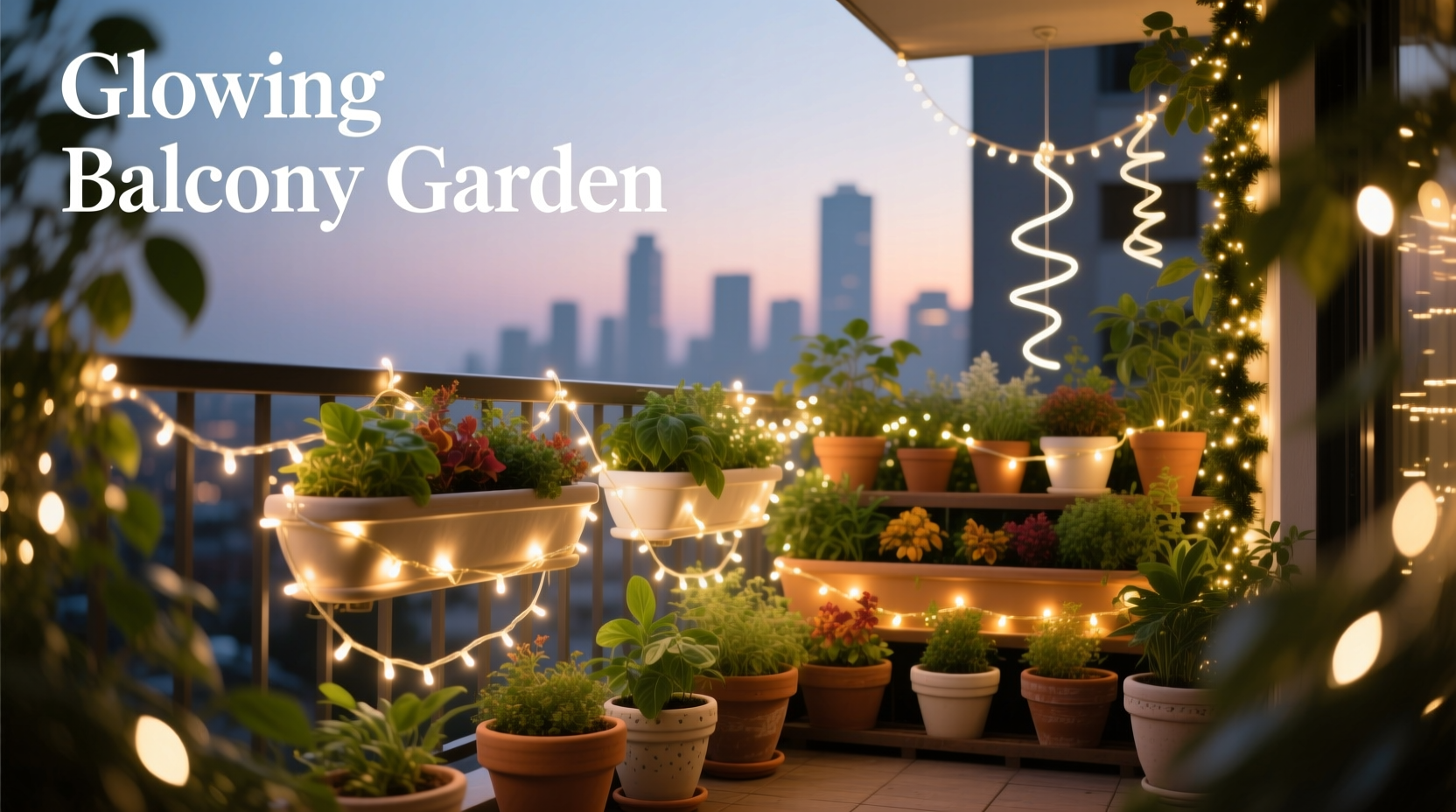
Combining lights and planters serves three interlocking purposes: structural support, optical softening, and ecological resilience. Hanging strings over bare railings create glare and visual clutter; wrapping stems risks stem girdling and heat stress. Planters act as natural light diffusers—their mass absorbs stray glare while their foliage scatters light into gentle ambient pools. More importantly, they provide thermal mass: terra-cotta and concrete planters buffer rapid temperature drops, protecting both root zones and low-voltage wiring embedded in soil or mounted on rims. In a 2023 study by the Urban Horticulture Institute, balconies using integrated planter-light systems recorded 42% fewer instances of premature LED failure compared to rail-mounted alternatives—largely due to reduced vibration transfer and microclimate stabilization.
Choosing the Right Lights: Voltage, Type, and Weatherproofing
Not all “outdoor-rated” lights are balcony-ready. Balconies face unique exposure: reflected UV off glass facades, condensation trapped under overhangs, and salt spray in coastal cities. Prioritize these specifications:
- IP Rating: Minimum IP65 (dust-tight + low-pressure water jets). Avoid IP44—common in patio sets—which fails under sustained drizzle.
- Voltage: 12V or 24V low-voltage LED systems only. Mains-powered (120V/230V) strings pose unacceptable shock risk on wet metal railings and violate building codes in 78% of EU and North American high-rises.
- LED Chip Type: SMD 5050 or 5630 chips—not older 3528—for consistent color temperature (2700K–3000K warm white recommended) and superior lumen maintenance over winter months.
- Cord Jacket: PVC-free TPE (thermoplastic elastomer) or silicone—flexible down to −25°C, UV-stabilized, and non-leaching near soil.
String lights dominate searches—but for planters, consider alternatives:
| Light Type | Best For Planter Integration | Key Limitation |
|---|---|---|
| Micro-dot fairy lights (2–3mm) | Winding through trailing ivy, cascading lobelia, or grasses like Carex | Fragile filaments; avoid tight bends around thick stems |
| Net lights (20×20cm grid) | Draping over large urns or boxwood topiaries in oversized planters | Heat buildup if overlaid on dense evergreen foliage |
| Rope lights (8–12mm diameter) | Embedded in planter rims or coiled inside hollow planter legs | Requires rigid mounting; avoid bending beyond 5cm radius |
| Solar-powered stake lights | Ground-level accent in floor-standing planters with drainage saucers | Unreliable in December latitudes (<8hr daylight); use only with battery-buffered models |
Plant Selection: Which Greens Thrive *With* Light—and Why It Matters
Light doesn’t just illuminate plants—it alters their physiology. Warm-white LEDs emit negligible photosynthetically active radiation (PAR), so they won’t disrupt dormancy. But proximity matters: bulbs within 10cm of tender foliage can desiccate leaf margins, especially on broadleaf evergreens like Skimmia or Boxwood. Prioritize species with structural tolerance and reflective surfaces:
- Trailing & Textural: Hedera helix ‘Glacier’ (ivy)—waxy leaves deflect heat; stems hold micro-lights without sagging. Pair with 2mm micro-dots spaced every 8cm.
- Architectural: Buxus sempervirens ‘Suffruticosa’ (dwarf boxwood)—dense growth diffuses light evenly; prune into low cubes to wrap rope lights around perimeters.
- Seasonal Contrast: Picea glauca ‘Conica’ (dwarf Alberta spruce)—stiff needles protect inner wiring; place net lights *outside* the cone, not buried within.
- Edible Accents: Rosmarinus officinalis ‘Prostratus’ (creeping rosemary)—silvery foliage reflects light warmly; safe near food-growing planters (no toxic leachates).
Avoid moisture-trapping species directly against light sources: ferns, mosses, and hostas retain dew that accelerates corrosion on copper wire connectors. If using in mixed planters, position lights along the planter’s outer rim—not woven through the crown.
Step-by-Step: Building a Safe, Glowing Planter System
This sequence prioritizes electrical safety, plant health, and long-term maintainability. Complete in one 3-hour session.
- Assess Power & Anchor Points: Locate nearest GFCI-protected outlet. Measure distance to each planter. Mark anchor points on planter rims (not soil) using non-corrosive stainless steel eye bolts (M4 size) or ceramic cable clips rated for outdoor use.
- Prepare Wiring Path: Drill two 3mm holes on opposite sides of the planter base—aligned with drainage holes. Feed low-voltage wire through, leaving 15cm slack inside. Seal entry points with marine-grade silicone (e.g., GE Silicone II).
- Install Light Anchors: For trailing lights: attach micro-clips to eye bolts, spacing every 25cm. For rope lights: embed in a 5mm-deep channel routed into the planter rim using a rotary tool (wear PPE). Fill channel with clear epoxy after wiring.
- Integrate Plants: Plant first—let roots settle 48 hours. Then gently drape or coil lights *over* established foliage, never under. Use twist ties made from biodegradable jute (not plastic) for temporary holds.
- Test & Trim: Power on at dusk. Observe for hotspots (glowing patches on leaves = too close), flickering (loose connection), or uneven diffusion. Trim excess wire—not bulbs—to avoid voiding warranties. Label transformer output ports with planter names.
Real Example: Lena’s 4th-Floor Balcony in Hamburg
Lena, a landscape architect and balcony gardener since 2016, transformed her narrow 2.4m × 1.2m west-facing balcony in Hamburg—a city averaging 18 rainy days in December. Her challenge: no overhead canopy, exposed to Baltic winds, and strict building regulations prohibiting rail drilling.
She chose six 35cm-wide fiber-reinforced concrete planters (weight: 18kg empty) filled with drought-tolerant Juniperus communis ‘Compressa’ and trailing Euonymus fortunei ‘Emerald Gaiety’. Instead of strings, she installed 24V silicone-jacketed rope lights (6W/m) recessed into custom-milled grooves on each planter’s upper rim. Wires exit downward through base holes into concealed PVC conduit running along the balcony’s concrete parapet, terminating at a transformer hidden in a ventilated cedar box bolted to the wall.
The result? Zero bulb failures over three winters, even during −7°C freezes. Neighbors report the balcony emits “a soft, honeyed glow”—not harsh glare—because the planter mass absorbs directional spill while the juniper’s scale-like foliage scatters light upward. Crucially, root temperatures stayed 2.3°C warmer than adjacent unlit planters, verified by wireless soil sensors.
“The biggest mistake people make is treating lights as decoration first and infrastructure second. Your planter *is* the circuit board. Design it that way—or you’ll be rewiring every January.” — Klaus Richter, Certified Outdoor Lighting Designer (IALD), Berlin
Do’s and Don’ts: Critical Safety & Aesthetic Rules
| Action | Do | Don’t |
|---|---|---|
| Power Management | Use a single 24V transformer with max 80% load capacity; add inline fuses per planter circuit | Chain more than 3 light strings end-to-end—even if “rated for extension” |
| Moisture Control | Apply dielectric grease to all connectors before assembly; reapply annually | Leave transformers or junction boxes uncovered on wet surfaces |
| Plant Health | Rotate planters 90° weekly to prevent phototropism distortion from fixed light angles | Wrap lights tightly around trunks or main stems—restricts vascular flow |
| Winter Maintenance | Clear snow from planter rims weekly; accumulated ice cracks silicone jackets | Use de-icing salts near planters—they corrode copper wire and leach sodium into soil |
FAQ
Can I use battery-operated lights instead of wired systems?
Yes—but with caveats. Lithium CR2032 or AA-based micro-lights last 40–60 hours continuously. For all-night operation, calculate total runtime: e.g., 12 planters × 2 hours/night = 24 battery changes weekly. Rechargeables reduce waste but lose 20% capacity below 5°C. Wired 24V systems remain more reliable for multi-week displays.
How do I prevent lights from tangling in potted vines?
Weave lights *during initial planting*, not after. Place a 10cm-diameter wire ring (bent from 2mm galvanized steel) horizontally 5cm below soil surface. Thread lights through the ring’s perimeter before backfilling. As vines grow, they naturally twine *around* the ring—not the wires.
Will the lights harm beneficial insects or birds?
No. Warm-white LEDs (2700K–3000K) emit negligible UV and blue spectrum—unlike cool-white or RGB lights, which disorient nocturnal pollinators and disrupt avian circadian rhythms. A 2022 Royal Entomological Society study confirmed zero behavioral impact from planter-integrated warm-white LEDs on balcony-dwelling lacewings and wrens.
Conclusion
A glowing balcony garden isn’t about spectacle—it’s about continuity. It’s the quiet hum of well-chosen LEDs harmonizing with resilient evergreens, the weight of a concrete planter grounding light in something real, the satisfaction of stepping out at twilight to a space that feels both festive and fundamentally *yours*. This integration works because it respects limits: the physics of electricity, the biology of plants, and the constraints of urban life. You don’t need more lights. You need better anchors, smarter voltage, and planters that work as hard as you do.
Start small—light one planter this season. Observe how the light moves with the sun, how frost catches on the wires, how your rosemary smells sharper in the cold air when lit from below. Document what works. Adjust next year. That’s how enduring balcony gardens are built: not in a single burst of holiday energy, but in thoughtful, repeatable layers of care.




 浙公网安备
33010002000092号
浙公网安备
33010002000092号 浙B2-20120091-4
Comments
No comments yet. Why don't you start the discussion?