
The human body is full of fascinating parts, each with its own function and name. One such part—often overlooked until it's mentioned—is the nostril. Despite being essential for breathing, smelling, and even facial expression, many people pause when asked how to spell \"nostrils\" or how to use the word properly in conversation or writing. This guide clears up confusion, ensures correct spelling, and shows how to use \"nostrils\" naturally and accurately in daily communication.
Understanding the Word: What Are Nostrils?
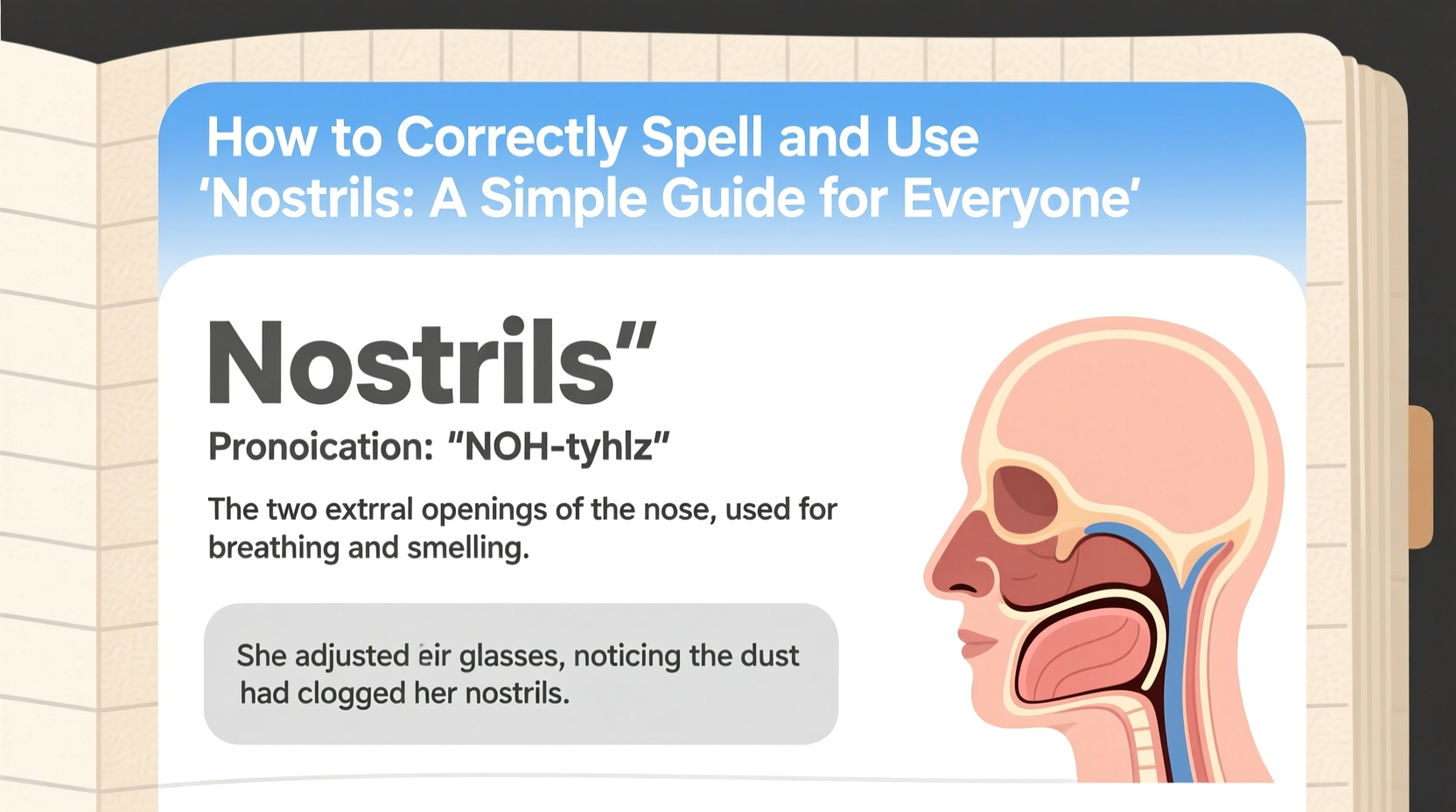
Nostrils are the two external openings of the nose that allow air to enter and exit the nasal cavity. They play a vital role in respiration, filtering dust and pathogens, warming incoming air, and contributing to our sense of smell. While the term might seem straightforward, misuse in speech or writing can lead to misunderstandings—or unintentional humor.
The word “nostril” comes from the Middle English *nostrel*, derived from *nos* (nose) and *thirl* (hole or perforation). So, literally, a nostril is a “nose-hole.” Though this may sound crude today, it reflects the anatomical truth. Most people have two nostrils, though some animals have more, and in rare medical cases, humans may experience asymmetry or blockages affecting one or both.
Correct Spelling: Common Mistakes and How to Avoid Them
Despite its common usage, “nostrils” is frequently misspelled. Here are the most typical errors and how to remember the correct form:
- Nosrtils – Transposing the “t” and “r” is a common typo due to fast typing.
- Nostrills – Doubling the “l” incorrectly; the base word ends with a single “l.”
- Nostrels – An outdated spelling still occasionally seen, but no longer standard.
- Nos-trills – Misapplying musical terminology or mishearing the word.
The correct spelling is nostrils. It is plural, referring to both openings. The singular is nostril.
To remember: Think of “nose” + “trill,” but without the second “l.” Or link it phonetically: /ˈnɑː.strəlz/ (NAH-struhls).
Do’s and Don’ts of Spelling “Nostrils”
| Do | Don’t | Reason |
|---|---|---|
| Use one “l” at the end | Double the “l” (nostrills) | “Tril” follows standard English spelling patterns |
| Keep “t” before “r” | Swap letters (nosrtils) | Maintains correct phonetic order |
| Add “s” for plural | Use apostrophes (nostril’s) | Apostrophes indicate possession, not plurality |
| Capitalize only at sentence start | Always capitalize (Nostrils) | Not a proper noun |
Using “Nostrils” Correctly in Sentences
Proper usage goes beyond spelling. Context matters. Whether you're writing a health article, describing a character in fiction, or commenting on someone’s reaction, using “nostrils” appropriately enhances clarity and tone.
In descriptive writing, flared nostrils often signal anger or exertion:
“She stood at the edge of the cliff, her nostrils flaring with each deep breath as she faced the storm.”
In medical or scientific contexts, precision is key:
“The patient reported chronic congestion in the left nostril, confirmed via nasal endoscopy.”
In casual speech, the word appears less frequently but still holds expressive power:
“I could smell the garlic bread the second I walked in—my nostrils knew before my brain did.”
Common Misuses to Watch For
- Confusing “nostril” with “nose”: “He blew his nostril” is incorrect. You blow your nose, not your nostril.
- Overuse in metaphor: While poetic, phrases like “the nostrils of society” are awkward and unclear.
- Incorrect pluralization: Saying “one nostrils” is grammatically wrong. Use “one nostril” or “both nostrils.”
Real-Life Example: A Teacher’s Classroom Moment
Ms. Rivera, a middle school science teacher, once held up a diagram of the human respiratory system. She pointed to the nasal cavity and asked, “What do we call these two openings?”
A student confidently answered, “Nostrells!” Another chimed in, “Isn’t it ‘nostrils’ with two L’s?” The class erupted in debate.
Instead of correcting them immediately, Ms. Rivera turned it into a spelling game. Students wrote the word on whiteboards, sounding it out. She explained the root words and showed slow-motion video of someone inhaling—watching the nostrils expand.
By the end of the lesson, every student spelled “nostrils” correctly and used it in a sentence about breathing. One even joked, “I’ll never sniff wrong again.”
This small moment highlights how a simple word, when taught clearly, sticks far better than rote memorization.
Expert Insight: Language and Anatomy Combined
“Precise terminology matters in both medicine and everyday communication. Misnaming body parts can lead to confusion—even in emergency situations. 'Nostrils' may seem minor, but getting it right supports clearer understanding across fields.” — Dr. Alan Pierce, MD, Respiratory Specialist and Medical Educator
Dr. Pierce emphasizes that while slang terms like “nose holes” are common in casual talk, they lack clinical accuracy. In professional settings—from nursing notes to patient education—correct spelling and usage prevent errors.
Step-by-Step Guide to Mastering “Nostrils”
- Learn the spelling: Memorize “nostril” (singular), “nostrils” (plural).
- Break it down: Say it slowly—nos-tril-s.
- Use it in a sentence: “After running, his nostrils were wide open.”
- Check context: Is it medical, emotional, or casual? Adjust tone accordingly.
- Review common errors: Avoid doubling the “l” or misplacing the “t.”
- Teach someone else: Explaining reinforces your own understanding.
Quick Checklist for Confident Usage
- ✅ Spell it N-O-S-T-R-I-L-S (plural)
- ✅ Use “nostril” for singular references
- ✅ Apply in anatomical, emotional, or sensory descriptions
- ✅ Avoid possessive forms unless needed (“the dog’s nostrils twitched”)
- ✅ Proofread in writing to catch typos
Frequently Asked Questions
Is “nostril” ever pluralized as “nostrili”?
No. “Nostrili” is not standard English. While Latin-inspired plurals exist in medical jargon (like “alveoli”), “nostrils” remains the accepted plural form in all contexts.
Can you have more than two nostrils?
Anatomically, humans have two external nostrils. Some medical conditions, like cleft lip or surgical reconstruction, may alter appearance or function, but the standard count remains two. Certain animals, like elephants or whales, have different nasal structures, but those aren’t referred to as “nostrils” in the same way.
Why do people flare their nostrils when angry?
Flaring nostrils during strong emotions like anger or fear is an involuntary response linked to increased breathing needs. It allows more air intake, preparing the body for action. It’s also a visible social signal—others subconsciously register it as intensity.
Final Thoughts: Small Word, Big Impact
Mastering the correct spelling and usage of “nostrils” might seem trivial, but language shapes understanding. Whether you’re writing a story, filling out a health form, or helping a child with homework, getting it right builds confidence and clarity. Words are tools—and even the smallest ones deserve attention.




 浙公网安备
33010002000092号
浙公网安备
33010002000092号 浙B2-20120091-4
Comments
No comments yet. Why don't you start the discussion?