
Tabletop trees occupy a unique space in holiday design: small enough to fit on mantels, sideboards, and desks, yet powerful enough to anchor an entire room’s aesthetic. Yet most fail to achieve true visual impact—not from lack of ornaments or quality branches, but from flat, single-plane lighting. A tree lit only with one string of lights reads as a silhouette, not a three-dimensional object. Depth isn’t added by more bulbs; it’s sculpted through intentional layering—strategic placement of light sources at varying distances, intensities, and color temperatures to mimic how natural light interacts with form. This technique transforms a decorative accent into a luminous centerpiece that draws the eye, invites closer inspection, and holds its presence even in well-lit rooms.
The Three-Layer Lighting Framework
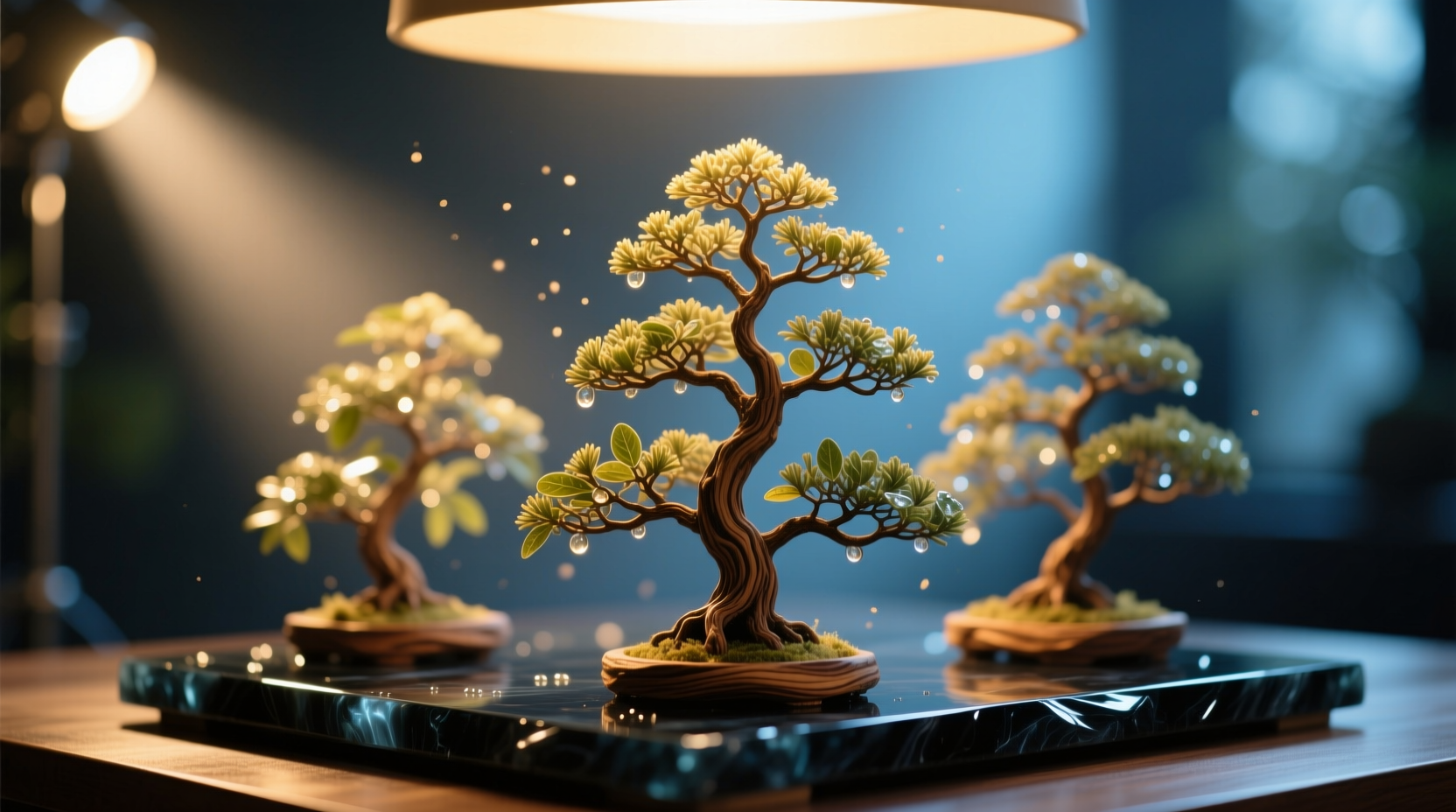
Professional lighting designers working with miniature botanical forms—from terrariums to scaled-down Christmas displays—rely on a consistent tripartite structure: background, mid-ground, and foreground layers. Each serves a distinct spatial function and must be calibrated in relation to the others. Unlike full-size trees where ambient room light provides context, tabletop trees exist in tighter, often brighter environments—making controlled layering essential to prevent visual washout.
The background layer establishes spatial context and separation from the surface beneath. It doesn’t illuminate the tree itself but creates a subtle halo or gradient behind it, reinforcing the illusion that the tree occupies its own volume of space. The mid-ground layer—the primary illumination—is responsible for revealing texture, branch density, and ornament placement. It must wrap around the form without casting harsh shadows across the front plane. The foreground layer adds tactile immediacy: pinpoint highlights on key ornaments, gilded tips, or textured bark that signal proximity and invite touch. When these three layers operate in concert, the brain perceives depth automatically—even before conscious analysis begins.
Equipment Selection: Beyond Standard Light Strings
Not all lights support layered control. Generic pre-wired strings with fixed brightness and no dimming or zoning capability limit your ability to differentiate layers. Prioritize tools that offer independent control per layer—either physically (separate cords and switches) or digitally (smart bulbs with app-based grouping).
| Layer | Recommended Light Type | Why It Works | Avoid |
|---|---|---|---|
| Background | Low-intensity LED strip (2700K–3000K), mounted 2–4 inches behind tree base on wall or riser | Creates soft, directional glow without spill; warm tone enhances wood/metal surfaces behind tree | Bulky plug-in lamps or unshielded spotlights that cast sharp edges |
| Mid-ground | Flexible micro-LED string (200+ bulbs, 3500K neutral white), battery- or USB-powered with built-in dimmer | Even distribution, low heat, fine gauge wire disappears into branches; neutral white renders ornaments accurately | Large-bulb C7/C9 strings or non-dimmable incandescent mini-lights that overpower delicate forms |
| Foreground | Individual micro-LED puck lights (3000K or 4000K), adhesive-backed, 3–5 mm diameter | Precise placement on specific ornaments; directional beam avoids washing out adjacent areas; no visible wiring | Clip-on ornament lights with thick wires or battery boxes that disrupt clean lines |
Color temperature matters critically. Using identical 2700K bulbs across all layers flattens perception—warmth loses its spatial cue when uniform. Instead, use 2700K for background (evoking distant candlelight), 3500K for mid-ground (mimicking daylight clarity), and 4000K for foreground (simulating close-range spotlight). This subtle progression reinforces depth just as atmospheric perspective does in painting: warmer, softer tones recede; cooler, crisper tones advance.
Step-by-Step Layered Lighting Setup
- Prepare the foundation: Position your tabletop tree on a stable, non-reflective surface—matte black or charcoal felt works best. Elevate it slightly using a ceramic riser or vintage book stack to create physical separation from the background plane.
- Install the background layer: Affix a 12-inch LED strip vertically along the wall directly behind the tree’s centerline, centered at the tree’s midpoint height. Use double-sided tape designed for electronics. Power it separately and set brightness to 20%—just enough to lift the tree off the wall without creating glare.
- Weave the mid-ground layer: Starting at the trunk base, gently spiral the micro-LED string upward, moving outward with each revolution. Maintain 1.5–2 inches between loops. Avoid wrapping tightly around individual branches—instead, drape loosely over junctions where branches diverge. This ensures even coverage without “hot spots.” Test brightness at 60% before finalizing.
- Anchor the foreground layer: Select 3–5 focal points: the topmost ornament, a central cluster of metallic baubles, and 1–2 lower ornaments with reflective surfaces (glass, mercury glass, or polished metal). Attach puck lights directly to the back of each ornament using removable adhesive dots. Angle them slightly downward to catch surface texture—not straight on, which flattens reflection.
- Final calibration: Turn off all overhead lighting. Observe the tree in near-darkness. Adjust mid-ground brightness until the branch structure is fully legible but not stark. Then reduce background brightness by 5% increments until the tree feels suspended—not floating, not pinned. Finally, increase foreground pucks until highlights pop but don’t burn out adjacent areas. Let your eyes rest for 30 seconds between adjustments.
Real-World Application: The Studio Apartment Mantel
When interior stylist Lena Chen redesigned her 450-square-foot Brooklyn studio, she faced a common constraint: a narrow marble mantel flanked by floor-to-ceiling windows. Her 22-inch flocked tabletop tree needed to hold visual weight against strong daylight and reflective surfaces—but traditional lighting made it disappear by noon. She applied layered principles with disciplined restraint. First, she mounted a 16-inch warm-white LED strip inside a shallow recessed shelf behind the mantel, angled slightly upward to graze the wall above the tree—not the tree itself. Second, she used a single 200-bulb micro-string with matte white wire, hand-wrapped to emphasize the tree’s asymmetrical silhouette rather than uniform coverage. Third, she placed three 4000K puck lights: one on a brass star totem at the apex, one on a vintage mercury glass ball mid-canopy, and one on a matte black ceramic ornament at the lowest visible branch tip. The result? By day, the tree read as a sculptural element defined by subtle shadow play; by night, it became a self-contained luminescent object with palpable depth—no longer competing with the space, but conversing with it.
“Depth in miniature lighting isn’t about complexity—it’s about hierarchy. One layer tells the viewer *where* the object sits in space, another reveals *what* it’s made of, and the third answers *how close* they can get. Get that sequence right, and scale becomes irrelevant.” — Rafael Torres, Lighting Designer, Studio Lumina NYC
Common Pitfalls & How to Avoid Them
- Overloading the mid-ground layer: Adding a second string “for more sparkle” eliminates contrast between layers. If your tree looks busy but undefined, remove one string and amplify foreground highlights instead.
- Mismatched power sources: Plugging background and mid-ground layers into the same outlet strip with shared surge protection can cause flicker or inconsistent dimming. Use separate outlets or dedicated smart plugs with independent scheduling.
- Ignoring surface reflectivity: Glossy tabletops, mirrored trays, or metallic stands bounce foreground light unpredictably. Place a ⅛-inch-thick wool or cork pad under the tree base to absorb stray reflections and deepen perceived shadow.
- Using motion-sensor or timer-based controls: These override manual layer calibration. For true depth control, disable auto-shutoff features—or use timers only for the background layer, keeping mid- and foreground manually adjustable.
FAQ
Can I achieve layered lighting with only one string of lights?
Technically yes—but with severe limitations. You’d need a programmable smart string with individually addressable bulbs and precise zoning software (e.g., Philips Hue Play or Nanoleaf Shapes). Even then, you lose physical separation: background light will inevitably spill onto the tree’s rear, reducing contrast. For reliable, repeatable results, separate light sources remain the professional standard.
How do I hide wiring without compromising layer integrity?
Use matte-black braided cable ties to bundle wires along the back of the tree stand or riser—not the trunk. For foreground pucks, route ultra-thin silicone-coated wires (28 AWG) behind ornaments and secure with clear nail polish dots. Never tape wires to branches—they shift, exposing cord and breaking the illusion. Conceal power adapters in hollow bases or behind decorative books.
Does tree material affect layering strategy?
Yes. Flocked or velvet-textured trees absorb light, requiring brighter mid-ground layers (70–80% brightness) and sharper foreground highlights to register texture. Clear acrylic or mirrored trees reflect aggressively—reduce background intensity to 10% and avoid cool-toned foreground lights, which create distracting blue halos. Natural wood or birch bark trees respond best to 3000K background and 3500K mid-ground, letting grain patterns emerge organically.
Conclusion
Creating depth with layered lighting on tabletop trees isn’t about acquiring more gear—it’s about cultivating intentionality. Every bulb, every watt, every degree of color temperature should serve a spatial purpose: to locate, reveal, or invite. When executed with precision, this approach transcends seasonal decoration. It becomes quiet craftsmanship—a demonstration that even the smallest objects deserve dimensional respect. Your tabletop tree shouldn’t merely sit on a surface; it should inhabit space, command attention without volume, and reward sustained looking with new details at every glance. Begin with one layer—your background—and build outward. Notice how the tree changes when light shifts from flat to formed. Then adjust, refine, and trust your eyes over presets. The most compelling holiday moments aren’t loud or bright—they’re deep, resonant, and quietly certain of their place in the world.




 浙公网安备
33010002000092号
浙公网安备
33010002000092号 浙B2-20120091-4
Comments
No comments yet. Why don't you start the discussion?