
Shopping with confidence means knowing exactly how much you're saving — especially when discounts are involved. While 30 percent off may sound like a great deal, the real value only becomes clear when you know the final price. And what if there's no calculator handy? The good news is that calculating 30 percent off any amount doesn’t require advanced math or digital tools. With a few straightforward mental strategies, you can compute discounts quickly and accurately in your head, whether you’re at a store, browsing online, or comparing deals.
This guide breaks down practical, proven methods to help you master percentage calculations on the fly. You’ll learn how to simplify numbers, use benchmarks, and apply shortcuts that turn complex arithmetic into fast, reliable mental math.
Understanding Percentages: The Foundation
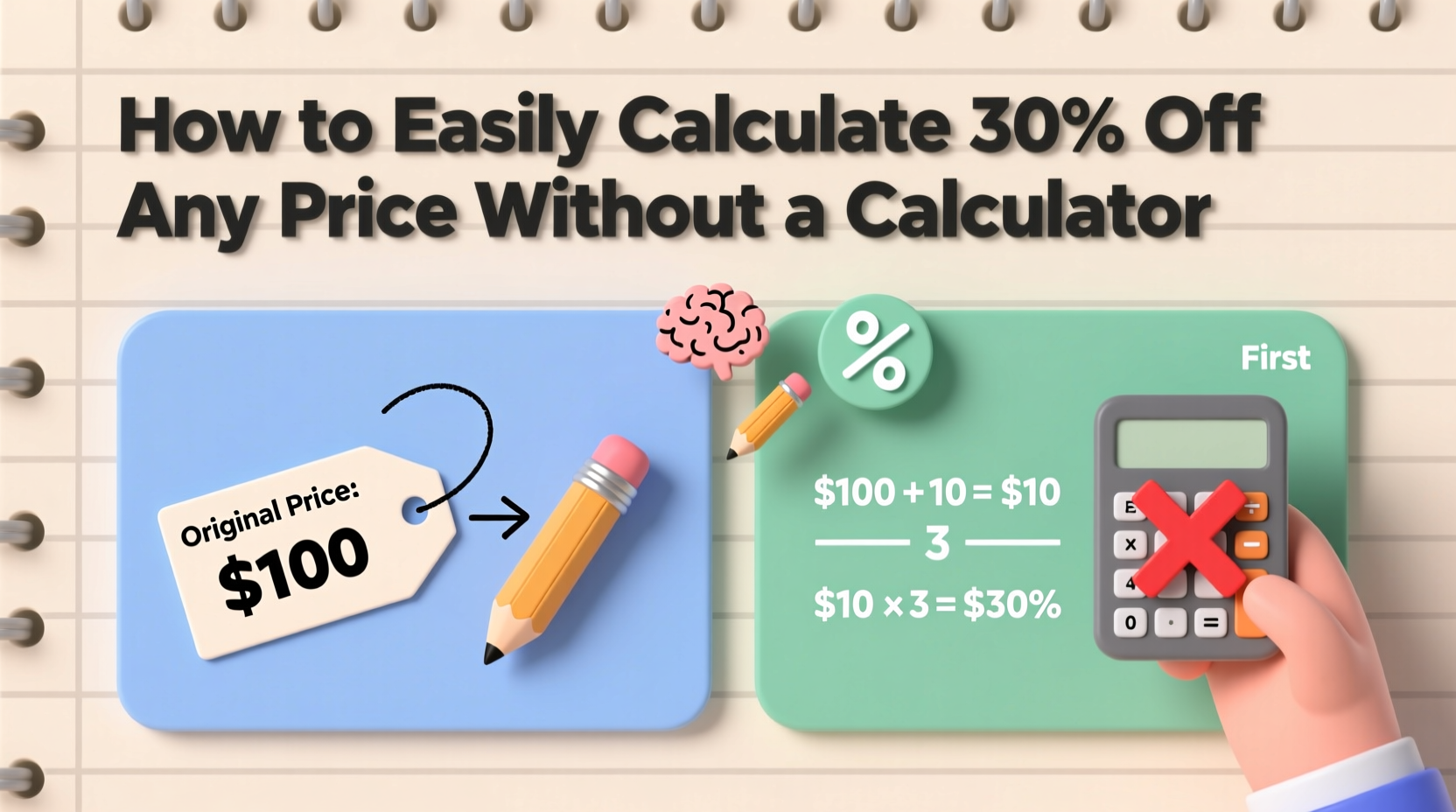
Before diving into shortcuts, it’s important to understand what “30 percent off” actually means. Percent means “per hundred,” so 30% is the same as 30 out of 100, or 0.30 in decimal form. When you take 30% off a price, you’re subtracting 30% of the original amount from itself.
For example, 30% off $100 means you subtract $30 (which is 30% of 100), leaving you with $70. But what about less round numbers, like $68 or $47? That’s where smart simplification comes in.
The key is breaking the problem into manageable parts. Instead of trying to calculate 30% all at once, think of it as 10% multiplied by 3. Since 10% is easy to find mentally (just move the decimal point one place to the left), this method becomes a powerful tool for quick estimation.
Step-by-Step Guide: Calculate 30% Off in Seconds
Follow this logical sequence to compute 30% off any price without writing anything down:
- Find 10% of the original price. Move the decimal point one place to the left. For example, 10% of $50 is $5.00; 10% of $87 is $8.70.
- Multiply that number by 3. This gives you 30%. So if 10% is $5, then 30% is $15. If 10% is $8.70, then 30% is $26.10.
- Subtract the discount from the original price. Take the 30% value and subtract it from the starting amount. $50 minus $15 is $35. $87 minus $26.10 is $60.90.
This method works for any number, big or small. Let’s walk through a real-world scenario.
Mini Case Study: Shopping at a Department Store
Sarah is shopping for a winter coat originally priced at $129. A sign says “30% off.” She wants to know the sale price before heading to the register.
She starts by calculating 10% of $129: moving the decimal gives her $12.90. She rounds this to $13 in her head for easier math (a common and acceptable trick). Multiplying $13 by 3 gives $39. Now she subtracts $39 from $129: $129 – $39 = $90.
Her estimate is $90. The exact calculation would be $129 × 0.30 = $38.70, so the actual price is $90.30. Her mental shortcut was only 30 cents off — well within an acceptable range for quick decision-making.
This kind of speed and accuracy builds confidence and helps avoid overpaying due to miscalculations.
Advanced Shortcuts for Faster Results
While the 10% × 3 method is reliable, there are additional tricks to make calculations even faster, especially when dealing with awkward numbers.
Round First, Then Calculate
If the price ends in an odd number (like $74.99), round it to the nearest ten or whole dollar first. For $74.99, use $75. Calculate 10% of $75 = $7.50. Multiply by 3: $22.50. Subtract from $75: $52.50. The actual discount on $74.99 is $22.497 (≈$22.50), so the result is nearly identical.
Use Benchmark Numbers
Familiarize yourself with common 10% and 30% values to build intuition. For instance:
| Original Price | 10% Value | 30% Discount | Sale Price |
|---|---|---|---|
| $20 | $2.00 | $6.00 | $14.00 |
| $50 | $5.00 | $15.00 | $35.00 |
| $80 | $8.00 | $24.00 | $56.00 |
| $100 | $10.00 | $30.00 | $70.00 |
| $150 | $15.00 | $45.00 | $105.00 |
Having these reference points allows you to interpolate. If an item is $130, you know it’s $20 more than $110. Since 30% of $100 is $30 and 30% of $150 is $45, you can estimate that 30% of $130 is around $39.
Expert Insight: Why Mental Math Still Matters
In an age of smartphones and instant calculators, some may question the need for mental arithmetic. But experts emphasize its lasting value.
“Mental math isn’t just about crunching numbers — it builds numerical fluency and financial awareness. People who can estimate discounts quickly are less likely to fall for misleading sales tactics.” — Dr. Alan Reyes, Cognitive Mathematics Educator, University of Oregon
Being able to calculate percentages mentally also sharpens decision-making. It reduces dependency on devices and improves confidence when budgeting, negotiating, or comparing value across products.
Common Mistakes to Avoid
Even simple math can go wrong under pressure. Here are frequent errors people make when calculating 30% off — and how to prevent them:
- Misplacing the decimal point. Remember: 10% of $45 is $4.50, not $450 or $0.45. Moving the decimal one place left is crucial.
- Forgetting to subtract the discount. Some stop at finding 30% and forget to subtract it from the original price. The discount is not the final price — it’s the amount saved.
- Over-rounding. Rounding is helpful, but rounding $47 to $60 makes the estimate useless. Stick to rounding to the nearest $5 or $10 for best results.
- Confusing 30% off with 30% of. “30% off” means you pay 70%. “30% of” means only the discount portion. Keep the language straight.
Checklist: Master 30% Off Calculations in 5 Steps
Use this checklist whenever you need to calculate a discount quickly:
- ✅ Identify the original price
- ✅ Find 10% by shifting the decimal one place left
- ✅ Multiply that number by 3 to get 30%
- ✅ Subtract the 30% value from the original price
- ✅ Round appropriately if needed for speed
Repeat this process a few times, and it will become second nature.
FAQ
Can I use this method for other percentages?
Absolutely. The 10% rule is versatile. For 20%, double 10%. For 15%, add half of 10% to itself. For 25%, divide the price by 4. Build from the 10% foundation.
What if the price is under $10?
The same rules apply. For example, 30% off $7.99: 10% is $0.799 ≈ $0.80. Multiply by 3: $2.40. Subtract: $7.99 – $2.40 = $5.59. The exact discount is $2.397, so your estimate is very close.
Is it faster to multiply by 0.70 instead?
Yes, since 30% off means you pay 70%, multiplying the original price by 0.70 gives the sale price directly. However, multiplying decimals mentally is harder for most people. The 10% × 3 method is simpler and more accessible.
Conclusion
Calculating 30 percent off any price without a calculator is a skill that pays off every time you shop. By mastering the 10% shortcut, rounding wisely, and practicing regularly, you gain financial clarity and avoid being misled by flashy sale signs. These techniques aren’t just useful — they’re empowering.
You don’t need a degree in mathematics or a smartphone to know a true bargain when you see one. With a little practice, these mental habits become automatic, giving you confidence in your spending decisions.




 浙公网安备
33010002000092号
浙公网安备
33010002000092号 浙B2-20120091-4
Comments
No comments yet. Why don't you start the discussion?