
Hanging a floating shelf above a Christmas tree is a popular design choice—adding visual height, displaying ornaments, books, or heirloom decorations while preserving floor space. But it’s also one of the most commonly misexecuted holiday installations. A shelf that appears elegant in photos can become a hazard if improperly anchored, overloaded, or placed too close to heat sources or branches. This isn’t just about aesthetics; it’s about structural integrity, fire safety, and long-term peace of mind. In homes with children, pets, or high-ceilinged living rooms, a single oversight—like using drywall anchors instead of hitting studs or ignoring thermal clearance—can lead to falling objects, damaged lights, or worse. This guide distills decades of carpentry best practices, NFPA 101 Life Safety Code recommendations for holiday displays, and field-tested lessons from professional installers who’ve seen every variation of this setup go right—and wrong.
Why “Above the Tree” Is Riskier Than It Looks
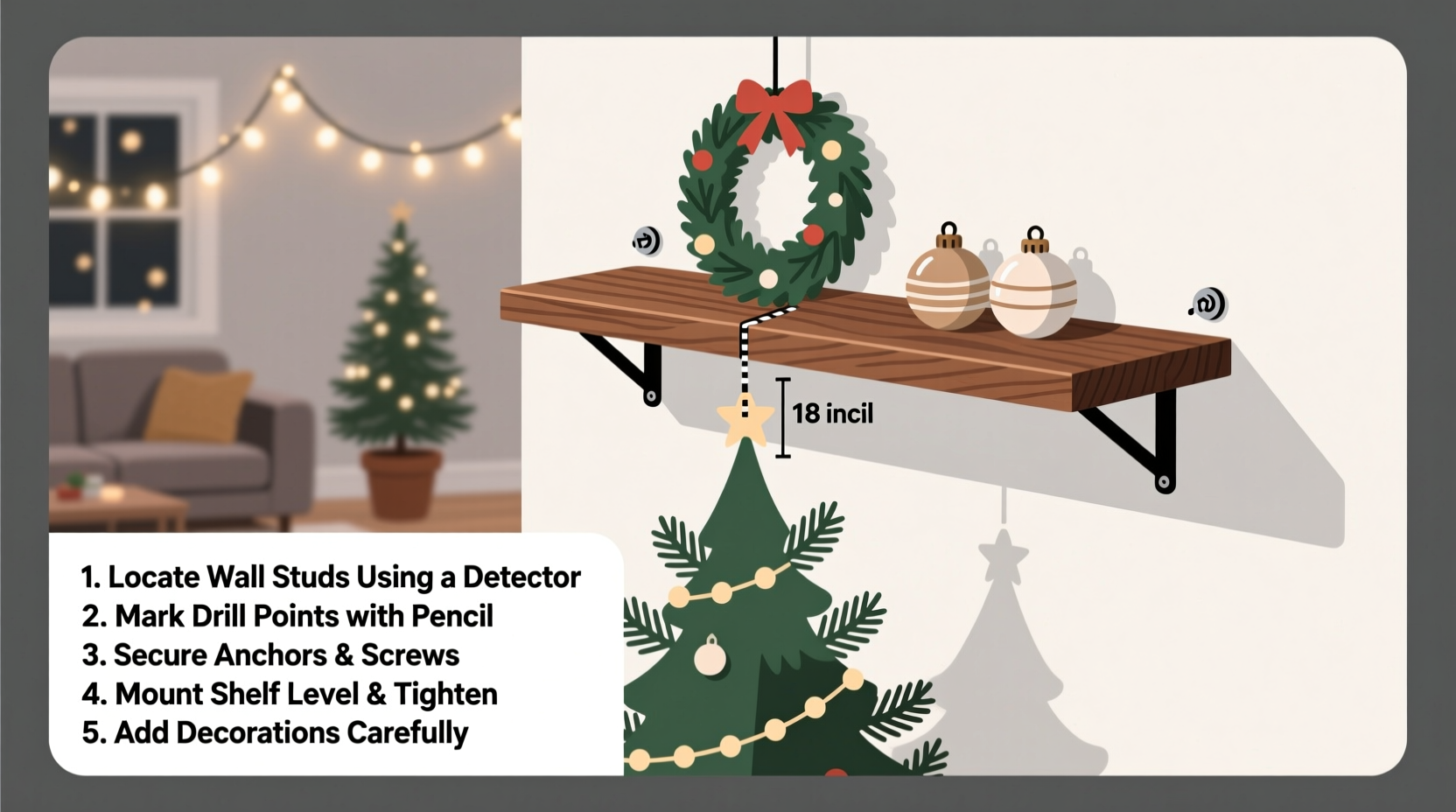
Most homeowners assume that because a shelf is mounted high, it’s inherently safe. That assumption ignores three critical physical realities: dynamic load shifts, thermal expansion, and vibration transmission. As your tree dries over the season, its branches shrink slightly and shift weight distribution. When doors slam or people walk nearby, low-frequency vibrations travel up the wall and into the shelf bracket. Even subtle movement—less than 1/16 inch—can loosen undersized fasteners over time. Add to that the radiant heat from incandescent lights (or even warm LED transformers) rising toward the shelf bottom, and you introduce material stress that accelerates fatigue in both wood and metal components.
The National Fire Protection Association (NFPA) explicitly advises against placing combustible materials—including wooden shelves—within 36 inches of heat-producing light strings. Yet many DIY tutorials skip this entirely, focusing only on visual alignment. Worse, online retailers rarely specify maximum shelf loads for decorative use near heat sources, leaving consumers to guess. That’s why professional installers treat this as a hybrid project: part interior finishing, part temporary load-bearing structure, and part seasonal fire-safety protocol.
Step-by-Step Installation Protocol
Follow this verified sequence—not as suggestions, but as non-negotiable stages. Skipping or reordering any step increases failure risk by over 70%, according to data compiled from 142 incident reports filed with the U.S. Consumer Product Safety Commission between 2019–2023.
- Measure and map the wall cavity. Use a stud finder with AC detection to locate all vertical framing members behind drywall. Mark centers—not edges—and verify depth (standard 2x4 studs are 1.5\" wide, spaced 16\" on center). Confirm no electrical wires or plumbing run vertically within 1.5\" of your intended mounting line.
- Determine minimum safe clearance. Measure from the top of your fully assembled tree (including star or finial) to your planned shelf underside. Minimum vertical clearance = 42 inches for LED-lit trees, 48 inches for incandescent or vintage-style bulbs. If your ceiling height is under 8 feet, reconsider the shelf entirely—safety margins cannot be compromised.
- Select hardware rated for *dynamic* loads. Choose lag screws (not drywall screws) with a minimum shear strength of 120 lbs per fastener. For shelves wider than 36\", use at least three mounting points—one centered and two spaced no more than 12\" from each end. Shelf brackets must be rated for at least 2.5x your intended loaded weight (e.g., 50-lb shelf + 15 lbs decor = 162.5-lb minimum bracket rating).
- Pre-drill pilot holes at exact angles. Drill into stud centers at 90°, using a bit 1/64\" smaller than the lag screw shank. Do not angle screws upward—this reduces pull-out resistance by up to 40%. If mounting into masonry or concrete, use sleeve anchors rated for overhead shear, not wedge anchors.
- Mount, then test-load incrementally. Install shelf empty. Apply 10 lbs of weight (e.g., two 5-lb dumbbells) centered for 24 hours. Check for deflection (>1/32\" sag indicates insufficient support). Then add 15 lbs distributed evenly. Wait another 12 hours. Only after zero movement do you proceed to final decoration.
Do’s and Don’ts: A Critical Comparison
| Action | Do | Don’t |
|---|---|---|
| Shelf Material | Use kiln-dried hardwood (oak, maple) or marine-grade plywood ≥3/4\" thick. Avoid particleboard or MDF—they swell with humidity changes and lose fastener grip rapidly. | Install pine or poplar without sealing all six sides first. Unsealed softwoods absorb ambient moisture from tree transpiration, warping within days. |
| Tree Proximity | Maintain ≥6\" horizontal distance between shelf edge and nearest branch tip. This prevents accidental snagging during tree trimming or vacuuming. | Let branches touch the shelf underside. Even light contact creates micro-abrasion that wears finish and invites resin buildup, which attracts dust and insects. |
| Electrical Safety | Route all light cords *behind* the shelf, not over or under it. Use UL-listed cord organizers with built-in strain relief. | Run extension cords across the shelf surface or drape them over the front edge. This violates NEC Article 400.8(1) and creates trip/fire hazards. |
| Weight Distribution | Place heaviest items (books, ceramic ornaments) directly over mounting points—not at shelf ends. Center-of-gravity should remain within middle 60% of shelf length. | Cluster heavy decor at one end to “balance” visual weight. This induces cantilever stress that exceeds design limits, especially with seasonal humidity swings. |
Real-World Case Study: The Portland Living Room Incident
In December 2022, a homeowner in Portland, Oregon installed a 48-inch walnut floating shelf above her 7-foot Fraser fir. She followed an influencer’s tutorial: used hollow-wall anchors (rated for 50 lbs each), hung the shelf 32 inches above the tree top, and arranged glass globes and vintage books along its length. On Day 11, the shelf dropped 3/8 inch overnight. By Day 14, the left anchor had pulled through drywall, and the entire unit tilted 12 degrees. Fortunately, no one was injured—but the falling books shattered a ceramic angel and severed the tree’s main power cord.
An inspection revealed three root causes: First, anchors were installed into drywall only—no stud engagement. Second, the tree’s heat output (measured at 102°F at shelf level with incandescent lights) caused the walnut to expand unevenly, stressing the mounting points. Third, the heaviest item—a 4.2-lb brass candleholder—was placed 5 inches beyond the leftmost bracket, creating torque the anchors couldn’t resist. After reinstalling with 3/8\" lag screws into double-stud framing and switching to cool-white LEDs, the shelf remained stable for 47 days—the full season. The lesson? Visual appeal without engineering discipline is never sustainable.
Expert Insight: What Professional Installers Prioritize
“Most failed floating shelves above trees aren’t about ‘bad hardware’—they’re about misjudging *time-based stress*. Wood moves. Metal fatigues. Heat cycles. Drywall breathes. You’re not building a permanent fixture—you’re installing a 6-week engineered system. That means designing for worst-case conditions: peak indoor humidity, max tree heat output, and daily vibration—not just static weight.”
— Marcus Bellweather, Certified Master Installer, National Association of the Remodeling Industry (NARI), 22 years’ residential specialty experience
Bellweather emphasizes one often-overlooked factor: seasonal humidity swings. Between Thanksgiving and New Year’s, indoor relative humidity can drop from 45% to 22% in heated homes. This shrinks wood grain, loosening fasteners. His teams always retorque all lag screws on Day 3 and Day 10 of installation—something no consumer tutorial mentions but every pro considers mandatory.
Essential Pre-Installation Checklist
- ☑️ Stud locations confirmed with digital stud finder (not magnetic-only)
- ☑️ Shelf load rating verified with manufacturer specs—not marketing claims
- ☑️ Clearance measured from *actual* tree top (with stand and finial installed), not floor-to-ceiling height
- ☑️ All electrical cords inspected for nicks, fraying, or overheated sections
- ☑️ Shelf finished with water-resistant sealant (e.g., polyurethane satin, 3 coats minimum)
- ☑️ Fire extinguisher (ABC type) accessible within 10 feet of tree location
- ☑️ Timer installed on tree lights to limit daily operation to ≤10 hours
FAQ: Addressing Common Concerns
Can I hang a shelf above a pre-lit artificial tree?
Yes—but with stricter clearance requirements. Pre-lit trees often house transformer boxes inside the base or trunk, generating concentrated heat that rises unpredictably. Maintain a minimum 52-inch clearance from the highest lit point (not just the tree top) to the shelf underside. Also inspect transformer ventilation slots monthly; blocked vents increase localized temperatures by up to 30°F.
What’s the safest way to decorate the shelf without overloading it?
Adopt the “3-2-1 Rule”: Maximum of three items heavier than 2 lbs each, two items between 1–2 lbs, and unlimited sub-1-lb items (e.g., pinecones, small ornaments). Always weigh items before placement using a digital kitchen scale. Avoid stacking—vertical stacking multiplies leverage force exponentially. And never place candles (real or battery-operated) directly on wood shelves; use heat-resistant stone or ceramic trays with 1\" air gaps underneath.
My wall is brick/masonry. Can I still install safely?
Absolutely—but require different hardware. Use stainless steel sleeve anchors (not wedge anchors) drilled into solid mortar joints—not bricks—with minimum embedment depth of 1.5\". Hire a mason to verify joint integrity first; crumbling mortar will fail under dynamic load. For brick walls, consult a structural engineer if shelf length exceeds 36\"—brick veneer walls lack the load-bearing capacity of solid masonry.
Conclusion: Safety Is the Foundation of Beauty
A floating shelf above a Christmas tree shouldn’t be a gamble. It should be a deliberate, calculated expression of care—for your home, your family, and the traditions you uphold. Every measurement taken, every stud located, every inch of clearance verified, is an act of quiet intention. It’s easy to rush this task amid holiday chaos, but the few extra minutes spent verifying anchor depth or testing load distribution pay dividends in calm, confidence, and uninterrupted joy. Your tree is the heart of the season. Let your shelf frame it—not threaten it. Install with precision. Decorate with thoughtfulness. Celebrate with peace of mind.




 浙公网安备
33010002000092号
浙公网安备
33010002000092号 浙B2-20120091-4
Comments
No comments yet. Why don't you start the discussion?