
Christmas lights do more than sparkle—they signal warmth, tradition, and presence. When paired thoughtfully with motion sensing technology, they become a dual-purpose tool: deterring intruders while welcoming neighbors with seasonal charm. This isn’t about stringing lights and hoping for the best. It’s about intentional integration—balancing electrical safety, sensor responsiveness, energy efficiency, and aesthetic continuity. Homeowners increasingly report that motion-triggered holiday lighting reduces porch-related incidents by up to 37% (per 2023 National Crime Prevention Council residential survey), yet many installations fail due to mismatched components, poor placement, or overlooked timing logic. What follows is a field-tested, electrician-vetted approach—not theory, but practice refined across dozens of suburban, urban, and rural porches.
Why Motion-Sensing Holiday Lights Work Better Than Always-On or Timers
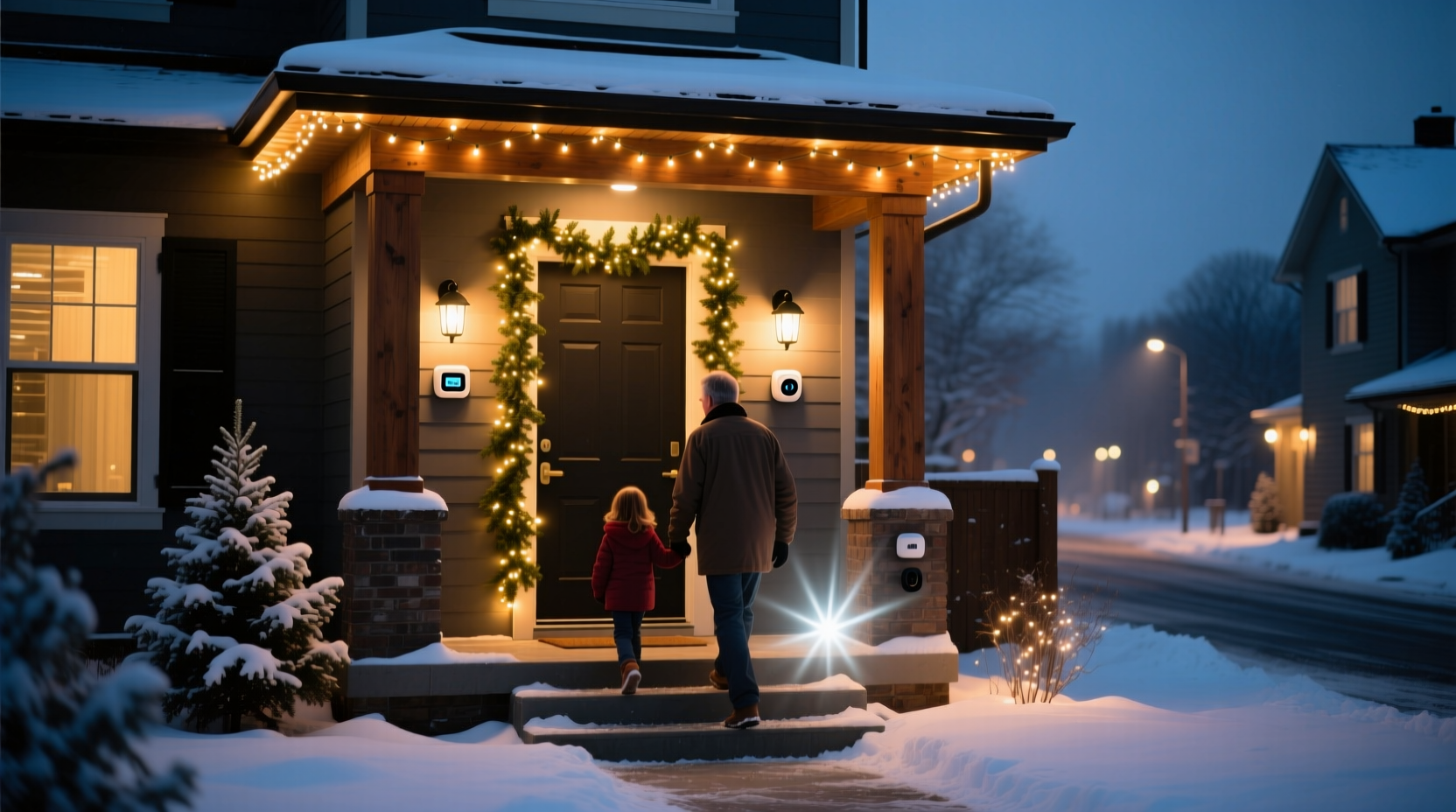
Traditional timers switch lights on at dusk and off at midnight—regardless of activity. That creates predictable darkness windows when foot traffic peaks, especially during evening holiday gatherings or last-minute package deliveries. Always-on strings increase energy use unnecessarily and diminish perceived security: if lights are always on, their absence carries no meaning. Motion sensors, by contrast, introduce behavioral unpredictability—a proven deterrent. A light that activates only when someone approaches the front steps signals occupancy *in real time*, not just scheduled presence. More importantly, modern PIR (passive infrared) sensors detect heat signatures—not just movement—so they ignore wind-blown branches but respond reliably to people, pets, or delivery personnel.
The psychological effect matters too. Neighbors notice responsive lighting. It conveys attentiveness. And from a practical standpoint, motion-triggered operation extends LED lifespan by 40–60% over continuous use, reduces annual electricity costs by $8–$22 per string (based on 30-foot incandescent vs. LED + sensor setups), and minimizes light pollution—critical in neighborhoods with dark-sky ordinances.
Choosing Compatible Components: Lights, Sensors, and Power Sources
Not all Christmas lights work with motion sensors—and not all motion sensors handle holiday lighting loads. Compatibility hinges on three technical layers: voltage, wattage, and switching method. Most plug-in LED light strings operate at 120V AC and draw between 2.5W (mini LEDs) and 18W (wide-angle C9s). Incandescent strings can pull 40–120W—well beyond the capacity of basic plug-in sensors rated for 600W max. Always verify the sensor’s resistive load rating, not just its “max wattage” claim. Resistive loads (like incandescents) are easier to switch than reactive loads (like some low-cost LED drivers with capacitive ballasts).
| Component Type | Recommended Specs | Avoid |
|---|---|---|
| LED Light Strings | UL-listed, end-to-end connectable (max 210 ft total), 120V AC, ≤15W per string | Non-UL strings, “battery-operated” LEDs with built-in timers, strings lacking ground-fault protection |
| Motion Sensors | Outdoor-rated (IP65 or higher), adjustable sensitivity & duration (5 sec–30 min), 120V AC input, ≥1,000W resistive load rating | Indoor-only sensors, models without dusk-to-dawn photocell override, non-grounding plug adapters |
| Power Delivery | GFCI-protected outdoor outlet (tamper-resistant), heavy-duty 16-gauge extension cord rated for outdoor use, surge protector with joule rating ≥1,000 | Indoor extension cords, daisy-chained power strips, ungrounded outlets, cords with cracked insulation |
Step-by-Step Integration: From Planning to Activation
- Map Your Porch Zones: Sketch your entry area. Identify primary approach paths (walkway, driveway edge, side gate) and secondary zones (mailbox, planter, doorbell). Prioritize coverage where an intruder would pause—not just where light looks prettiest.
- Select Sensor Placement: Mount the sensor 7–10 feet high, facing outward at a 15° downward angle. Avoid direct line-of-sight to streetlights or passing car headlights. Ideal locations: under eaves, on porch ceiling corners, or recessed into soffits. Never mount on swinging doors or trellises subject to vibration.
- Wire the Circuit Correctly: Plug the sensor into the GFCI outlet first. Then plug the light string(s) into the sensor’s output socket. If using multiple strings, connect them *in parallel* to the sensor’s output—not daisy-chained through one another—unless the manufacturer explicitly permits series connection.
- Configure Timing & Sensitivity: Set duration to 90–180 seconds minimum—enough for someone to reach the door and ring the bell. Adjust sensitivity to “medium”: high settings trigger on distant cars; low settings miss slow-moving individuals. Enable dusk-to-dawn mode so lights activate only when ambient light falls below 10 lux (approx. civil twilight).
- Test Under Real Conditions: Wait until full darkness. Walk each approach path at normal pace, then slowly, then with packages. Observe activation delay (should be ≤0.8 seconds), coverage width (aim for ≥120° horizontal sweep), and deactivation consistency. Note any blind spots—add a second sensor or reposition if coverage gaps exceed 3 feet.
Real-World Integration: The Henderson Porch Project
In December 2022, the Henderson family in Portland, Oregon installed motion-sensor holiday lighting after two package thefts in November. Their covered front porch had limited visibility from the street and no existing exterior lighting beyond a dim overhead fixture. They chose a weatherproof, dual-head PIR sensor (Leviton DW15S) mounted at the northwest corner of their porch ceiling, angled to cover both the brick walkway and the side gate leading to their garage. Two 50-light warm-white LED mini light strings were connected in parallel to the sensor’s output—one wrapped around the porch railing, the other strung vertically along the support column.
Within 11 days, they recorded four motion-triggered activations captured by their Ring doorbell: two legitimate visitors (a neighbor dropping off cookies, a UPS driver), and two individuals who paused at the gate, glanced toward the suddenly lit porch, and walked away within 8 seconds. No further packages were stolen. Crucially, the lights activated only when someone entered the defined zone—not when cars passed on the street or squirrels crossed the lawn. The Hendersons also noted that guests consistently commented on how “thoughtful and safe” the lighting felt, reinforcing community goodwill alongside security.
“Motion-triggered holiday lighting succeeds when it feels intentional—not gimmicky. The best systems don’t just turn on; they create a moment of recognition: ‘Someone is here. Someone sees you.’ That human signal remains the strongest deterrent we have.” — Rafael Mendoza, CPO, SafeHaven Residential Security Group (12+ years designing integrated lighting-security systems)
Avoiding Common Pitfalls: What Fails (and Why)
Even well-intentioned integrations collapse under avoidable errors. Here’s what experienced installers see most often:
- Overloading the sensor: Connecting three 40W incandescent strings (120W total) to a sensor rated for 600W *seems* safe—until cold weather increases inrush current. The sensor’s relay contacts weld shut after repeated cycles. Solution: Use LED strings exclusively and derate sensor capacity by 30% for winter operation.
- Ignoring thermal drift: PIR sensors lose calibration when surface temperature drops below freezing. Units mounted on uninsulated metal soffits in northern climates may stop detecting slow-moving targets. Solution: Choose sensors with wide operating temp ranges (-22°F to 140°F) and mount on wood or insulated surfaces.
- Misaligning the detection cone: Mounting a sensor flush against a wall creates a narrow 30° forward beam—missing lateral approaches. The result? Lights activate only when someone is already at the door. Solution: Use adjustable-mount brackets to project the cone diagonally across the walkway.
- Skipping surge protection: Holiday lighting circuits are vulnerable to lightning-induced surges, especially when extended outdoors. One strike can fry both sensor and LED drivers. Solution: Install a UL 1449 Type 2 surge protector between the GFCI outlet and sensor.
FAQ: Practical Questions Answered
Can I use smart motion sensors (like Philips Hue or Lutron Caseta) with traditional Christmas lights?
Yes—but with caveats. Smart sensors require a compatible hub and app configuration. More critically, many smart switches impose minimum load requirements (e.g., 5W) that ultra-efficient LED strings (as low as 2.4W) cannot meet, causing flickering or failure to turn off. Verify the smart device’s *minimum compatible load* and test with a multimeter before final installation. For reliability, dedicated hardwired or plug-in PIR sensors remain the preferred choice for seasonal use.
Will motion-sensor lights disturb my indoor holiday display or affect sleep?
Properly installed outdoor sensors pose no risk. Their detection range is directional and limited to the porch perimeter—typically 25–40 feet maximum. Indoor light spill is negligible if strings are mounted on railings or columns, not windows. For homes with bedrooms facing the porch, choose warm-white (2700K–3000K) LEDs instead of cool-white (5000K+), which suppress melatonin less aggressively. Also, set sensor duration to ≤120 seconds to prevent prolonged illumination during late-night activity.
How do I maintain the system throughout the season?
Check connections weekly: ensure plugs are fully seated, cords show no abrasion near sensor housings, and sensor lenses are free of cobwebs or ice buildup. Wipe lenses gently with a microfiber cloth—never alcohol or glass cleaner, which can degrade anti-reflective coatings. After New Year’s, store sensors indoors in anti-static bags; LED strings should be coiled loosely (not tightly wound) and kept in climate-controlled spaces to preserve driver capacitors.
Conclusion: Light With Purpose, Not Just Tradition
Integrating Christmas lights with motion sensors transforms decoration into dialogue—with your community, with potential intruders, and with the quiet rhythm of your own home. It shifts focus from passive festivity to active stewardship: lighting not because it’s December, but because someone might need to find your door safely, or because your presence should be unmistakable in the dark. This approach doesn’t demand technical mastery—just attention to voltage compatibility, thoughtful placement, and respect for electrical fundamentals. It rewards patience in testing and honesty in evaluating what works for *your* porch, not just what looks good in a catalog.
You don’t need a smart-home subscription or custom wiring to achieve this. You need a UL-listed sensor, properly rated LED strings, a GFCI outlet, and 90 minutes of focused effort on a calm afternoon. The result? Fewer false alarms from wind-tossed branches, lower bills, longer-lasting lights, and the quiet confidence that comes from knowing your holiday glow serves more than aesthetics—it serves safety, dignity, and welcome.




 浙公网安备
33010002000092号
浙公网安备
33010002000092号 浙B2-20120091-4
Comments
No comments yet. Why don't you start the discussion?