
For many watch wearers—especially those who rely on timepieces during outdoor adventures, night shifts, or underwater activities—the ability to read the time in darkness is not a luxury but a necessity. Luminous watch dials have evolved significantly over the decades, from early radium-based paints to modern photoluminescent and radioluminescent technologies. Yet, even the most advanced lume can underperform if not properly maintained or utilized. Understanding how to optimize and adjust your watch’s luminous function ensures you get the clearest, longest-lasting glow when it matters most.
The Science Behind Watch Lume
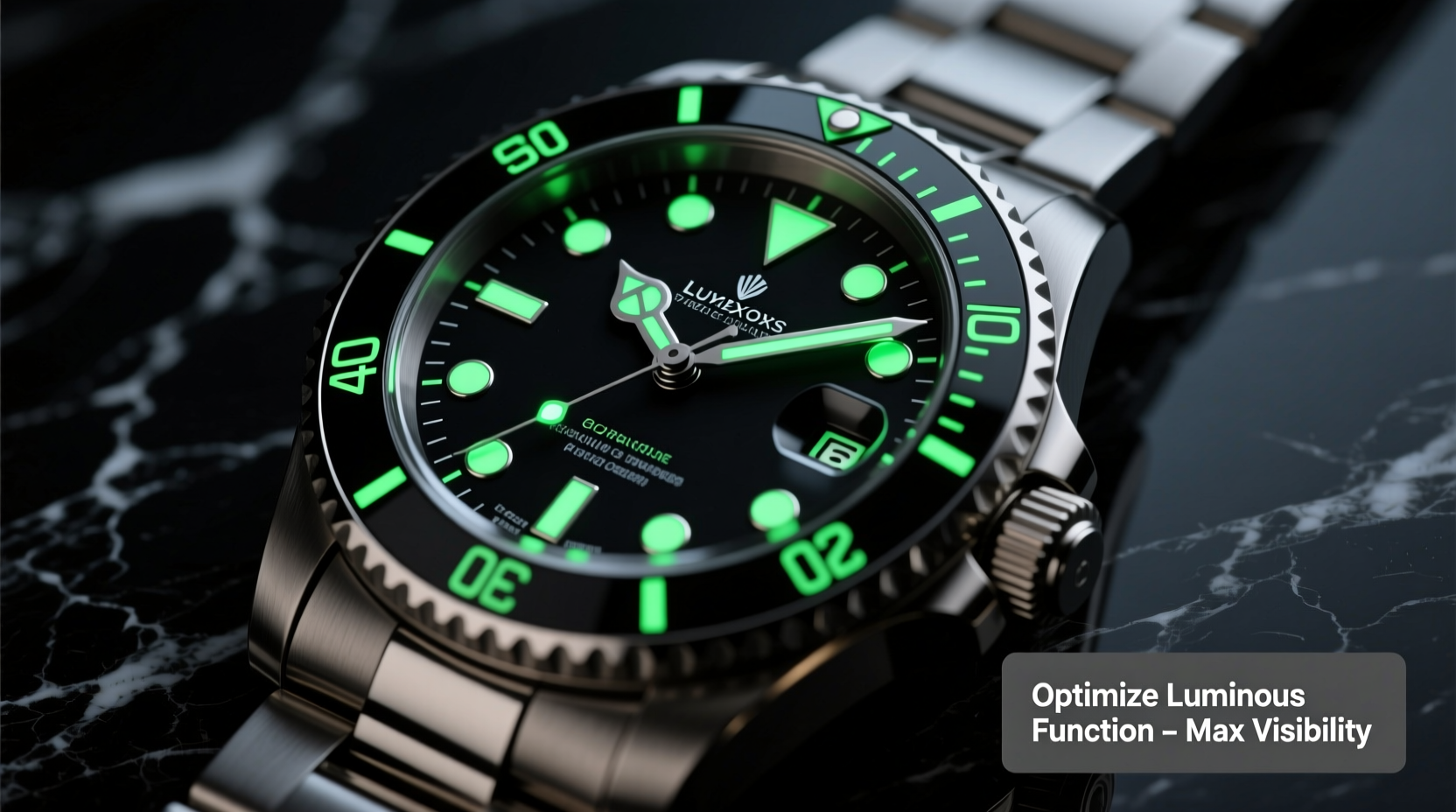
Luminous materials used on watches absorb light and re-emit it over time, creating a visible glow in the dark. The two primary types are:
- Photoluminescent (e.g., Super-LumiNova): These pigments charge under light sources—natural sunlight, fluorescent bulbs, or LED—and emit a soft glow after exposure. They are non-radioactive and widely used across mid-to-high-end watches.
- Radioluminescent (e.g., Tritium GTLS): Tiny glass tubes filled with tritium gas emit continuous light without needing external charging. This technology provides constant illumination for 10–20 years, ideal for military or professional use.
The brightness and duration of the glow depend on several factors: the type of lume, surface area applied, intensity and duration of prior light exposure, and environmental conditions such as humidity and temperature.
“Lume performance isn’t just about material quality—it’s also about user behavior. Most people don’t realize that five minutes of direct sunlight can outperform hours under office lighting.” — Daniel Park, Horological Materials Researcher at ChronoTech Labs
Step-by-Step Guide to Maximizing Lume Performance
To get the best visibility from your watch’s luminous markers and hands, follow this practical sequence:
- Expose to optimal light source: Place your watch under bright natural sunlight for 3–5 minutes. Sunlight contains a full spectrum of UV and visible light, making it the most effective charging source.
- Avoid weak indoor lighting: Standard office or room lighting lacks sufficient intensity and UV component. If sunlight isn’t available, use a strong LED flashlight held 2–4 inches from the dial for 1–2 minutes.
- Position face-up: Ensure all luminous elements are directly exposed. Angling the watch may leave some markers in shadow, reducing overall charge.
- Minimize obstruction: Remove sleeves, straps, or covers that block light from reaching the dial during charging.
- Test in darkness: After charging, move to a completely dark environment to assess glow intensity and duration. Note which hands or markers fade first.
Do’s and Don’ts of Lume Care
| Do’s | Don’ts |
|---|---|
| Charge under direct sunlight regularly | Leave your watch covered during daylight hours |
| Clean the crystal frequently to allow maximum light transmission | Use abrasive cleaners that scratch the crystal or degrade lume |
| Store with the dial facing upward near a window (if safe) | Expose tritium-lumed watches to prolonged extreme heat (>60°C), which can damage microtubes |
| Inspect for lume degradation annually | Assume older vintage lume still performs like new—even if intact, aged phosphors lose efficiency |
Real Example: Night Hiking with a Lumed Dive Watch
Mark, an experienced hiker in the Pacific Northwest, relies on his ISO-certified dive watch during overnight treks. During one trail navigation at 2 a.m., he noticed his watch hands were barely readable despite having worn it all day. Upon review, he realized he had kept his jacket sleeve pulled over the watch face throughout the afternoon, blocking light exposure. Even though ambient daylight was strong, the lume never charged.
After adjusting his habit—wearing the watch over his sleeve and periodically rotating his wrist toward the sun—he found the lume glowed brightly for over two hours post-sunset. He now uses a 30-second burst from his headlamp before descending into forested areas, ensuring consistent nighttime legibility.
This case illustrates a common oversight: passive wear does not guarantee active lume charging. Intentional exposure is key.
Enhancing Visibility Through Maintenance and Adjustment
Over time, dust, oils, and scratches on the watch crystal can significantly reduce both light absorption and emission. A cloudy sapphire or mineral glass acts like a filter, dimming the glow. Regular maintenance helps preserve optical clarity:
- Wipe the crystal weekly with a microfiber cloth dampened with water or mild soapy solution.
- Remove skin oils and dirt buildup, especially around bezels and case edges that may indirectly affect light penetration.
- Check for crystal fogging or internal condensation, which scatters light and reduces lume contrast.
If your watch has removable lume plots (common in custom builds or aftermarket modifications), consider upgrading to high-grade Swiss Super-LumiNova BGW9 (blue-white) or C3 (green-yellow), known for superior brightness and longevity.
Frequently Asked Questions
How long should watch lume last after charging?
High-quality Super-LumiNova can remain visibly bright for 3–6 hours, gradually fading over time. Tritium-based systems like MB-Microtec’s GTLS provide consistent brightness for up to 20 years without charging, though the glow dims slightly each year due to tritium decay.
Can I recharge lume with a UV flashlight?
Yes, UV flashlights (365–395 nm wavelength) can effectively charge photoluminescent materials. However, standard white LED lights often work better because they deliver broader-spectrum energy, including UV-A components already present in sunlight.
Why does my vintage watch no longer glow?
Older watches used radium or promethium, which degraded over time and posed health risks. Even surviving lume layers lose their phosphorescent properties after decades. Modern restoration often replaces old paint with safe, high-performance alternatives.
Checklist: Optimizing Your Watch’s Lume Function
- ✅ Expose watch face to direct sunlight daily
- ✅ Keep crystal clean and scratch-free
- ✅ Wear watch on top of clothing to maximize light access
- ✅ Use a bright LED light for quick charging when outdoors at night
- ✅ Inspect lume condition annually for cracks, flaking, or dimming
- ✅ Consider lume upgrade if original material has degraded
- ✅ Avoid storing in complete darkness for extended periods
Conclusion
Maximizing your watch’s luminous function doesn’t require technical expertise—just awareness and routine attention. Whether you’re navigating city streets at midnight or tracking elapsed time during a deep dive, a well-maintained lume system gives you confidence and precision when visibility drops. By understanding how lume works, actively charging it, and maintaining its physical condition, you extend both the utility and lifespan of your timepiece.




 浙公网安备
33010002000092号
浙公网安备
33010002000092号 浙B2-20120091-4
Comments
No comments yet. Why don't you start the discussion?