
Warm white LED string lights create a cozy, inviting ambiance for patios, bedrooms, and living rooms. But when you try to dim them, problems often arise—buzzing sounds from fixtures, flickering, or an unwanted shift in color temperature that turns your soft golden glow into a harsh, cool white. These issues aren’t just annoying; they can shorten the lifespan of your lights and even pose electrical risks if ignored. The good news is that with the right components and setup, you can achieve smooth, silent dimming while preserving the warmth and charm of your lighting.
Why Dimming LED String Lights Goes Wrong
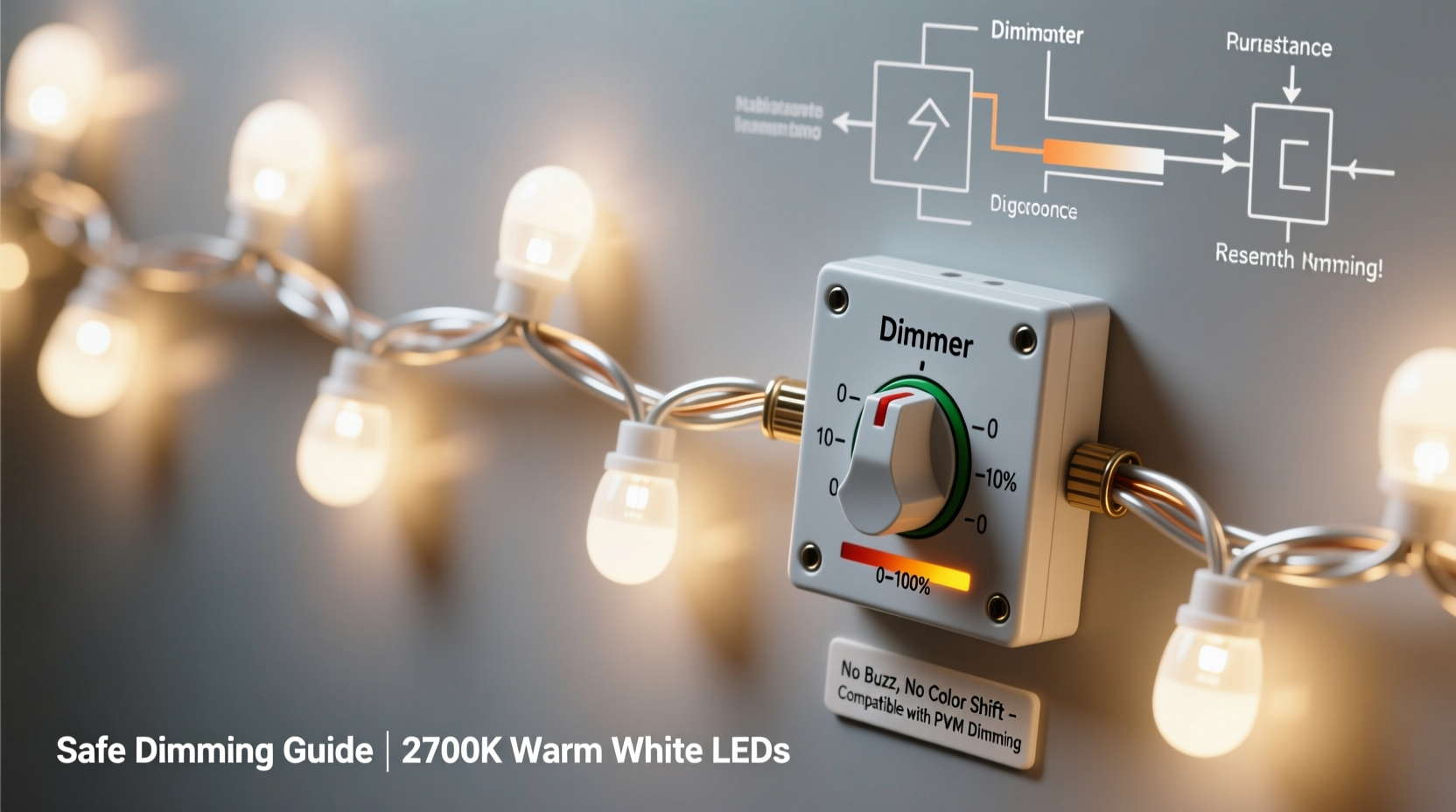
Traditional incandescent bulbs dim easily because they work on simple resistance principles—reduce voltage, reduce brightness, and the filament glows less intensely but maintains its warm tone. LEDs, however, operate differently. They rely on drivers and electronic circuits to regulate current, making them far more sensitive to changes in power delivery.
When paired with incompatible dimmers or poorly designed drivers, LED string lights often exhibit:
- Buzzing or humming noises caused by rapid switching (trailing-edge vs. leading-edge dimmer mismatch).
- Flickering due to unstable current regulation at low brightness levels.
- Color shift, where warm white (typically 2700K–3000K) appears cooler as certain diodes in multi-chip arrays drop out under low voltage.
- Limited dimming range, failing to go below 20–30% brightness.
These issues stem not from the LEDs themselves, but from mismatches between the dimmer switch, the power supply (driver), and the light string’s internal circuitry.
“Most dimming failures with LEDs come down to component compatibility—not quality. A high-end LED won’t perform well on a legacy dimmer.” — Daniel Reeves, Lighting Systems Engineer, LumenTech Solutions
The Right Components for Silent, Stable Dimming
Successful dimming starts with selecting compatible hardware. Unlike plug-and-play setups, optimal LED dimming requires matching three key elements: the light string, the driver (if external), and the dimmer switch.
Choose Dimmable Warm White LED String Lights
Not all LED string lights are dimmable. Check the product specifications carefully. Look for:
- Explicit labeling: “Dimmable” or “Compatible with ELV/CL dimmers.”
- Consistent color temperature across dimming ranges (some manufacturers specify this).
- High CRI (Color Rendering Index >90) for more natural light quality, especially at low brightness.
Strings using single-die warm white LEDs are less prone to color shift than those combining warm and cool diodes to simulate dimming warmth.
Use a Compatible LED Dimmer Switch
This is the most critical step. Most homes still use older dimmers designed for incandescent loads (60W+). These are typically “leading-edge” (triac-based) dimmers, which chop the front of the AC waveform. LEDs draw much less power (often 5–10W total), so these dimmers struggle to regulate properly, causing noise and flicker.
For LED string lights, use a “trailing-edge” dimmer (also called electronic low-voltage or ELV dimmer). These offer smoother control at low loads and are gentler on LED drivers.
Select the Correct Power Supply (for Plug-In or Hardwired Strings)
If your LED string uses an external transformer or driver (common in outdoor or commercial-grade strings), verify it's dimmable and matches the dimmer type. For example:
- 0–10V dimming requires a compatible driver and control wire.
- PWM (Pulse Width Modulation) drivers work best with trailing-edge dimmers.
- Some drivers support both phase-cut dimming and DC voltage reduction.
A mismatch here can cause the driver to oscillate, creating audible buzzing in the power supply itself.
Step-by-Step Guide to Installing a Buzz-Free Dimming System
Follow this sequence to install or upgrade your warm white LED string lighting for quiet, full-range dimming.
- Assess your current setup: Note whether your LED strings are plug-in or hardwired, their total wattage, and whether they’re labeled as dimmable.
- Turn off power at the circuit breaker before working with any wiring.
- Remove the existing dimmer switch and check its type (leading-edge vs. trailing-edge) and minimum load rating.
- Calculate total load: Add up the wattage of all connected LED strings. Example: 10 meters at 0.8W per meter = 8W total.
- Select a trailing-edge (ELV) dimmer rated for low-load applications (e.g., Lutron Diva DVCL-153P, Leviton D26HD).
- Install the new dimmer following manufacturer instructions. Ensure neutral wires are properly connected if required.
- Reconnect power and test at multiple dimming levels. Listen for buzzing and observe color consistency.
- Adjust placement if needed: Some drivers buzz when mounted near metal boxes or in tight spaces—add insulation or relocate.
If using multiple strings, avoid daisy-chaining beyond the manufacturer’s recommendation. Overloading a single circuit can destabilize dimming performance.
Do’s and Don’ts: Best Practices for Long-Term Performance
| Action | Do | Don’t |
|---|---|---|
| Dimmer Type | Use trailing-edge (ELV) dimmers for LED loads under 50W | Use old incandescent dimmers unless specified as LED-compatible |
| Load Matching | Ensure total LED wattage meets dimmer’s minimum load | Run a 6W load on a dimmer requiring 25W minimum |
| Cable Quality | Use shielded cables for long runs to reduce interference | Use damaged or undersized extension cords |
| Installation Environment | Keep drivers ventilated and away from moisture | Enclose drivers in sealed plastic or damp enclosures |
| Dimming Range | Test brightness down to 5% to confirm no flicker or color shift | Assume all “dimmable” LEDs go below 20% smoothly |
Mini Case Study: Fixing a Buzzing Patio Setup
Sarah installed 30 meters of warm white LED string lights across her backyard pergola using a standard wall dimmer she’d used for porch lights for years. After installation, the lights buzzed loudly at mid-dim levels and turned noticeably cooler when dimmed below 40%. Frustrated, she nearly removed the entire setup.
After consulting an electrician, she discovered two issues: first, her dimmer was a leading-edge model designed for 60W incandescents; second, her LED strings used dual-color chips (warm + cool white) blended via voltage, which caused the cool diodes to dominate at lower voltages.
The fix: She replaced the dimmer with a Lutron ELV model and switched to a single-die warm white LED string known for stable dimming. The buzzing stopped, and the lights maintained a consistent 2700K hue from 100% down to 10% brightness. Total cost: $45. Result: a serene evening space she now uses year-round.
FAQ: Common Questions About Dimming Warm White LEDs
Can I use a smartphone dimmer app with my LED string lights?
Yes—but only if you use a smart dimmer switch or smart plug designed for LEDs. Standard Wi-Fi plugs don’t offer true dimming; they cycle power on/off, which causes flicker. Use products like Lutron Caséta or TP-Link Kasa Smart Dimmer Switches for smooth, app-controlled dimming without compromising light quality.
Why do my LED strings change color when dimmed?
This usually happens with “color-blended” warm white LEDs that mix warm and cool diodes. At full power, both operate; when dimmed, the cooler diodes remain active longer, shifting the overall tone. To avoid this, choose strings with true single-color warm white diodes and constant-current reduction (CCR) dimming.
Is it safe to dim non-dimmable LED string lights?
No. Attempting to dim non-dimmable LEDs can overheat the internal driver, create fire hazards, void warranties, and cause permanent damage. Always verify “dimmable” labeling before connecting to any dimmer circuit.
Expert Tips for Maximizing Light Quality and Lifespan
Even with the right hardware, small details affect performance. Consider these advanced tips:
- Add a dummy load if your total LED wattage is below the dimmer’s minimum. A small incandescent nightlight (5–10W) wired in parallel can stabilize the circuit—though this reduces energy efficiency.
- Use dimmers with soft-start features to gradually ramp up voltage, reducing thermal stress on LEDs and extending lifespan.
- Group lights by batch number when installing multiple strings. Slight variations in binning can cause inconsistent color rendering when dimmed.
- Avoid using extension cords longer than 50 feet with low-voltage strings—voltage drop can cause uneven brightness and instability during dimming.
Checklist: Pre-Dimming Setup Verification
Before flipping the switch, run through this checklist:
- ✅ LED string is labeled “dimmable”
- ✅ Total wattage meets dimmer’s minimum load requirement
- ✅ Dimmer type matches LED requirements (preferably trailing-edge)
- ✅ Driver (if external) is dimmable and compatible with the dimmer
- ✅ Wiring connections are secure and correct (line, load, neutral, ground)
- ✅ No daisy-chaining beyond manufacturer limits
- ✅ Installation environment is dry and well-ventilated
- ✅ Tested at multiple brightness levels for buzzing, flicker, and color shift
Conclusion: Enjoy Warm, Quiet Ambiance Without Compromise
Dimming warm white LED string lights shouldn’t mean sacrificing comfort for aesthetics. With careful selection of dimmable LEDs, trailing-edge dimmers, and compatible drivers, you can achieve a seamless fade from bright illumination to candlelit warmth—without a single buzz or unnatural hue. The investment in proper components pays off in longevity, safety, and daily enjoyment. Whether illuminating a bedroom canopy or wrapping trees in a garden, your lights should enhance the atmosphere, not distract from it.




 浙公网安备
33010002000092号
浙公网安备
33010002000092号 浙B2-20120091-4
Comments
No comments yet. Why don't you start the discussion?