
The holiday season brings joy, warmth, and festive decorations—none more central than the Christmas tree. Yet for pet owners, especially those with energetic dogs or curious cats, that centerpiece can quickly become a hazard. A playful leap, an enthusiastic tail wag, or a sudden pounce on a dangling ornament can destabilize even the sturdiest-looking tree stand. The result? A toppled tree, broken ornaments, spilled water, and potential injury to both pets and people.
According to the American Society for the Prevention of Cruelty to Animals (ASPCA), household accidents involving pets increase during the holidays, with decorated trees ranking among common triggers. But with thoughtful preparation and practical safety measures, it’s entirely possible to enjoy a beautiful tree while keeping your furry family members safe. This guide provides actionable strategies to reinforce and secure your Christmas tree stand against pet-related tipping, blending structural solutions, behavioral training, and smart design choices.
Why Pet Owners Face Unique Tree-Security Challenges
Active pets don’t intentionally knock over trees, but their natural behaviors often lead to unintended consequences. Dogs may jump at low-hanging decorations, chase reflections off tinsel, or simply run through the room at full speed. Cats are climbers by instinct; a tree’s branches offer irresistible vertical territory. Even small pets like rabbits or guinea pigs can cause vibrations if housed nearby.
A standard Christmas tree stand, while sufficient under normal conditions, is rarely designed to withstand lateral force from animals. Most retail stands rely on water reservoirs and basic screw clamps to hold the trunk, offering minimal resistance to dynamic movement. Once a tree tilts beyond 15 degrees, physics takes over—its center of gravity shifts, making recovery nearly impossible without external support.
This vulnerability is compounded in homes with hardwood or tile flooring, where rubber feet on stands may not provide enough grip. Combine this with a 6- to 7-foot tree weighing 40+ pounds (including water and ornaments), and the risk becomes clear: a single misstep from a pet can trigger a domino effect of damage.
Choosing the Right Tree Stand for Stability
The foundation of tree security begins with the stand. Not all stands are created equal—some are built for convenience, others for durability. For pet owners, prioritize weight capacity, base width, and anchoring compatibility.
Look for models labeled “heavy-duty” or “commercial-grade.” These typically feature wide triangular bases, metal construction, and integrated mechanisms for tightening around the trunk. Some advanced stands include pre-drilled holes for wall mounting or come with included straps. Avoid lightweight plastic stands, even if they claim large water capacity—they flex under pressure and lack structural rigidity.
When evaluating options, consider the following features:
- Weight-to-base ratio: A broader base distributes weight more evenly and resists tipping.
- Trunk clamp mechanism: Look for dual-screw or ratchet systems that lock the trunk firmly in place.
- Floor grip: Rubberized feet or non-slip pads help prevent sliding on smooth surfaces.
- Water capacity: While not directly related to stability, a larger reservoir reduces refill frequency, minimizing opportunities for pets to investigate the base.
| Stand Type | Best For | Pet-Safety Rating | Notes |
|---|---|---|---|
| Basic Plastic Stand | Occasional use, light trees | ★☆☆☆☆ | Avoid in homes with pets; prone to slipping and cracking. |
| Metal Tripod Stand | Medium trees, moderate activity | ★★★☆☆ | Sturdy but may need additional anchoring. |
| Commercial Heavy-Duty Stand | All homes with pets | ★★★★★ | Built-in anchor points, superior grip, durable materials. |
| Wall-Mounted Bracket System | High-risk environments | ★★★★★ | Requires installation but offers maximum security. |
Step-by-Step: Securing Your Tree Against Tipping
Even the best stand needs reinforcement when pets are present. Follow this sequence to ensure your tree remains upright throughout the season.
- Select a stable location. Avoid placing the tree near furniture pets use to jump (e.g., sofas, coffee tables). Keep it centered in a low-traffic area, ideally against a solid wall.
- Assemble the stand properly. Ensure all screws are tightened securely and the trunk is seated fully. Test stability by gently rocking the tree before decorating.
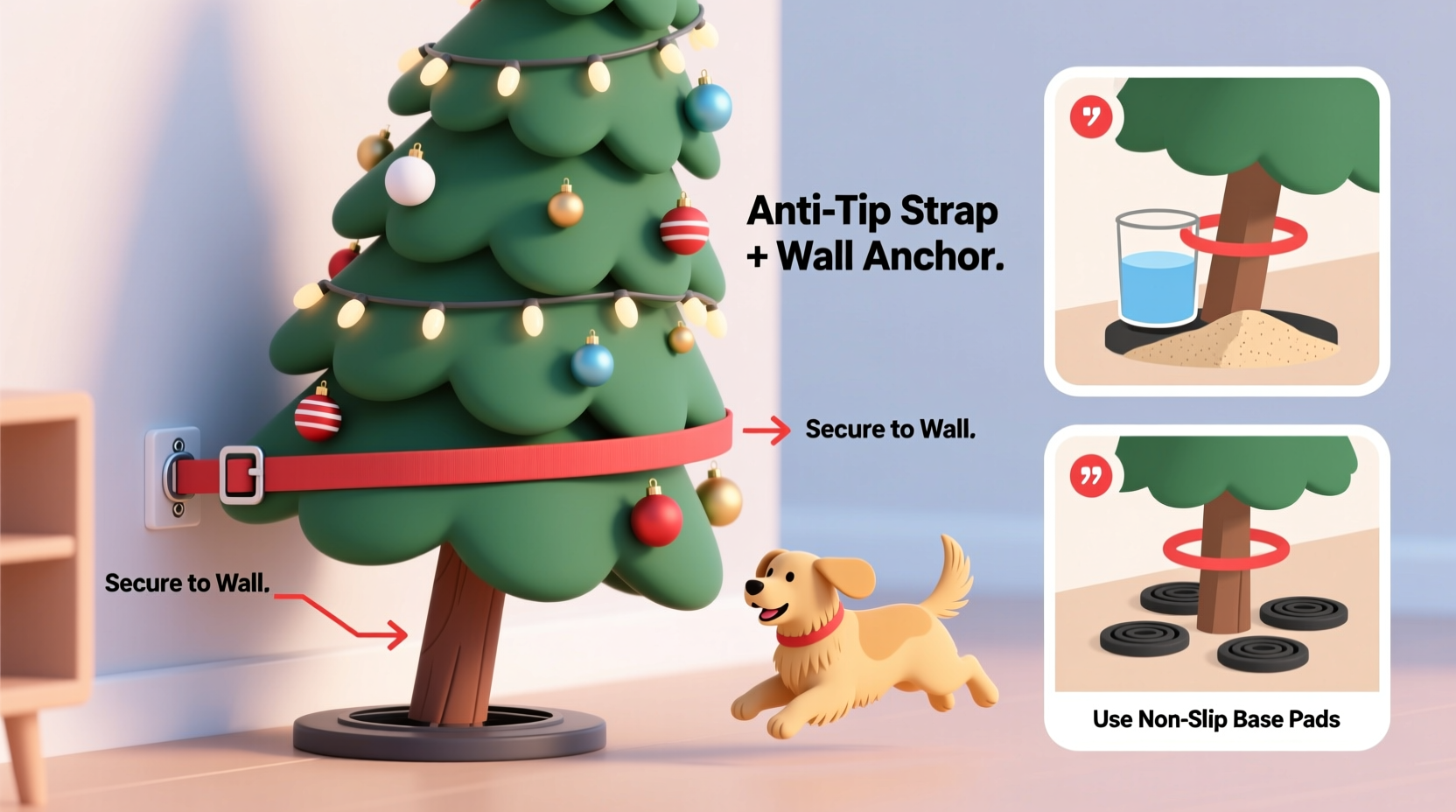
- Add floor protection. Place a non-slip rug pad or anti-slip shelf liner beneath the stand to prevent sliding.
- Anchor to the wall. Use soft nylon straps or decorative ribbons to tether the upper third of the tree to a wall stud. Attach one end to a sturdy branch and the other to a screw anchored into drywall or wood.
- Reinforce with multiple anchor points. For tall or top-heavy trees, use two straps—one on each side—for balanced support.
- Test the system. Simulate pet impact by gently pushing the tree sideways. It should resist movement without straining the anchor.
Behavioral Strategies to Complement Physical Security
No physical barrier replaces consistent pet training. While securing the tree mechanically is essential, teaching your pet to respect its space adds a critical layer of protection.
Begin training early in the season, before the tree is fully decorated. Use positive reinforcement to reward calm behavior near the tree zone. If your dog tends to jump, practice commands like “stay” or “leave it” within proximity of the tree. For cats, discourage climbing by covering lower branches with aluminum foil or double-sided tape—surfaces most felines dislike.
Redirect attention with designated play areas and toys placed away from the tree. Puzzle feeders or treat-dispensing toys can keep pets mentally engaged during gatherings when distractions increase.
“Preventing tree accidents isn’t just about hardware—it’s about managing animal behavior. A well-secured tree buys time, but training creates lasting safety.” — Dr. Rebecca Langston, DVM, Certified Animal Behaviorist
Real-World Example: The Thompson Family’s Near-Miss
The Thompsons in Denver, Colorado, learned the hard way during the 2022 holidays. Their two-year-old Labrador, Max, had always been curious about the Christmas tree, but never aggressive. One evening, while chasing a ball across the living room, Max skidded and collided with the base. The tree—a 7-foot Fraser fir in a standard plastic stand—toppled within seconds, shattering glass ornaments and spilling three gallons of water across the hardwood floor.
No one was injured, but cleanup took hours, and the tree could not be re-erected safely. Determined to avoid a repeat, the family invested in a heavy-duty metal stand with a wide base and installed two discreet nylon straps anchored into wall studs. They also began training Max with boundary cues using a wireless pet barrier mat near the tree zone.
In 2023, despite multiple close calls—including a kitten batting at a low ornament—the tree remained upright. “It’s not just about the straps,” said Sarah Thompson. “It’s the combination of better equipment and teaching our pets what’s off-limits.”
DIY and Decorative Anchoring Solutions
Some pet owners worry that visible straps or brackets detract from holiday aesthetics. Fortunately, creative solutions allow for both safety and style.
Use wide satin ribbons in seasonal colors (red, green, gold) to tie the tree to wall anchors. Position them diagonally from the upper branches to discreet wall hooks painted to match the trim. From a distance, they appear as part of the decoration rather than a safety measure.
Alternatively, wrap thin, flexible steel cables in festive garland or fake ivy to conceal them. Ensure connections are tight and tested before relying on them.
For renters or those avoiding wall modifications, consider freestanding stabilizers—tall tripod frames that surround the tree and connect at the top. These sit independently on the floor and don’t require drilling, though they do occupy more space.
Checklist: Pet-Safe Christmas Tree Setup
Use this checklist every holiday season to ensure your tree is secure and pet-friendly:
- ✅ Choose a heavy-duty tree stand with a wide, non-slip base
- ✅ Place the tree away from pet jumping zones and high-traffic areas
- ✅ Install non-slip padding under the stand
- ✅ Anchor the tree to a wall stud using soft straps or ribbons
- ✅ Test stability by gently pushing the trunk
- ✅ Train pets with boundaries and positive reinforcement
- ✅ Avoid low-hanging ornaments, tinsel, and toxic plants (e.g., mistletoe)
- ✅ Monitor interactions during unsupervised times
Frequently Asked Questions
Can I use fishing line to secure my Christmas tree?
While strong, fishing line is nearly invisible and poses a choking or entanglement risk to pets. It can also cut into branches under tension. Opt for wider, soft-strapped tie-downs instead.
What if I can’t drill into the wall?
If wall anchoring isn’t possible, use a weighted base (such as sandbags hidden in a decorative basket) or a freestanding stabilizing frame. Positioning the tree between two walls or in a corner can also improve stability.
Are artificial trees safer than real ones?
Artificial trees are generally lighter, which can make them more prone to tipping unless properly weighted. However, they eliminate risks associated with spilled water and sap, which can irritate pets’ paws or stomachs if ingested.
Final Thoughts: Safety Enables Celebration
A secure Christmas tree isn’t just about protecting your decor—it’s about creating a safe environment where both people and pets can enjoy the season without fear of accidents. By combining robust hardware, strategic placement, and consistent training, you transform a potential hazard into a symbol of harmonious celebration.
The effort you invest in securing your tree pays dividends in peace of mind, fewer disruptions, and longer-lasting holiday cheer. This year, take the time to evaluate your setup, involve your household in safety practices, and implement a system tailored to your pet’s behavior and your home’s layout.




 浙公网安备
33010002000092号
浙公网安备
33010002000092号 浙B2-20120091-4
Comments
No comments yet. Why don't you start the discussion?