
The English language is full of words that sound alike but carry different meanings and uses. One such word is \"latter,\" often confused with \"later\" due to their similar pronunciation. While both appear in everyday writing, only one refers to the second of two things mentioned. Misusing \"latter\" can lead to confusion or undermine the clarity of your message—especially in formal or professional writing. Understanding its correct spelling, meaning, and application ensures precision and credibility in communication.
\"Latter\" is not difficult to spell—it’s simply L-A-T-T-E-R—but its proper usage requires attention to context. Unlike \"later,\" which relates to time, \"latter\" is about position in a sequence, specifically when choosing between two options. This guide breaks down everything you need to know: from basic definitions to advanced applications, complete with real-world examples and practical tips.
Understanding the Meaning of “Latter”
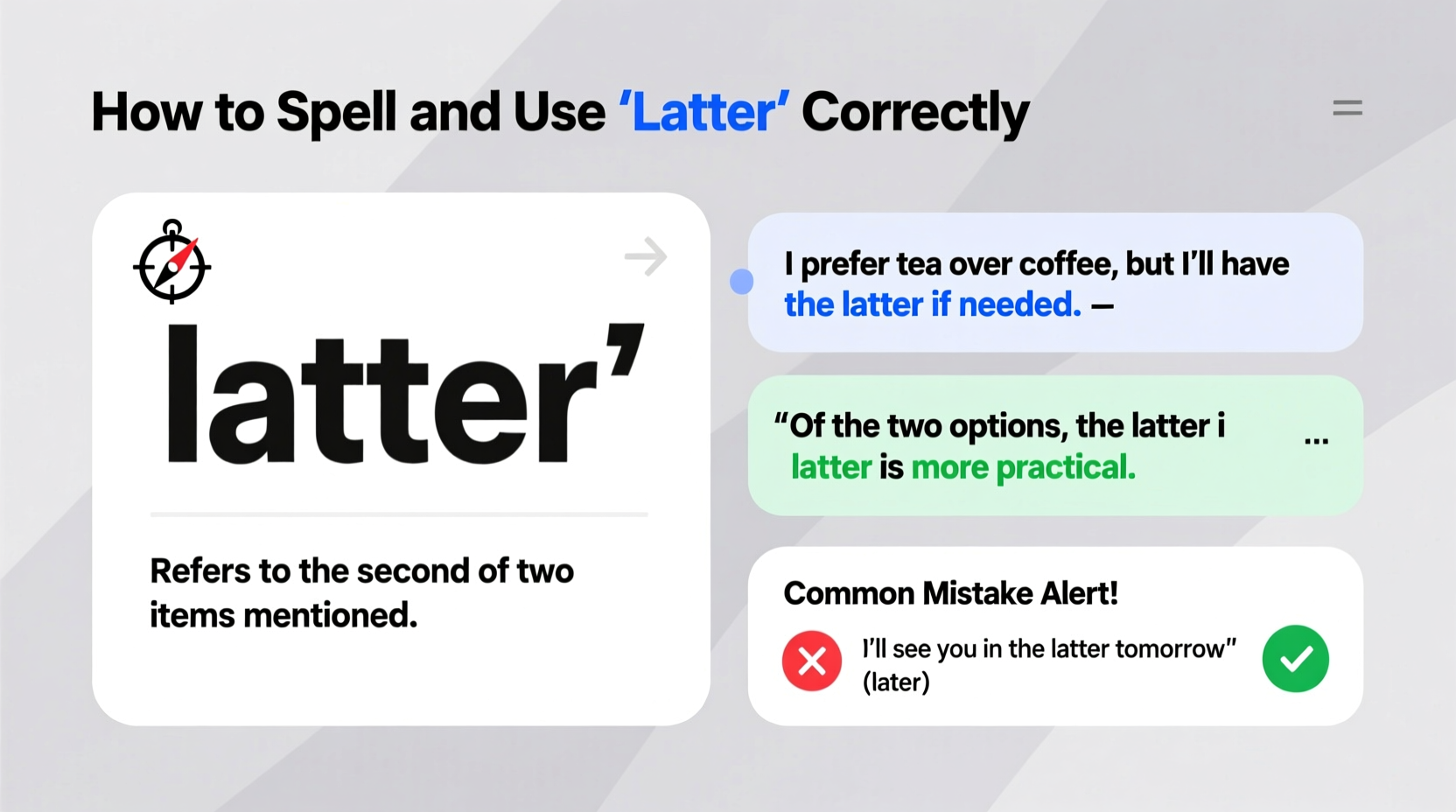
At its core, \"latter\" refers to the second of two items, people, or ideas previously mentioned. It acts as an adjective and is always used in contrast to \"former,\" which denotes the first of the two. The pair \"former\" and \"latter\" helps writers avoid repetition while maintaining clarity.
For example:
- I can have tea or coffee. I think I’ll go with the latter.
- We discussed hiring internally or externally. The latter option may bring fresh perspectives.
In both cases, \"latter\" efficiently points back to the second option without needing to repeat it. This makes writing more concise and fluid, especially in comparative discussions.
“Precision in word choice separates competent writing from exceptional writing. Using ‘latter’ correctly shows attention to detail.” — Dr. Helen Reeves, Linguistics Professor at Cambridge University
Common Confusion: Latter vs. Later
One of the most frequent errors in written English is mixing up \"latter\" and \"later.\" Though they sound nearly identical, their meanings are entirely different.
| Word | Meaning | Example |
|---|---|---|
| Latter | The second of two things mentioned | Between hiking and swimming, I prefer the latter. |
| Later | At a future time; after the present moment | I’ll finish the report later tonight. |
To remember the difference, focus on the double “t” in both \"latter\" and \"second\"—a small mnemonic that can prevent costly errors. Also, consider that \"last\" and \"latter\" both start with “lat,” subtly linking them to order rather than time.
How to Use “Latter” in Sentences: Practical Examples
Using \"latter\" effectively enhances clarity and avoids redundancy. Below are several sentence structures demonstrating correct usage across different contexts.
1. In Comparisons
When presenting two choices, \"latter\" cleanly identifies the second.
- She could take the bus or walk home. She chose the latter.
- Our team debated launching in June or September. The latter date allows more preparation.
2. In Formal Writing
Academic and business writing often relies on \"former\" and \"latter\" for brevity.
- The proposal supports tax reform or increased public spending. While the former promotes efficiency, the latter stimulates demand.
- Two candidates applied: Maria Chen and James Reed. The latter has more experience in digital marketing.
3. With Implied Pairs
Sometimes, the two items aren’t explicitly listed but are understood from context.
- After reviewing the feedback, some wanted changes, others didn’t. I agree with the latter.
Note: Be cautious with implied pairs. Overuse or unclear references can confuse readers. Always ensure the antecedent is unmistakable.
Step-by-Step Guide to Using “Latter” Correctly
Follow this five-step process to confidently incorporate \"latter\" into your writing:
- Identify Two Clear Options: Ensure you’ve mentioned exactly two items, people, or ideas. \"Latter\" only works in dual comparisons.
- Check Order: Confirm the second item is the one you intend to reference.
- Replace with Clarity: Substitute the second noun with \"the latter\" to avoid repetition.
- Avoid Ambiguity: If the sentence contains more than two elements, do not use \"latter.\" Instead, rephrase or name the item directly.
- Edit for Tone: In casual conversation, using \"the second one\" may be clearer. Reserve \"latter\" for formal or concise writing.
Frequently Asked Questions
Can “latter” be used when discussing more than two things?
No. \"Latter\" strictly applies to the second of two. When listing three or more items, using \"latter\" creates ambiguity. For example, in “apples, oranges, and bananas,” saying “I prefer the latter” is incorrect because it's unclear whether it refers to bananas or oranges. Rephrase: “I prefer bananas” or “I prefer the last option.”
Is it ever correct to say “the later” instead of “the latter”?
Rarely. “The later” might appear in phrases like “the later part of the day,” where \"later\" functions as an adjective related to time. However, “the later of two meetings” is acceptable, but “the latter” is still preferred when contrasting two specific events. Avoid “the later” when you mean “the second mentioned.”
Can “latter” stand alone without “the”?
No. “Latter” must be preceded by “the” when used as a noun substitute. Saying “I chose latter” is grammatically incorrect. Always write “I chose the latter.”
Real-World Example: A Business Email
Consider this scenario: A manager drafts an email to stakeholders outlining two strategies for increasing customer retention.
“We’ve evaluated two approaches: improving response times or offering loyalty rewards. While the former enhances service quality, the latter has shown stronger results in pilot markets and aligns better with our long-term goals. We recommend moving forward with the latter strategy.”
Here, “the latter” avoids repeating “offering loyalty rewards,” making the message concise and professional. Repeating the full phrase would feel redundant. Using “later” (“We recommend doing this later”) would completely change the meaning and create confusion.
Checklist: Using “Latter” Like a Pro
- ☑ Mentioned exactly two options?
- ☑ Second option is clearly intended?
- ☑ Used “the latter,” not just “latter”?
- ☑ Avoided using it with lists of three or more?
- ☑ Paired with “former” when contrasting both options?
- ☑ Double-checked spelling: L-A-T-T-E-R?
Conclusion
Mastering small but powerful words like \"latter\" elevates your writing from functional to polished. It’s not just about avoiding mistakes—it’s about communicating with precision and confidence. Whether you’re drafting an email, writing a report, or editing an article, taking a moment to verify your use of \"latter\" pays dividends in clarity and professionalism.




 浙公网安备
33010002000092号
浙公网安备
33010002000092号 浙B2-20120091-4
Comments
No comments yet. Why don't you start the discussion?