
Procrastination isn’t just a bad habit—it’s a psychological response to discomfort, uncertainty, or fear of failure. Whether it’s writing a report, cleaning the kitchen, or starting a workout, the resistance we feel often has less to do with the task itself and more to do with the emotional weight it carries. The good news? You don’t need willpower or motivation to overcome it. What you need is a strategy that bypasses resistance long enough to create momentum. That’s where the five minute rule comes in.
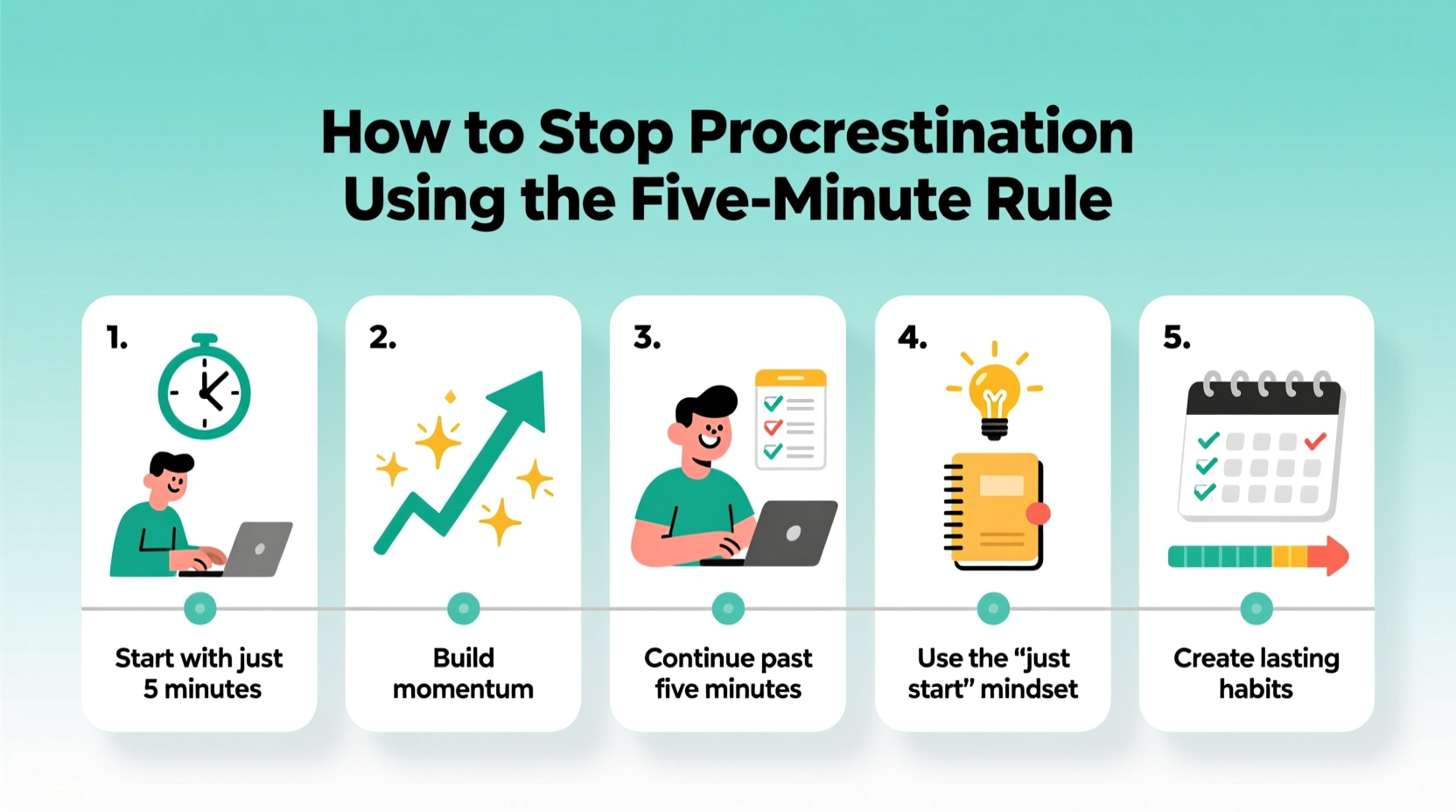
The five minute rule is not about finishing tasks in five minutes. It’s about starting them. By committing to work on something for just five minutes, you disarm your brain’s resistance mechanism. Once you begin, inertia shifts—you’re far more likely to keep going than you were before you started. This deceptively simple technique leverages behavioral psychology to make action easier, reduce mental friction, and build consistent productivity.
The Psychology Behind the Five Minute Rule
Why does such a short time commitment work so well? The answer lies in how our brains process effort and reward. When faced with a daunting task, the prefrontal cortex—the part responsible for decision-making—often gets overridden by the limbic system, which prioritizes comfort and avoids pain. This leads to avoidance behavior: “I’ll do it later,” “It’s too big,” or “I’m not in the mood.”
The five minute rule sidesteps this conflict by reframing the task as temporary and low-risk. Instead of asking yourself to complete a project, you’re only asking to try it for 300 seconds. That tiny commitment feels manageable, even trivial. And once you start, two powerful forces kick in: the Zeigarnik effect (unfinished tasks linger in memory and create psychological tension) and the principle of behavioral momentum (action breeds more action).
“Starting is the most important step. Once you begin, the mind adjusts to the new reality and resistance decreases.” — Dr. BJ Fogg, Behavioral Scientist, Stanford University
Dr. Fogg’s research on tiny habits supports this idea: small actions lead to lasting change because they’re easy to adopt and trigger positive reinforcement. The five minute rule operates on the same principle. It’s not about achievement; it’s about initiation.
How to Apply the Five Minute Rule: A Step-by-Step Guide
This technique works across all areas of life—from professional projects to personal goals. Here’s how to use it effectively:
- Identify the Task You’re Avoiding
Select one specific activity you’ve been putting off. Be precise: instead of “work on taxes,” say “open tax folder and gather W-2 forms.” - Set a Timer for Five Minutes
Use a physical timer, phone, or browser-based tool. Knowing there’s a clear endpoint reduces anxiety about getting started. - Commit to Doing Only Five Minutes
Tell yourself you can stop after five minutes. This lowers the stakes and removes pressure. - Begin Immediately
Don’t wait for focus or inspiration. Start typing, writing, moving, organizing—whatever the first physical action is. - Decide After Five Minutes
When the timer ends, ask: “Do I want to continue?” Most of the time, you will. If not, stop guilt-free. You’ve already won by starting.
Real-Life Example: From Stalled Writer to Daily Output
Sarah, a freelance content writer, hadn’t touched her novel in eight months. Every evening, she’d sit at her desk, open the document, stare at the blank screen, and eventually close it to scroll social media. The idea of writing “a chapter” felt overwhelming. She decided to test the five minute rule.
On day one, she set a timer and told herself she only had to write one sentence. She wrote: “The sky over Alderwood was the color of burnt copper.” Then another. Then a paragraph. When the timer went off, she didn’t stop. She kept going for 27 more minutes. The next night, she repeated it. By the end of the week, she was writing for 30–45 minutes daily without resistance. Six weeks later, she completed her first draft.
What changed wasn’t her discipline or creativity—it was her approach. She stopped trying to force motivation and started using structure. The five minute rule gave her permission to be imperfect, and in doing so, unlocked progress.
Common Misconceptions About the Five Minute Rule
Despite its simplicity, people often misunderstand how the rule should be applied. Here are some myths—and the truths behind them:
| Misconception | Reality |
|---|---|
| You must finish the task in five minutes. | No—five minutes is the minimum, not the goal. The aim is to start, not complete. |
| It only works for small tasks. | It works best for large, intimidating ones. Breaking inertia is the hardest part. |
| If you stop after five minutes, you’ve failed. | Stopping is allowed. Starting—even briefly—is still progress. |
| It requires motivation to begin. | It replaces motivation. Action precedes motivation, not the other way around. |
The power of the rule isn’t in the time spent, but in the psychological shift it creates. Each time you follow through on a five-minute promise to yourself, you strengthen self-trust and weaken the habit of delay.
Advanced Tips to Maximize the Rule’s Effectiveness
While the basic version works for most people, these refinements can deepen its impact:
- Break Tasks into Five-Minute Entry Points
Instead of “clean the garage,” define the first five-minute version: “gather all gardening tools into one bin.” Make the entry point frictionless. - Use a “Pre-Game” Ritual
Put on focused music, clear your desk, or drink a glass of water before starting. These cues signal transition and prepare your mind for action. - Track Your Starts, Not Just Completions
In your journal or planner, mark when you used the five minute rule—even if you stopped afterward. Over time, you’ll see a pattern of increased initiative. - Combine With the Two-Minute Rule for Micro-Tasks
If a task takes under two minutes, do it immediately. For longer ones, default to five minutes. This creates a tiered system for action. - Avoid Overthinking the Setup
Spending ten minutes preparing to spend five minutes working defeats the purpose. Open the document, pick up the broom, or grab the textbook—then start.
Checklist: How to Implement the Five Minute Rule Today
Follow this checklist to integrate the five minute rule into your daily routine:
- ☐ Identify one recurring task you typically delay.
- ☐ Break it down into the smallest possible first action.
- ☐ Write down: “I will do [task] for five minutes at [time] in [location].”
- ☐ Set a visible timer before beginning.
- ☐ Begin immediately—no warm-up, no excuses.
- ☐ At the end, decide whether to continue or stop.
- ☐ Reflect: How did starting affect your mood or mindset?
- ☐ Repeat tomorrow with the same or a new task.
Consistency matters more than duration. Doing this once builds awareness. Doing it five days in a row builds a new default behavior.
Frequently Asked Questions
What if I still don’t feel like starting, even for five minutes?
That’s normal. The rule doesn’t require enthusiasm—it only requires compliance. Tell yourself, “I don’t have to like it. I just have to do it for 300 seconds.” Often, the act of clicking “start” on the timer is enough to trigger movement.
Can the five minute rule be used for multiple tasks in a day?
Absolutely. In fact, it’s ideal for managing a cluttered to-do list. Prioritize the most avoided task first, then apply the rule to others as needed. You might find that several five-minute starts accumulate into significant progress by day’s end.
Does this work for chronic procrastinators or ADHD-related avoidance?
Yes—with modifications. For those with executive function challenges, pairing the rule with external accountability (e.g., telling someone your plan) or environmental design (e.g., removing distractions beforehand) increases success. The key is reducing activation energy to zero.
Building a Procrastination-Resistant Mindset
The five minute rule is more than a productivity hack—it’s a reframe of your relationship with effort. Instead of waiting for perfect conditions or peak motivation, you learn to act in spite of discomfort. Over time, this builds resilience. You begin to see tasks not as threats, but as experiments: “What happens if I just start?”
This mindset shift is cumulative. Each small start erodes the identity of “someone who puts things off” and replaces it with “someone who shows up, even briefly.” Identity change drives behavior change far more reliably than willpower ever could.
Moreover, the rule teaches self-compassion. You’re not failing when you stop after five minutes. You’re succeeding by honoring a commitment to begin. That kind of self-trust rebuilds confidence in your ability to follow through—one micro-win at a time.
Conclusion: Start Small, But Start Now
Procrastination thrives in the gap between intention and action. The five minute rule closes that gap with precision. It doesn’t demand perfection, large blocks of time, or dramatic willpower. It simply asks you to begin—briefly, honestly, and without judgment.
Today, pick one thing you’ve been avoiding. Set a timer. Work for five minutes. See what happens. Chances are, you won’t stop when the alarm rings. But even if you do, you’ve done more than you did yesterday. Progress isn’t always measured in output. Sometimes, it’s measured in courage—the quiet courage to press play when everything in you wants to hit pause.




 浙公网安备
33010002000092号
浙公网安备
33010002000092号 浙B2-20120091-4
Comments
No comments yet. Why don't you start the discussion?