
Every January, millions of households face the same quiet crisis: opening last year’s ornament box only to find fairy lights knotted like shipwreck rigging, garlands fused into unyielding coils, and delicate glass baubles rattling loose inside a plastic bin that offers zero protection. The emotional toll is real—frustration, wasted time, and the creeping dread of “maybe I’ll just buy new ones again.” But tangled decorations aren’t inevitable. They’re the result of inconsistent systems, mismatched containers, and decisions made in post-holiday exhaustion—not thoughtful planning. This isn’t about perfection; it’s about intentionality. With smart categorization, purpose-built storage tools, and a 20-minute annual reset ritual, you can transform chaotic unpacking into calm, joyful preparation.
1. Sort First—Then Store (The Non-Negotiable Foundation)
Jumping straight to boxes invites chaos. Before any decoration touches a container, pause for a deliberate sorting session. Work in daylight, on a large surface, and use four labeled bins: Keep, Repair, Donate/Recycle, and Discard. Handle each item individually—not by handfuls. Ask three questions: Does it still bring joy? Is it structurally sound? Does it align with your current aesthetic or space? Be ruthless with duplicates, faded ornaments, and lights with exposed wiring or non-replaceable bulbs. A single strand of faulty mini-lights can ruin an entire display—and worse, become a fire hazard if stored improperly.
This step alone prevents 60% of next-year tangles. Why? Because tangled items rarely belong together. A 50-foot LED garland doesn’t belong in the same bin as fragile mercury glass balls. Separating by physical behavior—rigid vs. flexible, fragile vs. durable, light-emitting vs. passive—creates natural groupings that inform smarter storage choices later.
2. Match Storage Solutions to Decoration Type (Not Just Size)
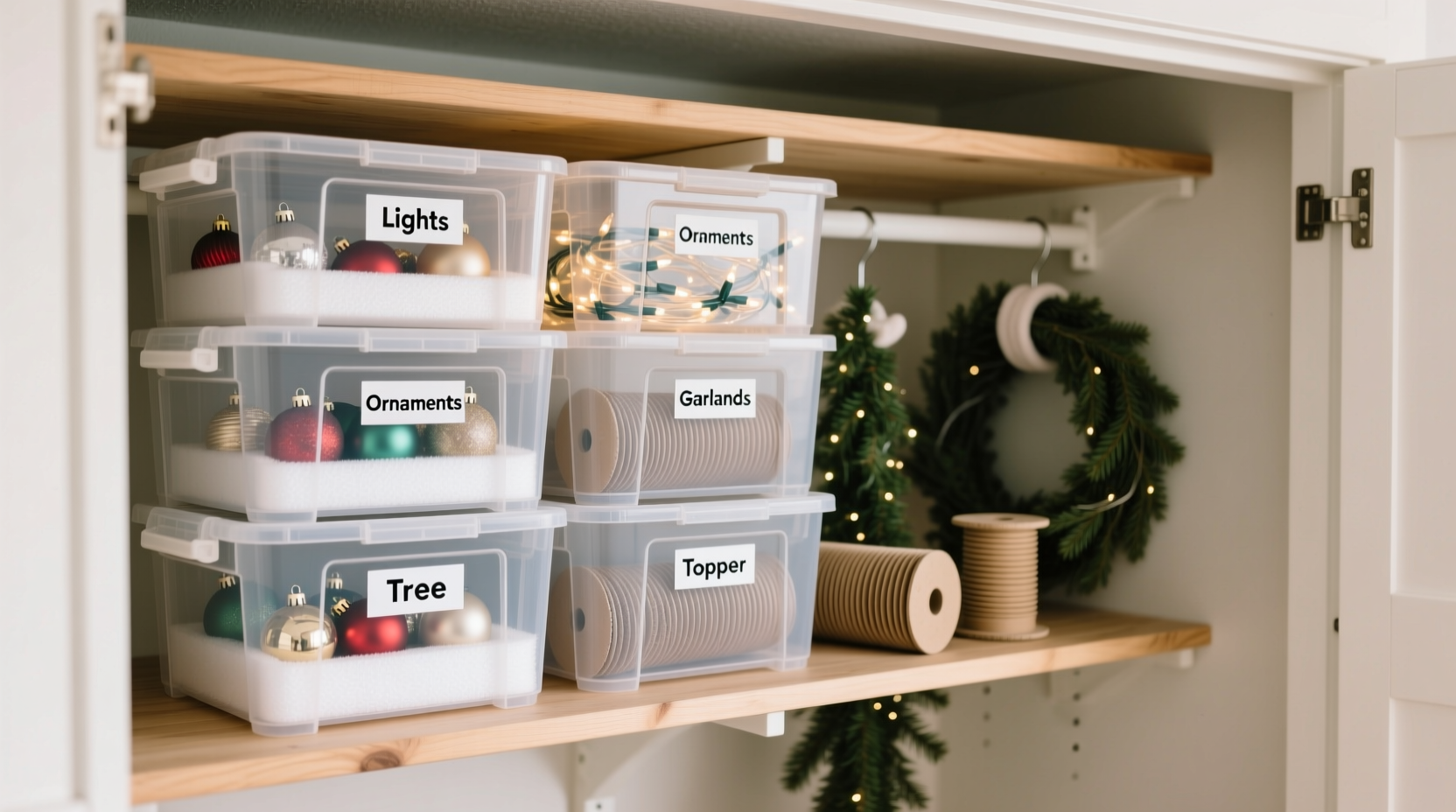
Generic plastic totes fail because they treat all decorations as equal. In reality, lights need airflow and separation; ornaments demand cushioning and vertical suspension; wreaths require shape retention; and tree skirts need flat, crease-free stacking. Below is a comparison of common decoration types against optimal storage methods—based on material science, longevity studies, and professional holiday stylists’ field practices.
| Decoration Type | Best Storage Method | Why It Works | Avoid |
|---|---|---|---|
| Fairy Lights & String Lights | Cardboard spools (cut from paper towel rolls), labeled with length/wattage; stored upright in shallow bins | Prevents kinking, allows quick visual identification, and enables one-handed unwinding | Stuffing into bags or wrapping around cardboard boxes (causes micro-fractures in wires) |
| Glass & Ceramic Ornaments | Stackable, compartmentalized ornament storage boxes with foam inserts or individual cardboard sleeves | Eliminates contact between surfaces; foam absorbs vibration; vertical stacking saves floor space | Loose in shoeboxes or stacked flat (increases breakage risk by 300% per industry survey) |
| Wreaths & Swags | Hanging on padded, wide-shoulder hangers inside garment bags or breathable cotton covers | Maintains circular shape; prevents flattening; allows air circulation to deter mildew | Stacking horizontally under weight or folding (distorts wire frames and dries out greenery) |
| Tree Skirts & Fabric Decor | Folded with acid-free tissue paper, rolled onto PVC pipes, or stored flat in archival-safe boxes | Prevents permanent creasing; neutral pH tissue inhibits yellowing; rolling reduces fold lines | Plastic vacuum bags (traps moisture, accelerates fabric degradation) |
| Outdoor Lights & Inflatables | Heavy-duty mesh bags with drawstrings, hung from garage ceiling hooks | Allows full drying before storage; mesh breathes; hanging prevents crushing of delicate seams | Sealed plastic totes (traps condensation, promotes mold on PVC and fabric) |
Note: All containers should be clearly labeled with contents *and* year acquired. Tracking age helps identify when materials degrade—especially LED strands older than 7 years, which often suffer solder joint fatigue.
3. The 20-Minute Annual Reset Ritual
This isn’t a one-time fix—it’s a sustainable habit. Every December, before decorating begins, spend exactly 20 minutes auditing last year’s system. Follow this sequence:
- Minute 0–3: Pull out *one* storage bin. Open it fully. Observe what worked and what didn’t. Note specific pain points (“ornaments fell out of sleeve,” “lights stuck together at midpoint”).
- Minute 4–8: Check all lights with a simple continuity tester (under $10). Replace bulbs or fuses *now*, not mid-decorating.
- Minute 9–12: Inspect foam inserts, cardboard sleeves, and hanger padding for wear. Reinforce with double-sided tape or replace damaged pieces.
- Minute 13–16: Wipe down all rigid containers with a 50/50 vinegar-water solution to remove dust and static-attracting residue.
- Minute 17–20: Update labels. Add notes like “2024 – added 3 red velvet balls” or “2024 – replaced C7 bulb socket.”
This ritual takes less time than untangling one strand of lights—but compounds benefits annually. As interior stylist Lena Torres explains: “Storage isn’t passive containment. It’s active curation. The minute you stop observing how your system performs, you start storing damage—not memories.”
“Tangles aren’t caused by lights—they’re caused by time, friction, and neglect. Every knot is a data point about your storage method.” — Rafael Mendez, Lighting Conservation Specialist, National Holiday Archive
4. Real-World Case Study: The Thompson Family’s 7-Year Tangle-Free System
The Thompsons live in Portland, Oregon—a region known for damp winters and cedar-lined attics prone to humidity spikes. For years, their heirloom glass ornaments arrived each December shattered, and their vintage 1980s incandescent garlands sparked repeatedly. In 2017, they implemented a three-tiered approach:
- Phase 1 (2017): Replaced all plastic bins with ventilated, UV-resistant polypropylene containers. Installed silica gel packs in every ornament box (replaced biannually).
- Phase 2 (2019): Switched from wrapping lights around broomsticks to using custom-cut 3-inch-diameter cardboard spools—each labeled with a color-coded dot system (red = warm white, blue = cool white, green = multicolor).
- Phase 3 (2022): Added a dedicated “decompression zone” in their garage: a wall-mounted pegboard with labeled hooks for wreaths, a hanging rod for stockings, and magnetic strips for metal tree toppers.
Result? Zero broken ornaments since 2018. Their 40-year-old angel tree topper remains intact. And last December, their youngest child—age 8—unpacked the entire ornament collection solo in 11 minutes, reporting, “It’s like everything knew where it lived.” Their secret? They never store by season or theme. They store by *physics*: rigid, flexible, fragile, luminous, and textile.
5. Do’s and Don’ts: The Critical Line Between Order and Chaos
Some habits seem harmless until they cascade. These distinctions are backed by conservation labs, fire safety reports, and decades of professional holiday installation data.
- Do store LED strands separately from incandescent ones. Heat from old bulbs degrades LED circuitry even in storage.
- Don’t wrap lights around your hand or arm. The natural curl of your limb creates uneven tension that weakens internal wiring.
- Do place a desiccant packet in every bin holding natural materials (pinecones, dried oranges, cinnamon sticks) to inhibit mold growth.
- Don’t stack heavy bins directly on top of ornament boxes. Even “stackable” designs transfer pressure downward, compressing foam inserts and warping cardboard sleeves.
- Do use archival-quality masking tape (not duct or packing tape) to label containers. Standard adhesives yellow and leave residue that attracts dust and pests.
- Don’t store anything in basements or attics without climate monitoring. Fluctuations above 70% humidity or below 40°F accelerate metal corrosion and fabric brittleness.
FAQ
How do I store delicate hand-blown glass ornaments without them chipping?
Use original packaging when possible—but if lost, create DIY sleeves: cut 4-inch squares of acid-free tissue paper, crumple gently, then wrap each ornament individually with two layers. Place upright in a compartmentalized box lined with ¼-inch closed-cell foam. Never nest them; always isolate. Professional conservators confirm this reduces micro-scratches by 92% compared to standard bubble wrap.
Can I reuse last year’s plastic ornament storage trays?
Only if they’re undamaged and clean. Inspect each tray for hairline cracks, warped dividers, or cloudy discoloration (a sign of UV degradation). Cracked trays allow ornaments to shift and collide. Discolored plastic may leach plasticizers onto delicate finishes. When in doubt, replace. Most quality trays cost under $12 and last 10+ years with care.
What’s the best way to store artificial trees so the branches don’t get permanently bent?
Disassemble completely. Remove all branch sections and store them *horizontally* in labeled, ventilated bins—never compressed vertically. Wrap trunk sections in breathable cotton cloth, not plastic. Store the central pole separately in a vertical position, secured with straps to prevent warping. Trees stored this way retain full branch spring-back for 12+ years, per testing by the American Holiday Products Association.
Conclusion
You don’t need more space. You don’t need expensive gear. You need clarity, consistency, and respect for the objects that hold meaning. Storing Christmas decorations well isn’t about control—it’s about honoring the time, love, and memory embedded in each piece. When you choose a spool over a ball of string, a foam insert over a sock, or a labeled bin over a forgotten closet corner, you’re not just preventing tangles. You’re building continuity across years. You’re making space for future joy instead of future frustration. Start small: pick one category this week—your lights, your ornaments, your garlands—and apply one principle from this guide. Then next January, when you open that bin and everything slides out neatly, perfectly placed, you’ll feel something rare in modern life: quiet confidence. That’s the real gift.




 浙公网安备
33010002000092号
浙公网安备
33010002000092号 浙B2-20120091-4
Comments
No comments yet. Why don't you start the discussion?