
Millimeters are among the most commonly used units of length in science, engineering, manufacturing, and daily life. Despite their frequency, incorrect notation—such as improper symbols, spacing, or pluralization—is widespread. Writing millimeters correctly ensures clarity, avoids costly errors, and maintains professionalism across documents, blueprints, and reports. This guide breaks down the proper way to express millimeters using standardized conventions from international measurement systems.
The Basics: What Is a Millimeter?
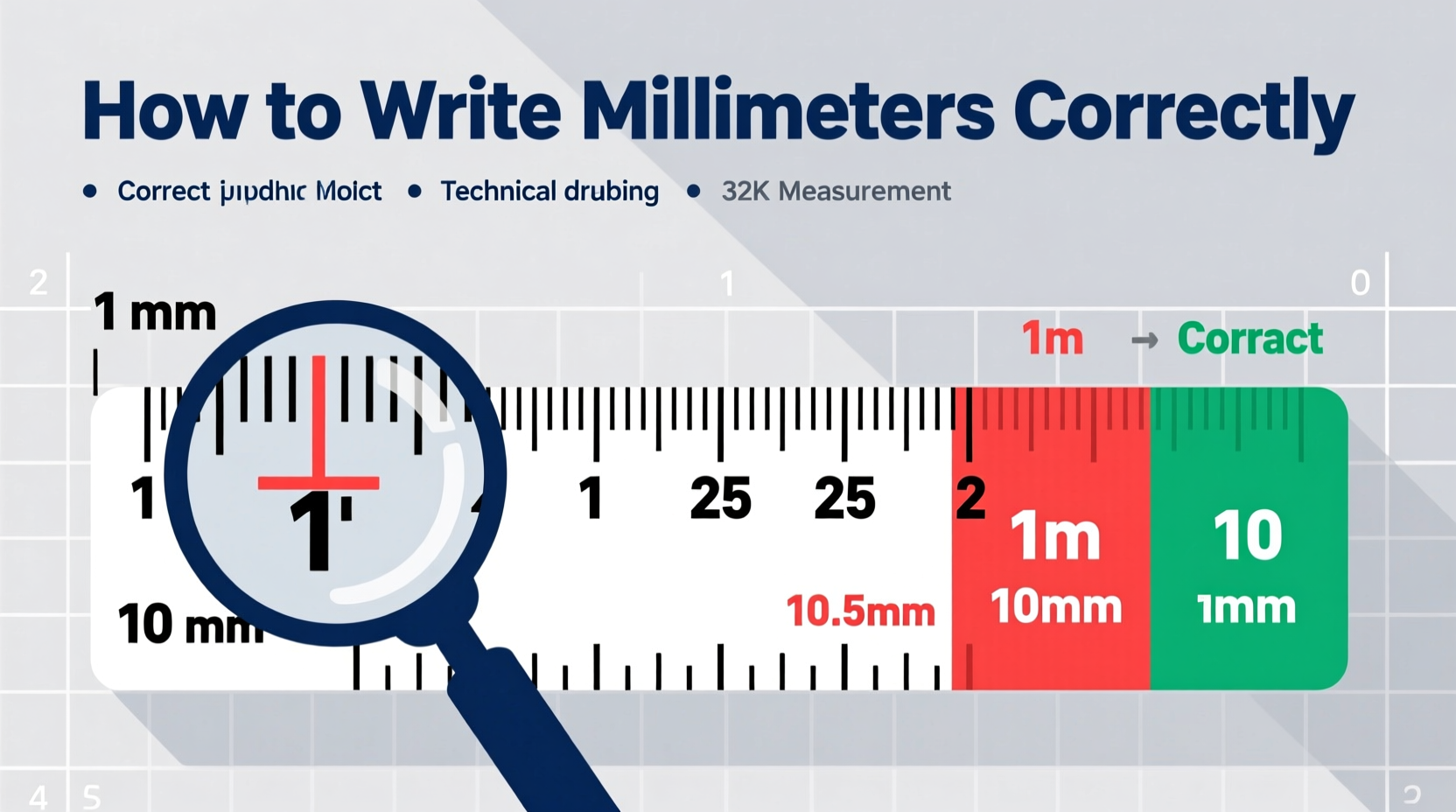
A millimeter (mm) is one-thousandth of a meter, making it a fundamental unit in the metric system. It's widely used for precise measurements where centimeters or meters would be too coarse. From mechanical tolerances to architectural drawings, accurate representation matters—not just in value, but in formatting.
The International System of Units (SI), maintained by the Bureau International des Poids et Mesures (BIPM), provides strict guidelines on how units like millimeters should be written. These standards help prevent ambiguity, especially in global collaboration.
“Consistency in unit notation isn’t about pedantry—it’s about precision. A missing space or wrong case can change meaning.” — Dr. Lena Moreau, Metrology Researcher at NIST
Correct Symbol and Formatting Rules
The correct symbol for millimeter is mm, always in lowercase letters. It follows specific typographic rules established by SI standards:
- Use a lowercase 'm' twice:
mm - No period after \"mm\" unless ending a sentence
- No pluralization: \"5 mm\", not \"5 mms\"
- Always include a space between the number and the unit:
10 mm, not10mm
This spacing rule applies universally across SI units. For example:
| Correct | Incorrect | Reason |
|---|---|---|
| 25 mm | 25mm | Lacks required space |
| 0.75 mm tolerance | .75mm tolerance | Missing zero & space |
| 300 mm × 200 mm | 300x200mm | Poor formatting; ambiguous multiplication |
| 1.5 mm drill bit | 1.5mms drill bit | Units never take an 's' for plural |
Step-by-Step Guide to Writing Millimeters Properly
Follow these steps every time you record or communicate a measurement in millimeters:
- Determine the numerical value: Measure accurately and record the number with appropriate significant figures.
- Add a space: Insert a single space after the number. Example:
12→12 - Append the unit symbol: Type
mmin lowercase without punctuation unless at the end of a sentence. - For dimensions: Use the multiplication symbol (×) when expressing area or volume. E.g.,
150 mm × 100 mm × 25 mm. - In tables or labels: Align units consistently in column headers or footnotes to reduce clutter. Example: Column labeled “Length (mm)” so individual entries only show numbers.
Common Mistakes and How to Avoid Them
Even experienced professionals occasionally slip up. Here are frequent errors and corrections:
- Merging number and unit:
50mm→ Correct:50 mm - Using uppercase:
MMorMm→ These denote megameters or mixed units, not millimeters. - Adding plurals:
10 mms→ Incorrect. The unit remainsmmregardless of quantity. - Using commas as decimal separators in English texts: While common in some countries, use periods in international English:
3.2 mm, not3,2 mm, unless following regional style guides.
##.## mm format.
Real-World Example: Engineering Drawing Error
In 2018, a small manufacturing firm in Germany received a design file specifying a component width of 8.5mm. Due to inconsistent notation throughout the document, the production team misread this as 85 mm during initial setup. The resulting parts were ten times larger than intended, causing delays and material waste exceeding €12,000.
Root cause analysis revealed that while the error stemmed partly from fatigue, the absence of standard spacing (8.5 mm) contributed to visual confusion. After implementing mandatory SI compliance checks—including automated spell/unit checks in drafting software—the company reduced measurement-related rework by 74% over six months.
When Context Changes Notation: Exceptions and Special Cases
While general rules apply broadly, certain fields adapt usage slightly:
- Typography and design: Font sizes may appear as
10ptor12pxwithout spaces due to convention, but millimeter-based layout specs still follow SI rules:5 mm margin. - Medical prescriptions: Rarely use millimeters directly, but imaging reports state lesion sizes as
4 mm, strictly adhering to spacing. - Automotive manuals: Often list torque specs like
25 N·mand thicknesses like3 mm, maintaining consistency across metrics.
In all cases, clarity trumps brevity. Even in informal notes, adopting correct notation builds good habits that pay off in formal work.
Checklist: Writing Millimeters Like a Pro
Before finalizing any document involving measurements, run through this checklist:
- ✅ All instances of \"millimeter\" use the symbol
mm, not spelled out (unless in narrative text) - ✅ There is a space between every number and
mm - ✅ No plural 's' added to
mm - ✅ Lowercase 'm' used—never
MM,Mm, ormm.(with period) - ✅ Dimensions use × instead of x or *:
100 mm × 50 mm - ✅ Decimal points are used appropriately:
0.8 mm, not.8 mm - ✅ Units are consistent within tables and sections
Frequently Asked Questions
Can I write \"millimetre\" instead of \"millimeter\"?
Yes. \"Millimetre\" is the British English spelling, while \"millimeter\" is American. Both refer to the same unit (symbol: mm). Choose based on your audience’s regional preferences, but keep the symbol unchanged.
Do I need to spell out \"millimeters\" in formal writing?
In prose or narrative text, spelling it out is acceptable: “The blade was five millimeters thick.” However, in technical sections, tables, or equations, use the symbol: 5 mm. Consistency within the document is key.
Is it ever okay to skip the space between number and unit?
Almost never in formal or technical communication. Some programming environments or legacy systems may compress notation (e.g., CSS uses 10mm), but human-readable documentation should preserve the space per SI standards.
Final Thoughts: Precision Starts with Notation
Writing millimeters correctly might seem minor, but it reflects attention to detail that defines high-quality technical communication. Whether you're drafting a research paper, creating product specifications, or annotating a DIY project plan, proper notation eliminates guesswork and enhances credibility.
Standards exist not to constrain, but to enable understanding across languages, disciplines, and borders. By writing 10 mm instead of 10mm, you align yourself with a global community committed to accuracy.




 浙公网安备
33010002000092号
浙公网安备
33010002000092号 浙B2-20120091-4
Comments
No comments yet. Why don't you start the discussion?