
As the holiday season approaches, homeowners face a subtle but meaningful design decision: how to best illuminate their homes with festive lighting. Among the most popular choices are icicle lights draped along porch rails and vertical light strands hung from windows—both evoke winter charm, but they deliver very different aesthetic results. While both options can elevate a home’s seasonal presence, one often stands out as more refined, balanced, and enduring in its elegance. The answer isn’t always obvious, and it depends on architectural style, proportion, context, and execution.
Elegance in holiday lighting isn’t about brightness or quantity—it’s about harmony, restraint, and intentionality. This article examines the visual impact, installation nuances, and stylistic strengths of icicle lights on porch rails versus vertical window drops, helping you make an informed choice that enhances your home’s character without overwhelming it.
The Visual Language of Holiday Lighting
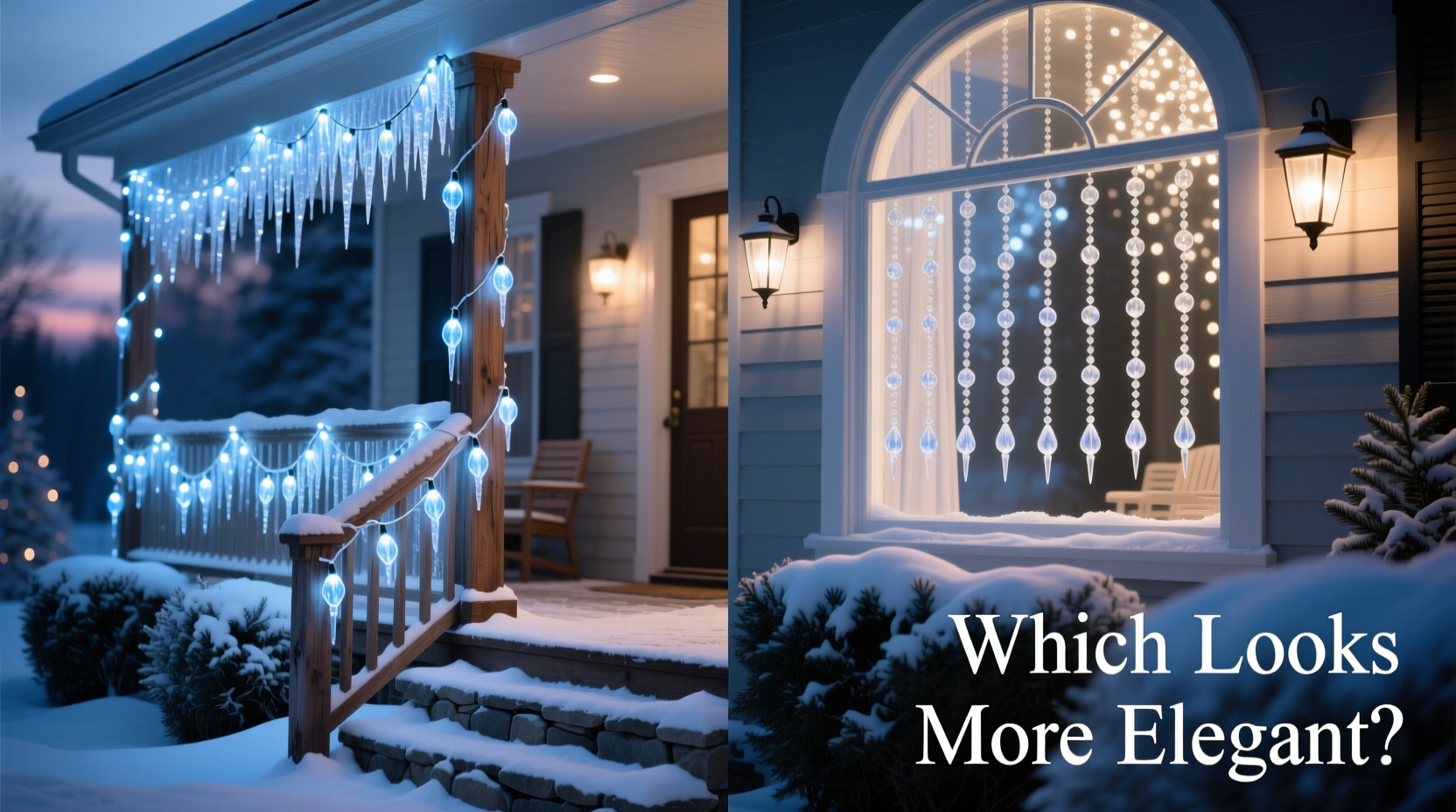
Holiday lights do more than decorate—they shape perception. They frame architecture, draw the eye upward or outward, and influence how a home feels from the street. Icicle lights and vertical drops each speak a different visual language.
Icicle lights, traditionally installed along rooflines, eaves, or porch rails, mimic frozen droplets cascading down. When placed on porch rails, they create a horizontal band of sparkle at ground level. In contrast, vertical window drops are long strands suspended from the top of a window frame, falling straight down like actual icicles. These emphasize height, rhythm, and symmetry.
The distinction matters. Horizontal lighting tends to ground a structure, anchoring it visually. Vertical lighting, however, lifts the eye, adding dimension and suggesting grandeur. For this reason, many designers favor vertical elements when aiming for elegance—vertical lines are classically associated with formality, balance, and architectural dignity.
Design Principles: Proportion, Rhythm, and Focal Points
Elegance emerges from thoughtful composition. Consider three core principles:
- Proportion: Lighting should match the scale of your home. Overloading small porches with dense icicle strands can appear cluttered.
- Rhythm: Repetition creates visual flow. Vertical drops spaced evenly across multiple windows generate a rhythmic cadence.
- Focal Points: Strategic lighting draws attention to architectural features. A centered front door flanked by drops becomes a natural focal point.
When icicle lights are applied to porch rails, they often highlight areas already close to eye level—railings, steps, foundation plantings. While this adds warmth, it risks emphasizing the base of the house rather than its full stature. Unless the porch is deep and architecturally significant, this can make the home feel shorter or heavier.
Vertical window drops, especially on multi-story homes, extend the perceived height of the façade. They align naturally with window mullions and columns, reinforcing existing vertical lines. This alignment with architectural bones is what gives them a more tailored, intentional appearance—closer to interior design than decoration.
“Lighting that follows the lines of the architecture doesn’t just decorate—it reveals the home’s true character.” — Daniel Reeves, Architectural Lighting Designer
Comparative Analysis: Icicle Lights on Porch Rails vs. Vertical Window Drops
| Feature | Icicle Lights on Porch Rails | Vertical Window Drops |
|---|---|---|
| Visual Effect | Grounds the home; cozy, festive | Lifts the eye; formal, elegant |
| Architectural Integration | Low – emphasizes railings over structure | High – complements window lines and symmetry |
| Installation Difficulty | Easy – follows accessible rail lines | Moderate – requires precise spacing and height control |
| Weather Resilience | Good – less exposed to wind | Fair – sways in wind; may tangle |
| Best For | Cottages, ranches, covered porches | Colonials, Victorians, two-story homes |
| Elegance Score (1–10) | 6 | 9 |
The table illustrates a clear trend: vertical window drops score higher in elegance due to superior integration with architectural lines and their ability to enhance verticality. That said, icicle lights on porch rails have their place—particularly in casual, rustic, or cabin-style homes where intimacy trumps formality.
Real-World Example: Two Homes, Two Approaches
Consider two neighboring houses on a quiet suburban street. Both are colonial-style, two-story homes with symmetrical facades and double-hung windows.
House A installs warm white icicle lights along its wraparound porch railing. The effect is cheerful and inviting, especially from the sidewalk. However, because the lights run horizontally at knee-height, the upper floors remain visually dark. The home appears squat, and the lighting draws attention downward—toward damp wood and winter debris near the foundation.
House B opts for vertical window drops on all second-floor windows, using evenly spaced strands of 70-count mini lights. The drops fall cleanly from lintels to sills, creating crisp vertical lines. Paired with a simple outline of the roofline, the result is balanced and refined. From the street, the home glows with quiet sophistication. Neighbors comment that it “looks professionally decorated.”
This case study underscores a key insight: elegance often comes not from more lights, but from better placement. House B didn’t use more bulbs—just more thoughtful ones.
Step-by-Step Guide to Installing Elegant Vertical Window Drops
If you choose vertical drops for their elegance, follow these steps for a polished result:
- Measure window height: Determine drop length (typically 6–9 feet). Allow 6 inches of excess at top and bottom.
- Select uniform strand length: Use pre-lit icicle sets or custom-cut strings to ensure consistency.
- Mark attachment points: Use a laser level or tape measure to mark clips at the top of each window jamb.
- Install mounting clips: Use adhesive-backed or screw-in clips rated for outdoor use.
- Hang strands vertically: Align each drop with the window’s outer edge or center mullion for symmetry.
- Secure bottom ends: Tuck or clip the end near the sill to prevent swaying.
- Connect to power: Use a single extension cord routed discreetly to an outdoor GFCI outlet.
- Test and adjust: Step back and view from the street. Adjust any uneven strands.
For maximum elegance, limit strands to one or two per window and avoid overcrowding. Less is more—especially with light.
When Porch Rail Icicles Work Best
Porch rail installations aren’t inherently inelegant—they simply require the right context. They shine in the following scenarios:
- Deep, columned porches: On homes with prominent porticos or verandas, rail lighting enhances depth and shelter.
- Low-profile homes: Ranches or bungalows benefit from horizontal emphasis, which matches their footprint.
- Layered lighting schemes: When paired with uplighting or tree wraps, porch icicles add texture without dominating.
- Entertainment zones: If your porch is used for gatherings, lighting there improves ambiance and safety.
The key is integration. Icicle lights on a narrow railing of a two-story home rarely look elegant in isolation. But when part of a broader lighting plan—say, combined with subtle roofline accents and pathway markers—they contribute to a cohesive, welcoming display.
Checklist: Choosing the Right Style for Your Home
Use this checklist to determine which option suits your home’s elegance goals:
- ☐ Is your home two stories or taller? → Favors vertical drops
- ☐ Do your windows have strong vertical lines? → Favors vertical drops
- ☐ Is your porch deep and architecturally significant? → Favors rail icicles
- ☐ Are you aiming for a formal, magazine-worthy look? → Favors vertical drops
- ☐ Do you want low-maintenance, easy setup? → Favors rail icicles
- ☐ Is your home symmetrical? → Favors vertical drops for balanced rhythm
- ☐ Will lights be viewed mostly from the street? → Favors vertical drops for visibility
If most of your answers lean toward vertical drops, that’s likely your path to elegance.
FAQ
Can I use both icicle lights on rails and vertical drops?
Yes, but with caution. Combining both can work if done sparingly and with clear hierarchy. For example, use vertical drops as the primary feature and minimal rail lighting as accent. Avoid equal emphasis, which can create visual competition and clutter.
Do vertical window drops damage windows or siding?
Not if installed properly. Use non-damaging clips designed for gutters, trim, or siding. Avoid drilling into vinyl or stucco unless necessary, and never use staples. Adhesive hooks rated for outdoor use are a safe alternative.
Which uses more electricity—rail icicles or window drops?
It depends on total bulb count, not style. However, vertical drops often use fewer strands overall (e.g., one per window) compared to continuous rail runs, potentially saving energy. Always use LED lights to minimize consumption.
Final Verdict: Which Looks More Elegant?
After evaluating proportion, architectural harmony, real-world examples, and expert insight, the conclusion is clear: vertical window drops generally appear more elegant than icicle lights on porch rails.
They respect the vertical language of traditional architecture, create rhythm and balance, and elevate the home’s presence. When executed with precision, they convey thoughtfulness and refinement—qualities at the heart of elegance.
Icicle lights on porch rails have charm and accessibility, but they often serve a decorative rather than architectural role. They’re excellent for cheer, but less effective at conveying sophistication.
That said, elegance is not one-size-fits-all. On a sprawling farmhouse porch or a craftsman bungalow with wide stoops, rail lighting can be perfectly appropriate—and even elegant in context. The goal is alignment: between lighting, architecture, and intent.
Conclusion: Illuminate with Intention
The difference between ordinary and elegant holiday lighting lies in intention. It’s not about how many strings you hang, but where and why. Vertical window drops win in most cases because they align with timeless design principles—symmetry, proportion, and vertical emphasis.
Before installing a single bulb, step outside and study your home’s lines. Where does the eye naturally travel? What features deserve emphasis? Let architecture guide your lights, not the other way around.




 浙公网安备
33010002000092号
浙公网安备
33010002000092号 浙B2-20120091-4
Comments
No comments yet. Why don't you start the discussion?