
For iPhone users clinging to the iPhone XS Max, the allure of newer models often hinges on one critical feature: the camera. Apple marketed the iPhone 11 Pro Max as a significant leap in mobile photography, especially compared to its predecessor. But does that leap justify upgrading from the already capable XS Max? The answer depends on how you use your phone and what kind of photos matter most to you.
The XS Max, released in 2018, featured a dual-camera system with 12MP wide and telephoto lenses. It delivered excellent dynamic range, accurate color reproduction, and solid portrait mode results. Two years later, the iPhone 11 Pro Max introduced a third ultra-wide lens, Night Mode, improved low-light performance, and computational photography enhancements. On paper, the upgrade seems compelling. In practice, the value varies by user.
Camera Hardware: Triple vs Dual Lenses
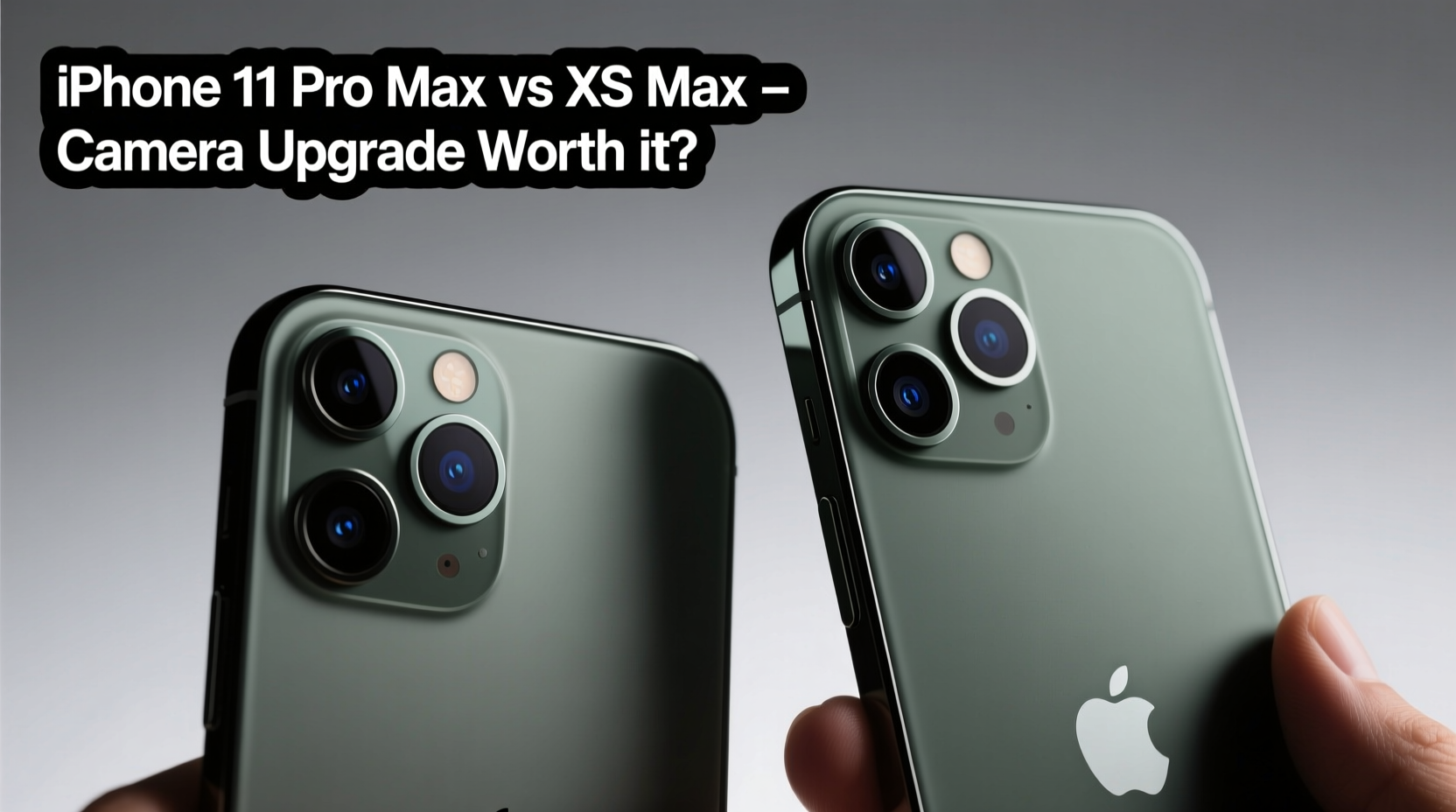
The most visible difference between the two phones is the addition of a third lens on the 11 Pro Max. While the XS Max offers a 12MP wide (f/1.8) and 12MP telephoto (f/2.4), the 11 Pro Max adds a 12MP ultra-wide (f/2.4) to the mix. This gives users more creative flexibility—especially in tight spaces or when capturing expansive landscapes.
The ultra-wide lens opens up new framing possibilities. Real estate photographers can capture entire rooms without stepping back; travelers can fit more of a monument into a single shot. However, this lens has limitations: it lacks optical image stabilization and performs poorly in low light due to its f/2.4 aperture. Still, for daytime shooting, it’s a game-changer.
“The shift to triple cameras wasn’t just about specs—it was about empowering users to shoot like professionals without carrying extra gear.” — David Kim, Mobile Photography Analyst at TechLens
Low-Light Performance and Night Mode
This is where the 11 Pro Max pulls decisively ahead. The XS Max struggles in dim environments, often producing grainy images with lost detail. The 11 Pro Max introduces Night Mode—a computational photography feature that uses multi-frame exposure stacking to brighten dark scenes while preserving color and texture.
Night Mode automatically activates when lighting is low, typically below 10 lux. It requires the user to hold still for 1–3 seconds, but the results are striking. Street signs become legible, facial features remain defined, and ambient lighting is rendered naturally. For anyone who frequently takes photos at night—dining out, city walks, concerts—this feature alone may justify the upgrade.
The 11 Pro Max also benefits from larger sensor pixels and improved sensor-shift stabilization on the wide lens, contributing to better noise control and dynamic range in challenging conditions.
Zoom and Portrait Capabilities
Both phones offer 2x optical zoom via their telephoto lenses, but the 11 Pro Max improves digital zoom thanks to higher-resolution input from all three sensors. At 4x digital zoom, the 11 Pro Max maintains more detail than the XS Max, which tends to soften earlier.
Portrait mode sees subtle but meaningful upgrades. The 11 Pro Max uses machine learning to better detect edges—especially around glasses, hair, and complex textures. It also allows adjustable bokeh strength after capture, a feature absent on the XS Max. Additionally, Night Mode now works in Portrait mode, letting users take well-lit portraits in darkness—an impossible task on the older device.
| Feature | iPhone XS Max | iPhone 11 Pro Max |
|---|---|---|
| Lens Configuration | Dual: Wide + Telephoto | Triple: Wide + Telephoto + Ultra-Wide |
| Night Mode | No | Yes (Wide & Portrait) |
| Max Digital Zoom (Good Quality) | ~4x | ~10x |
| Aperture (Main Sensor) | f/1.8 | f/1.8 (larger sensor) |
| Portrait Bokeh Adjustment | No | Yes (post-capture) |
| Low-Light Video | Moderate noise, soft detail | Cleaner, brighter, stabilized |
Real-World Example: A Travel Photographer’s Dilemma
Consider Sarah, a travel blogger using her XS Max for content creation. On a trip to Kyoto, she visits a traditional temple at dusk. With the XS Max, her shots are underexposed, requiring heavy editing that introduces noise. She misses the warm glow of lanterns reflecting off wooden beams.
A year later, on a return visit with the 11 Pro Max, she enables Night Mode. The resulting photo captures rich textures in the woodwork, balanced exposure across shadows and highlights, and natural color tones. She posts it to Instagram with minimal editing—and gains double her usual engagement.
For Sarah, the upgrade wasn’t about megapixels. It was about capturing moments authentically, even when lighting isn’t ideal. Her workflow became faster, her output more consistent, and her audience more engaged.
When the Upgrade Makes Sense
Not every user will benefit equally from the camera improvements. Consider these scenarios:
- You shoot in low light regularly: If you dine out, attend evening events, or walk cities at night, Night Mode is transformative.
- You value versatility: The ultra-wide lens lets you capture more without moving—ideal for architecture, group shots, or tight interiors.
- You edit photos professionally: The 11 Pro Max shoots in Smart HDR, delivering greater dynamic range and shadow recovery in post-processing.
- You record video: The 11 Pro Max supports 4K at 60fps with extended dynamic range and better stabilization across all lenses.
Checklist: Should You Upgrade?
- Are you frequently disappointed by blurry or dark photos at night? → Yes = Strong reason to upgrade.
- Do you wish you could step back further—or get closer—without losing quality? → Yes = Ultra-wide and improved zoom help.
- Do you rely on your phone for professional or semi-professional content? → Yes = Computational photography advantages add up.
- Is your XS Max still performing well otherwise? → Yes = Consider holding on unless camera is a top priority.
- Can you notice the difference in sample photos side-by-side? → No = You may not appreciate the upgrade enough to justify cost.
Frequently Asked Questions
Does the iPhone 11 Pro Max have better front camera quality?
Yes. The 11 Pro Max features a 12MP TrueDepth front camera with support for 4K video and slow-motion (1080p at 120fps), compared to the XS Max’s 7MP front shooter limited to 1080p at 60fps. Selfie detail and low-light performance are noticeably improved.
Can the XS Max be updated to use Night Mode?
No. Night Mode relies on both advanced hardware (larger sensor, faster ISP) and neural engine processing unavailable on the XS Max, even with iOS updates. It is exclusive to iPhone 11 and later models.
Is the video quality significantly better on the 11 Pro Max?
Yes. The 11 Pro Max offers extended dynamic range for video up to 60fps (vs 30fps on XS Max), stereo recording, and better stabilization, especially on the ultra-wide lens. For vloggers and creators, the improvement is tangible.
Conclusion: Is the Camera Upgrade Worth It?
If your primary motivation for upgrading is photography, the iPhone 11 Pro Max delivers meaningful advancements over the XS Max. The addition of Night Mode, the ultra-wide lens, improved zoom, and smarter HDR processing collectively enhance both convenience and creative potential. For casual users who mostly shoot in daylight, the difference may feel incremental. But for those who push their phones in challenging conditions—or simply want the best possible photo with zero effort—the upgrade pays off.
The camera isn’t just a tool for capturing moments; it shapes how we experience them. With the 11 Pro Max, fewer moments are lost to poor lighting or limited perspective. If your memories deserve better clarity, richer detail, and truer colors—even after sunset—the answer is clear.




 浙公网安备
33010002000092号
浙公网安备
33010002000092号 浙B2-20120091-4
Comments
No comments yet. Why don't you start the discussion?