
The Samsung Galaxy Note 9 was a flagship powerhouse in 2018—offering top-tier specs, the iconic S Pen, and a premium design. Fast forward to today, and many long-time Note 9 users are wondering whether making the leap to the iPhone 11 is a smart move. While both devices were leaders in their time, the shift from Android to iOS involves more than just hardware—it’s about ecosystem, longevity, user experience, and future-proofing. This deep dive compares key aspects of both phones to help you determine if the upgrade is truly worth it.
Performance and Longevity: A Shift in Processing Power
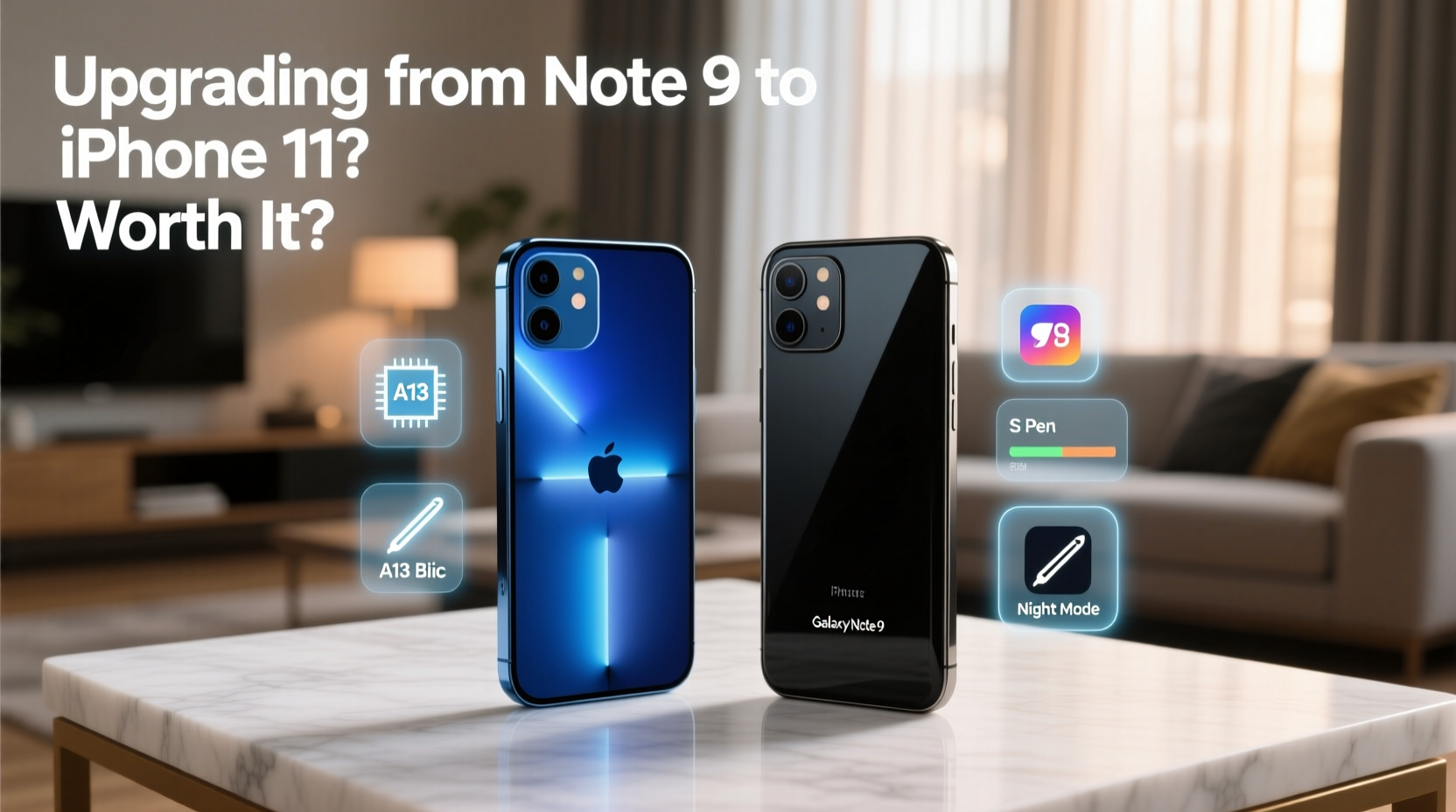
The Galaxy Note 9 launched with either the Exynos 9810 or Snapdragon 845 chipset (depending on region), paired with up to 8GB of RAM. At the time, it handled multitasking, gaming, and productivity with ease. However, by 2023, Samsung ended major OS updates for the Note 9, limiting it to Android 10. Security patches have also ceased, making continued use less secure over time.
In contrast, the iPhone 11, released in 2019, runs on Apple’s A13 Bionic chip—an architecture that still performs impressively in 2024. Despite being a year newer, the iPhone 11 benefits from Apple’s aggressive software support policy. It shipped with iOS 13 and is eligible for updates up to iOS 17, meaning it receives security patches and feature enhancements nearly five years after release.
The A13 Bionic’s efficiency and optimization within iOS mean smoother animations, faster app launches, and better battery management under load. For users who rely on their phone daily for work, communication, and media, this sustained performance makes the iPhone 11 a more future-ready device than the aging Note 9.
Camera Comparison: Evolution in Photography
The Note 9 featured a capable dual-camera system: 12MP wide and telephoto lenses with variable aperture (f/1.5–f/2.4). It excelled in low light and offered reliable zoom up to 2x optical and 10x digital. However, image processing has advanced significantly since 2018.
The iPhone 11 introduced Apple’s next-generation computational photography. With its dual 12MP system—wide and ultra-wide lenses—it captures more scene data, leverages Smart HDR, and uses Deep Fusion for superior texture and detail in mid-to-low light. The ultra-wide lens adds creative flexibility, letting users capture landscapes or group shots previously impossible on the Note 9.
Videography is where the iPhone 11 pulls far ahead. It supports 4K video at 60fps across all lenses, extended dynamic range, and advanced stabilization. The Note 9 maxes out at 4K@30fps without the same level of post-processing or stabilization. If you create content or value high-quality video, the iPhone 11 is a substantial upgrade.
“Smartphone photography isn’t just about megapixels anymore—it’s about how the hardware and software work together. Apple leads in computational imaging.” — David Kim, Mobile Imaging Analyst at TechLens
Ecosystem and Software Experience
One of the most significant factors in upgrading from the Note 9 to the iPhone 11 isn’t the phone itself—it’s the ecosystem. If you’re already invested in Google services, Samsung DeX, or use a Windows PC, switching to iOS requires adjustment. But if you own other Apple devices—a MacBook, iPad, or Apple Watch—the integration becomes a compelling advantage.
iOS offers seamless continuity features like Handoff, Universal Clipboard, iMessage syncing, and AirDrop between Apple devices. iCloud provides automatic photo backup, document sync, and Find My network integration. Messages, FaceTime, and Apple’s privacy-first approach appeal to users prioritizing security and cross-device harmony.
On the flip side, the Note 9 offered unique tools like the S Pen for note-taking, screen-off memos, and DeX mode, turning your phone into a desktop-like interface. These features remain unmatched on iPhone. However, if you no longer rely on stylus input or desktop extension, their absence may not be a dealbreaker.
Design, Display, and Usability
The Note 9 sports a 6.4-inch Quad HD+ Super AMOLED display with a traditional 18.5:9 aspect ratio and a physical fingerprint sensor below the camera module. Its curved glass and metal frame feel premium, but the thick bezels and forehead/chin areas appear dated compared to modern designs.
The iPhone 11 features a 6.1-inch Liquid Retina LCD (not OLED), which lacks the deep blacks and contrast of the Note 9’s screen. However, Apple’s color accuracy, brightness, and True Tone technology make it highly usable in various lighting conditions. The notch houses Face ID, replacing the fingerprint sensor with facial recognition—a faster and more secure method for most users.
Build-wise, the iPhone 11 introduced improved water resistance (IP68, same as Note 9) and better drop performance thanks to its aerospace-grade aluminum and glass design. Battery life is slightly better on the iPhone 11, offering up to 17 hours of video playback versus the Note 9’s 13–14 hours in real-world mixed use.
- Mini Case Study: Sarah, Graphic Designer & Note 9 User
- Sarah used her Note 9 for sketching ideas with the S Pen and managing client emails. After switching to an iPhone 11, she missed the stylus initially but adapted using an Apple Pencil on her iPad. She gained instant access to her MacBook via iCloud, began using AirPods seamlessly, and appreciated the consistent camera quality for client photo reviews. “The ecosystem made up for losing the S Pen,” she says.
Detailed Feature Comparison
| Feature | Galaxy Note 9 | iPhone 11 |
|---|---|---|
| Release Year | 2018 | 2019 |
| Chipset | Snapdragon 845 / Exynos 9810 | A13 Bionic |
| RAM | 6GB / 8GB | 4GB |
| Storage Options | 128GB / 512GB (expandable) | 64GB / 128GB / 256GB (non-expandable) |
| Rear Cameras | 12MP (wide) + 12MP (telephoto) | 12MP (wide) + 12MP (ultra-wide) |
| Front Camera | 8MP | 12MP (supports 4K video) |
| Display | 6.4” QHD+ Super AMOLED | 6.1” Liquid Retina LCD |
| Battery | 4,000 mAh | 3,110 mAh (but more efficient) |
| Software Support | Ended (Android 10) | Ongoing (iOS 17 supported) |
| Unique Features | S Pen, DeX, expandable storage | Face ID, Night mode, U1 chip, longer update cycle |
Checklist: Is Upgrading Worth It?
Use this checklist to evaluate your personal upgrade potential:
- ✅ Are you still satisfied with your Note 9’s performance in daily tasks?
- ✅ Do you miss recent camera features like Night mode or ultra-wide shots?
- ✅ Are you concerned about security due to lack of updates?
- ✅ Do you own other Apple devices (Mac, iPad, Watch)?
- ✅ Do you value longer software support and resale value?
- ✅ Can you live without the S Pen and microSD card slot?
If you answered “no” to the first three and “yes” to the last three, the iPhone 11 likely offers meaningful improvements.
Frequently Asked Questions
Can I transfer my data from Galaxy Note 9 to iPhone 11 easily?
Yes. Apple provides the “Move to iOS” app on the Google Play Store, which securely transfers contacts, messages, photos, calendars, and free apps from your Android device during initial setup.
Will my accessories work with the iPhone 11?
Most Bluetooth headphones and chargers will work. However, Samsung-specific accessories like DeX docks or S Pen tips won’t be compatible. You’ll need Lightning cables instead of USB-C.
Is the iPhone 11 waterproof like the Note 9?
Both phones have an IP68 rating, meaning they can survive submersion in up to 2 meters of water for 30 minutes. Real-world protection is similar, though neither should be submerged intentionally.
Final Verdict: Should You Upgrade?
Upgrading from the Galaxy Note 9 to the iPhone 11 isn’t just about newer hardware—it’s about entering a tightly integrated ecosystem with long-term software support, superior computational photography, and stronger resale value. While you lose the S Pen and expandable storage, you gain reliability, security, and a smoother overall experience.
If your Note 9 is showing signs of slowdown, battery degradation, or app incompatibility, the iPhone 11 represents a logical next step—especially if you value peace of mind through regular updates and seamless device integration.




 浙公网安备
33010002000092号
浙公网安备
33010002000092号 浙B2-20120091-4
Comments
No comments yet. Why don't you start the discussion?