
In 2024, smartphone photography has reached a point where even seasoned photographers pause before reaching for their DSLRs. The iPhone 12 Pro, released in 2020, was once seen as a capable but limited alternative to professional gear. Yet, four years later—with advances in computational photography, AI processing, and widespread high-resolution display consumption—the question arises: has the iPhone 12 Pro, or smartphones in general, truly replaced larger cameras like DSLRs?
The answer isn’t binary. While smartphones have closed the gap in many real-world scenarios, they still face fundamental limitations due to physics and sensor size. This article breaks down the current state of play, comparing the iPhone 12 Pro against traditional DSLRs across key performance metrics, use cases, and creative demands.
Image Quality: Sensor Size vs. Computational Magic
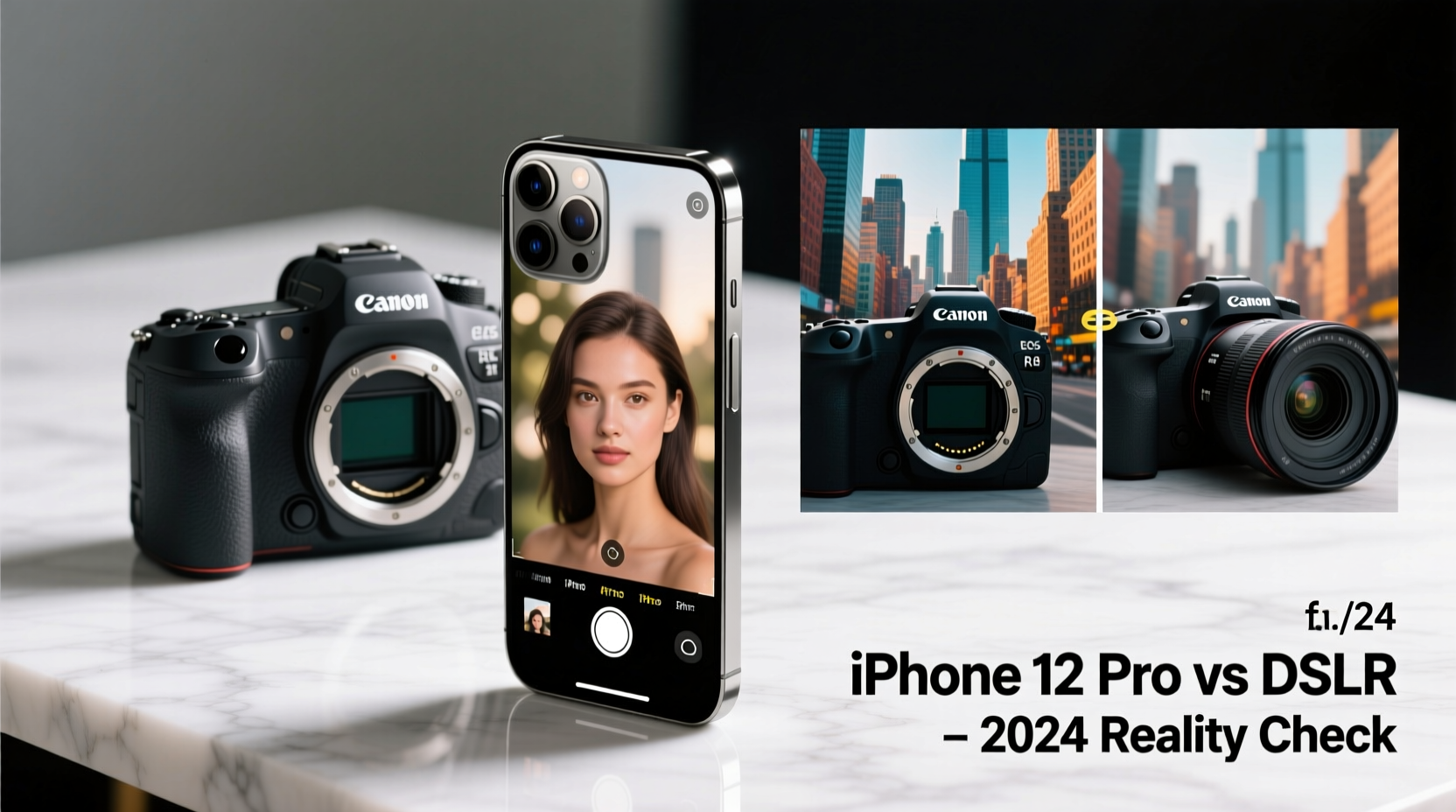
At the heart of any camera is its sensor. DSLRs typically feature APS-C or full-frame sensors measuring 22–36mm wide. In contrast, the iPhone 12 Pro’s main sensor is just over 7mm diagonally. That physical difference means DSLRs capture significantly more light, resulting in superior dynamic range, lower noise in low light, and greater detail in shadows and highlights.
However, Apple compensates with computational photography. Features like Deep Fusion, Smart HDR 3, and Night mode stack multiple exposures, adjust tone mapping per pixel, and reduce noise algorithmically. In daylight or well-lit indoor scenes, the iPhone 12 Pro produces images that are not only sharp and color-accurate but often more immediately pleasing than unprocessed DSLR shots.
But under challenging lighting—such as dim restaurants or backlit landscapes—the iPhone struggles. Even with Night mode, it can’t match the clean, high-fidelity output of a DSLR at ISO 1600 or higher. Highlights blow out faster, and shadow recovery introduces grain.
Lens Flexibility and Optical Limitations
DSLRs offer interchangeable lenses—wide-angle, telephoto, macro, prime, zoom—allowing photographers to adapt instantly to any subject. The iPhone 12 Pro comes with three rear cameras: 12MP ultra-wide, wide, and telephoto (2x optical zoom). While this setup covers common focal lengths, it lacks true optical flexibility.
The telephoto lens maxes out at 2x magnification. Beyond that, digital zoom degrades quality quickly. Meanwhile, DSLR users can attach a 100-400mm lens for wildlife or sports without sacrificing resolution. Similarly, macro photography on DSLRs with dedicated lenses achieves far greater detail and depth control than the iPhone’s close-focus workaround.
Additionally, DSLRs allow manual aperture control, enabling selective focus effects (shallow depth of field) that are physically impossible on the tiny iPhone sensor—even with Portrait Mode simulations.
“Smartphones excel at convenience and consistency, but they don’t offer creative freedom. You’re limited by what Apple decides the camera should do.” — Lena Torres, Professional Photojournalist
Video Capabilities: Where the iPhone Shines
When it comes to video, the iPhone 12 Pro holds surprising ground. It records 4K at up to 60fps with Dolby Vision HDR, a feature most consumer DSLRs still lack. The stabilization—both optical and sensor-shift—is exceptional, making handheld footage smooth and cinematic.
DSLRs, while capable of high-quality video, often require external microphones, gimbals, and log profiles to achieve comparable results. The iPhone integrates all of this into one compact device with minimal setup.
For vloggers, social media creators, or indie filmmakers needing fast turnaround, the iPhone 12 Pro offers a streamlined workflow. Clips edit seamlessly in apps like iMovie or Final Cut Pro, and sharing is instantaneous.
Yet, professionals still prefer DSLRs (or mirrorless equivalents) for long-form production. Reasons include better overheating management, longer recording times, interchangeable lenses, XLR audio support, and greater bit depth for color grading.
Workflow and Real-World Usability
The biggest advantage of the iPhone 12 Pro isn’t image specs—it’s integration. Photos are automatically backed up to iCloud, tagged with location and AI-powered recognition, and shareable in seconds. There’s no need for memory card transfers, file sorting, or curation software unless desired.
DSLR workflows remain fragmented. Transferring files, managing RAW formats, editing in Lightroom or Capture One—all add time and technical overhead. For casual shooters or busy creatives, this friction makes smartphones the default choice.
Moreover, the iPhone doubles as a communication, planning, and editing tool. Need to send a proof to a client? Done. Want to apply filters or tweak exposure on the spot? Possible. DSLRs, despite Wi-Fi capabilities, lag behind in seamless connectivity.
Checklist: When to Choose iPhone 12 Pro vs DSLR
- Choose iPhone 12 Pro if:
- You prioritize speed and convenience
- Your content goes directly to social media
- You shoot mostly in daylight or moderate lighting
- You want built-in stabilization and audio
- You value portability and always having a camera
- Choose DSLR if:
- You need maximum image fidelity and dynamic range
- You shoot in low light frequently
- You require telephoto, macro, or specialty lenses
- You shoot professionally or print large formats
- You want full manual control over every parameter
Detailed Comparison Table: iPhone 12 Pro vs Entry-Level DSLR (Canon EOS 90D)
| Feature | iPhone 12 Pro | Canon EOS 90D (DSLR) |
|---|---|---|
| Sensor Size | ~7mm diagonal (1/1.55\") | APS-C (22.3 x 14.9mm) |
| Resolution | 12MP (main) | 32.5MP |
| Low-Light Performance | Fair (with Night mode) | Excellent (ISO 100–25600 expandable) |
| Zoom (Optical) | 2x (telephoto), 0.5x (ultra-wide) | Depends on lens (e.g., 70–300mm = 4.3x) |
| Video Recording | 4K@60fps, Dolby Vision HDR | 4K@30fps (no crop), no HDR video |
| Interchangeable Lenses | No | Yes (EF-S mount) |
| Manual Controls | Limited (via third-party apps) | Full (shutter, aperture, ISO, focus) |
| Battery Life (approx.) | 12–15 hours (mixed use) | ~800 shots per charge |
| File Format | HEIF/JPEG, ProRAW (limited) | RAW + JPEG |
| Portability | Extremely high | Moderate (body + lenses) |
Real-World Example: Travel Photography in Kyoto, 2024
Consider travel photographer Mark Chen, who visited Kyoto in early 2024. He brought both his Canon 90D with a 24-105mm lens and his iPhone 12 Pro. His goal: document temples, street food, and cultural moments for Instagram and a personal blog.
During temple visits, he used the DSLR to capture high-dynamic-range interiors with rich textures and accurate colors. But when wandering Nishiki Market, the iPhone became his go-to. It slipped into his pocket, started recording instantly, and captured candid moments without drawing attention.
He posted daily Instagram Stories from the iPhone, edited on-device with presets. Later, he selected a few DSLR shots for his portfolio website, where resolution and tonal depth mattered more.
His takeaway: “The iPhone handled 70% of my shooting needs. But the 30% done with the DSLR made the difference between good content and standout work.”
FAQ
Can the iPhone 12 Pro replace a DSLR for professional photography?
Not fully. While it excels in editorial, documentary, or social-first contexts, it lacks the resolution, dynamic range, and lens versatility required for commercial, wedding, or fine art photography. Some niche pros use iPhones successfully, but they remain exceptions.
Is ProRAW on the iPhone 12 Pro a game-changer?
It helps. ProRAW combines Apple’s computational processing with editable RAW data, giving more post-processing flexibility. However, the small sensor limits how much you can recover shadows or adjust white balance compared to DSLR RAW files.
Will future iPhones eliminate the need for DSLRs?
Unlikely. While computational photography will keep improving, physics constrains smartphone sensors. DSLRs—and modern mirrorless cameras—are also evolving. The two will likely coexist, serving different tiers of creators.
Conclusion: Coexistence, Not Replacement
The iPhone 12 Pro hasn’t replaced the DSLR—but it has redefined what “good enough” means for most people. For everyday photography, content creation, and rapid storytelling, the iPhone is not just sufficient; it’s often superior in workflow and immediacy.
DSLRs remain essential for those who demand the highest image quality, creative control, and adaptability. They are tools for craft, not convenience. The average user may never need one. But for professionals and enthusiasts, they’re still irreplaceable.
Rather than viewing them as competitors, think of the iPhone and DSLR as complementary tools. One fits in your pocket and connects to the world instantly. The other captures reality with unmatched fidelity. In 2024, the smartest photographers use both—choosing the right tool for the moment.




 浙公网安备
33010002000092号
浙公网安备
33010002000092号 浙B2-20120091-4
Comments
No comments yet. Why don't you start the discussion?