
In the mid-2010s, switching between iOS and Android wasn’t just about brand preference—it was a fundamental shift in user experience. For many consumers, the choice came down to devices like the Apple iPhone 5s and the Samsung Galaxy Core Prime. Released within months of each other—September 2013 for the iPhone 5s and November 2014 for the Galaxy Core Prime—these phones represented entry-level access to smartphones at the time. But nearly a decade later, how do they stack up against each other? And more importantly, for someone upgrading from an iPhone 5s to a Galaxy Core Prime back then, was that move truly an upgrade—or a lateral shift with compromises?
This analysis dives into hardware, software longevity, app ecosystem support, and real-world usability to determine whether the Galaxy Core Prime offered meaningful improvements over the iPhone 5s or simply traded one set of limitations for another.
Hardware Comparison: Specs Tell Half the Story
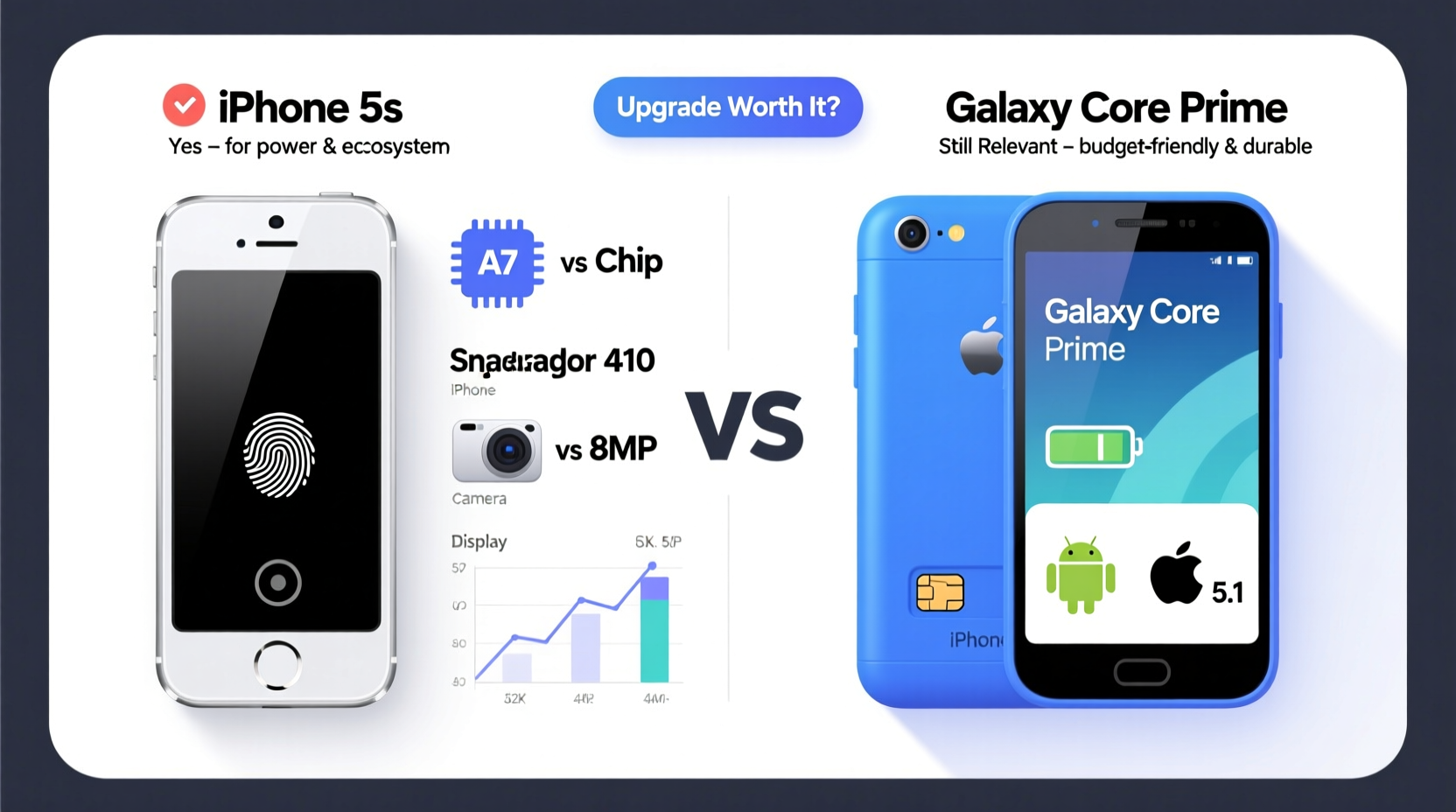
The iPhone 5s was a landmark device in Apple’s lineup. It introduced the Touch ID fingerprint sensor, featured the first 64-bit mobile processor (the A7 chip), and had a refined aluminum unibody design. In contrast, the Galaxy Core Prime targeted budget-conscious buyers with modest specs: a 1.2GHz quad-core processor, 1GB RAM, and 8GB storage expandable via microSD.
On paper, the iPhone 5s outperformed the Core Prime in processing power and build quality. However, raw performance isn’t the only factor when assessing real-world use.
| Feature | iPhone 5s | Galaxy Core Prime |
|---|---|---|
| Release Date | September 2013 | November 2014 |
| Processor | Apple A7 (64-bit) | Qualcomm Snapdragon 410 (1.2 GHz quad-core) |
| RAM | 1GB | 1GB |
| Storage Options | 16/32/64GB (non-expandable) | 8GB (expandable via microSD) |
| Display | 4.0\" Retina (1136x640) | 4.5\" TFT (480x800) |
| Camera (Rear) | 8MP, f/2.4 | 5MP, no flash |
| Battery Capacity | 1440 mAh | 2000 mAh |
| Operating System | iOS 7 (upgradable to iOS 12) | Android 4.4.4 (KitKat), up to Android 5.1) |
| Weight | 112g | 132g |
While the Core Prime offered a slightly larger screen and bigger battery, its lower-resolution display and weaker camera suggest it prioritized affordability over quality. The iPhone 5s, despite being older, had superior component integration and optimization typical of Apple’s vertical design approach.
Software & Longevity: Where the Divide Widens
One area where the iPhone 5s clearly wins is long-term software support. Apple provided updates for the iPhone 5s all the way up to iOS 12, released in 2018—five years after launch. This meant users could continue accessing modern security patches, updated apps, and new features far longer than typical Android devices of the era.
Samsung, on the other hand, supported the Galaxy Core Prime with only minor updates beyond Android 5.1 Lollipop. By 2016, most mainstream apps began dropping compatibility due to outdated OS versions. Google Play Store eventually stopped supporting KitKat in key areas, severely limiting functionality.
“iOS devices from this generation received twice as many official updates compared to their Android counterparts, even budget iPhones.” — David Lin, Mobile Ecosystem Analyst
For users relying on banking apps, social media, or messaging platforms, this lack of update support quickly made the Core Prime feel obsolete—even if the hardware still powered on.
Real-World User Experience: A Mini Case Study
Consider Maria, a teacher in Manila who upgraded from her aging iPhone 5s to a Galaxy Core Prime in early 2015. Her goal was simple: better battery life and expandable storage for storing lesson plans and student photos.
Initially, she appreciated the extra 560mAh battery and the ability to add a 32GB microSD card. She could finally keep WhatsApp, Facebook, and a music library without constant deletion. However, by late 2016, frustrations mounted. Instagram stopped loading properly. Gmail became sluggish. Even basic Chrome browsing triggered frequent crashes.
She found herself unable to install newer versions of educational apps required by her school district. Meanwhile, her colleague still using an iPhone 5s (on iOS 10) had full access to updated tools until 2019.
Maria’s experience reflects a broader trend: short-term gains in flexibility were offset by rapid obsolescence due to limited software support.
Was the Upgrade Worth It? A Step-by-Step Evaluation
To determine whether moving from the iPhone 5s to the Galaxy Core Prime was justified, consider these steps:
- Assess your primary needs: Were you seeking longer battery, more storage, or a larger screen? The Core Prime delivered here.
- Evaluate app dependency: Did you rely on modern apps requiring current OS versions? If yes, the iPhone 5s remained viable longer.
- Consider future-proofing: The iPhone 5s continued receiving updates until 2018; the Core Prime’s useful life ended around 2016.
- Weigh ecosystem loyalty: Switching from iOS to Android meant re-purchasing apps, re-syncing data, and learning a new interface.
- Factor in resale and repair: iPhone 5s units retained higher resale value and had more third-party repair options globally.
For users needing immediate relief from storage limits or poor battery, the Core Prime offered tangible benefits. But for those valuing stability, security, and multi-year usability, staying with the iPhone 5s—or waiting for a more capable Android device—would have been wiser.
Frequently Asked Questions
Can the Galaxy Core Prime run modern apps today?
No. With a maximum OS of Android 5.1, most current apps—including WhatsApp, YouTube, and banking apps—no longer support the device. Even lightweight browsers struggle with modern web standards.
Is the iPhone 5s still usable in 2024?
Limitedly. While it can make calls, send texts, and use offline apps, it cannot update beyond iOS 12. Safari lacks support for many modern websites, and app developers no longer optimize for such old systems. It functions best as a backup or emergency phone.
Why did Samsung provide fewer updates than Apple?
Unlike Apple’s tightly controlled ecosystem, Samsung relies on carrier approvals and fragmented hardware drivers across regions. Combined with lower priority for budget models, this results in shorter update cycles—often just 1–2 years of major OS upgrades.
Final Verdict: A Trade-Off, Not a True Upgrade
The Galaxy Core Prime wasn’t so much an upgrade from the iPhone 5s as it was a pivot toward different trade-offs. It offered physical advantages—larger screen, removable battery, expandable storage—but sacrificed long-term reliability, software support, and overall polish.
The iPhone 5s, though smaller and less flexible in storage, benefited from Apple’s commitment to backward compatibility and tighter app ecosystem control. Its optimized hardware-software integration allowed it to remain functional and secure years longer than similarly specced Android devices.
In hindsight, unless the user specifically needed microSD expansion or dual-SIM capability (available in some regional variants), the move to the Core Prime likely shortened their effective smartphone lifespan rather than extending it.
Conclusion: Learn From the Past, Choose Smarter Today
The iPhone 5s vs Galaxy Core Prime debate underscores a timeless truth in tech: specs don’t tell the whole story. Real value lies in sustained usability, security updates, and ecosystem continuity. While the Core Prime may have seemed like a practical step forward in 2014, its rapid decline highlights the risks of choosing budget hardware over long-term viability.
If you're navigating similar decisions today—whether between legacy devices or modern budget models—remember Maria’s story. Ask not just what the phone can do now, but how long it will keep doing it well.




 浙公网安备
33010002000092号
浙公网安备
33010002000092号 浙B2-20120091-4
Comments
No comments yet. Why don't you start the discussion?