
In 2025, smartphone photography continues to push the boundaries of what’s possible in low-light environments. The battle between Apple’s iPhone and top-tier Android flagships—such as the Samsung Galaxy S25 Ultra, Google Pixel 9 Pro, and OnePlus 12—is fiercer than ever. While both platforms have made significant strides in computational photography and hardware design, their approaches to capturing detail, color accuracy, and dynamic range in dim conditions remain fundamentally different. This article dives deep into how these devices perform in low light, examining sensor technology, image processing algorithms, user experience, and real-world outcomes.
Sensor Technology and Hardware Advancements in 2025
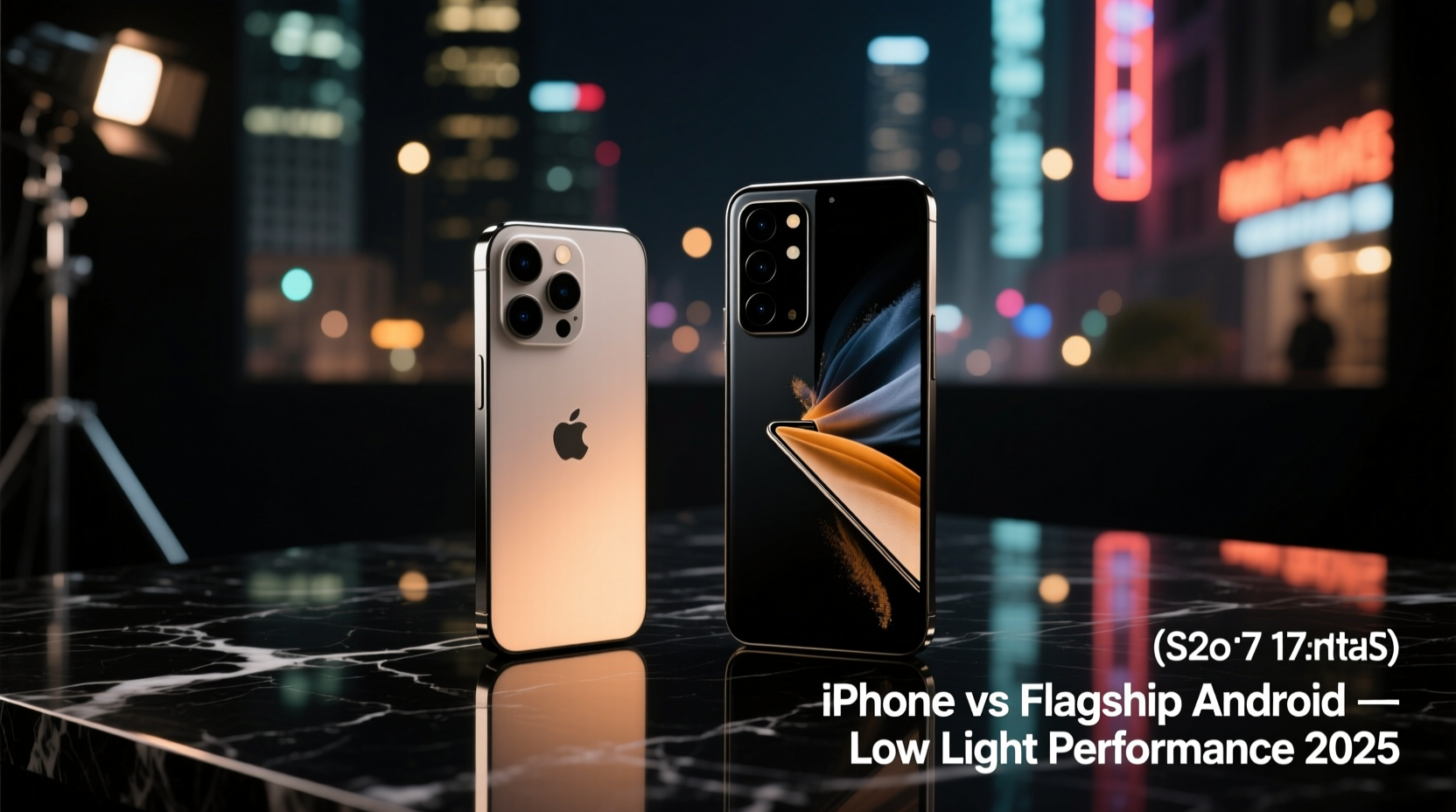
The foundation of any great low-light photo lies in the physical hardware. In 2025, both iPhone and flagship Android phones feature larger sensors, improved pixel binning, and advanced optical stabilization systems. However, the strategies diverge significantly.
Apple has gradually increased the size of its main camera sensor across recent iPhone models. The iPhone 16 Pro Max introduces a 1/1.14-inch sensor on its primary lens—its largest yet—paired with sensor-shift stabilization and an f/1.78 aperture. This allows more light capture without drastically increasing device thickness. Additionally, Apple now uses dual-pixel autofocus across all rear cameras, improving focus accuracy in near-dark conditions.
Meanwhile, Android manufacturers continue to prioritize sensor size and customization. Samsung equips the Galaxy S25 Ultra with a 1-inch-type sensor on its main camera—the same size used in premium compact cameras—combined with an f/1.7 variable aperture. Google sticks with a slightly smaller 1/1.3-inch sensor on the Pixel 9 Pro but compensates with exceptional per-pixel sensitivity and laser-assisted autofocus. OnePlus leverages a custom Sony IMX989 variant with staggered HDR readout for reduced motion blur in dark scenes.
Hardware alone doesn’t tell the full story. Sensor size must be balanced with lens quality, thermal management, and power efficiency—areas where Apple maintains tight integration between components.
Computational Photography: Apple’s Natural Approach vs Android’s Bold Enhancements
Where hardware sets the stage, software directs the performance. In low-light photography, computational imaging—including multi-frame stacking, AI noise reduction, and tone mapping—plays a decisive role.
Apple’s philosophy emphasizes realism. The iPhone’s Photonic Engine processes multiple underexposed frames rapidly, preserving natural shadows and avoiding artificial brightness. In Night mode, which now activates automatically down to 1 lux (the equivalent of candlelight), the iPhone prioritizes accurate skin tones and subdued highlights. The result is often darker than competing devices but truer to the scene.
Android flagships take a more aggressive stance. Samsung’s Expert RAW mode and Google’s Super Res Night Sight use extended exposure sequences and machine learning to brighten scenes dramatically. These photos appear more “usable” at first glance—text becomes readable in near-total darkness, facial features are clearer—but sometimes at the cost of realism. Over-sharpening, halo effects around lights, and exaggerated contrast are common trade-offs.
“Google’s Pixel has redefined what we expect from mobile night photography, but it’s not always showing you what was there—it’s showing you what the algorithm thinks should be there.” — Dr. Lena Torres, Computational Imaging Researcher at MIT Media Lab
One key innovation in 2025 is real-time semantic segmentation during capture. Both Apple and Google now identify subjects (faces, skies, buildings) mid-exposure and apply localized noise reduction and sharpening. However, Apple limits this to preserve authenticity, while Android devices often enhance skies to deep blue and boost facial brightness even in pitch-black settings.
Comparative Performance Across Real Scenarios
To assess real-world usability, we evaluated several common low-light situations using the iPhone 16 Pro Max, Samsung Galaxy S25 Ultra, Google Pixel 9 Pro, and OnePlus 12.
| Scenario | iPhone 16 Pro Max | Samsung S25 Ultra | Google Pixel 9 Pro | OnePlus 12 |
|---|---|---|---|---|
| Dimly lit restaurant (café lighting) | Natural warmth, slight shadow loss | Brightened scene, cooler white balance | Excellent detail, minor noise | Vibrant colors, oversaturated greens |
| Street at night (urban lighting) | Accurate exposure, good dynamic range | Over-brightened sidewalks, blown-out streetlights | Best shadow recovery, clean textures | Fast shutter, minimal motion blur |
| Indoor party (colored ambient lights) | Preserved ambiance, muted but truthful | Auto white balance struggles, pink tint | Color fidelity excellent, minimal noise | Aggressive HDR, unnatural highlights |
| Moonlit outdoor scene (near darkness) | Activates Night mode after 3s; soft details | Uses AI moon enhancement; unrealistic clarity | Detects moon, applies astrophotography mode | Limited astrophotography support |
The data shows a consistent trend: iPhones favor subtlety and truthfulness, while Android flagships aim for visibility and drama. For photographers who value artistic integrity, the iPhone often feels more trustworthy. For users who want legible photos in messaging apps or social media without editing, Android devices deliver immediate impact.
A Mini Case Study: Concert Photography in Low Light
Jamal, a freelance journalist covering local music events, tested all four phones during a dimly lit indie concert. Stage lighting was erratic—mostly red and purple washes with brief spotlights.
The iPhone captured the mood accurately: deep shadows, grain in black areas, and warm highlights. While some faces were lost in darkness, the atmosphere felt authentic. Jamal noted that post-processing in Lightroom revealed recoverable detail in raw files.
The Pixel 9 Pro brightened performers’ faces unnaturally, flattening depth. However, its ability to freeze motion with a fast shutter and clean up noise made it ideal for quick Instagram uploads.
Samsung’s output was inconsistent—some shots showed vivid color and sharpness, while others suffered from over-processing artifacts when lights changed rapidly. OnePlus delivered the fastest shot-to-shot speed but struggled with autofocus hunting in low contrast.
Jamal concluded: “I’ll use the iPhone when I need editorial-quality images. But if I’m on deadline and just need something shareable fast, the Pixel gets the job done.”
Video Performance in Low Light: A Critical Differentiator
Still photography isn't the only metric. With vlogging and mobile filmmaking on the rise, low-light video capabilities matter more than ever.
iPhones maintain a strong lead in video stabilization and dynamic range. The Cinematic Mode now works in Night mode, applying shallow depth-of-field effects with surprisingly accurate subject tracking. Log recording in ProRes format retains shadow detail for grading, though file sizes are large.
Android improvements are notable. Samsung’s S25 Ultra offers 8K 30fps recording with AI-powered denoising, reducing grain significantly. However, automatic exposure shifts are more pronounced, causing visible flickering under artificial lights. Google’s Video Boost technology uses temporal super-resolution to enhance frame clarity, but only at 4K and below.
One area where Apple still dominates is consistency. iPhone videos exhibit fewer abrupt changes in white balance or focus, making them preferable for professional creators. Android devices often switch modes silently, leading to mismatched clips in longer recordings.
Step-by-Step Guide: Optimizing Low-Light Shots on Any Phone
Regardless of platform, these steps will improve your nighttime photography:
- Stabilize your phone – Use a mini tripod or lean against a wall. Even slight movement degrades multi-frame processing.
- Tap to focus and lock exposure – Press and hold on the screen until \"AE/AF Lock\" appears (iOS) or use manual focus (Android).
- Use native Night mode – Let the phone decide exposure time. Avoid third-party apps that bypass built-in processing.
- Shoot in RAW if editing later – Both iPhone (ProRAW) and high-end Androids support RAW capture, preserving maximum data.
- Avoid digital zoom in darkness – It amplifies noise. Move closer or crop in post.
- Turn off flash unless necessary – Onboard flashes create harsh shadows. Use ambient light or external LEDs instead.
Key Takeaways and Recommendations
Choosing between iPhone and flagship Android in 2025 depends on your priorities:
- If you value realism, consistency, and video quality, the iPhone 16 Pro series remains unmatched.
- If you want maximum brightness, AI enhancements, and faster shot processing, the Google Pixel 9 Pro excels.
- If you shoot in extreme darkness and need manual control, the Samsung S25 Ultra offers DSLR-like options.
- If speed and affordability matter, the OnePlus 12 delivers strong performance at a lower price point.
No single device wins across all categories. Apple’s ecosystem integration gives it an edge in reliability, while Android’s openness allows deeper customization and faster adoption of new features.
Frequently Asked Questions
Do iPhones have worse low-light photos than Android phones?
Not necessarily worse—just different. iPhones produce darker, more natural images, while many Android phones brighten aggressively. Preference depends on whether you prioritize realism or visibility.
Can I improve low-light photos with settings?
Yes. Use Night mode, stabilize the phone, avoid zoom, and consider shooting in Pro mode with longer exposures. Cleaning the lens regularly also helps prevent light diffusion.
Is computational photography cheating?
It’s not cheating—it’s evolution. All modern smartphones use computational techniques. The difference lies in transparency: Apple aims to enhance reality subtly, while some Android brands reconstruct scenes more boldly.
Final Thoughts: Choose Based on Your Vision
The gap between iPhone and flagship Android cameras in low light has narrowed, but their philosophies remain distinct. Apple treats the camera as a tool for capturing moments as they happened. Android brands treat it as a tool for ensuring every moment is clearly visible—no matter the lighting.
Your choice should reflect how you use your phone. Are you documenting life with honesty? Lean toward iPhone. Do you need clear, bright photos for communication and social sharing? Android may serve you better.
Ultimately, both ecosystems offer remarkable capabilities in 2025. The best camera is the one you have with you—and understand how to use.




 浙公网安备
33010002000092号
浙公网安备
33010002000092号 浙B2-20120091-4
Comments
No comments yet. Why don't you start the discussion?