
When planning a party, one small detail can make a big difference: having enough ice. Running out halfway through an event means scrambling to buy more bags from the store—often at inflated prices—or serving lukewarm drinks. Countertop ice makers promise a solution: continuous ice production with minimal effort. But they also occupy valuable kitchen real estate. So, is investing in a countertop ice maker truly worthwhile for entertaining, or does the convenience come at the cost of clutter?
The answer depends on your lifestyle, kitchen layout, hosting frequency, and expectations for guest experience. This article breaks down the pros and cons, compares models, shares real-world use cases, and helps you decide whether a countertop ice maker earns its place in your home.
How Countertop Ice Makers Work
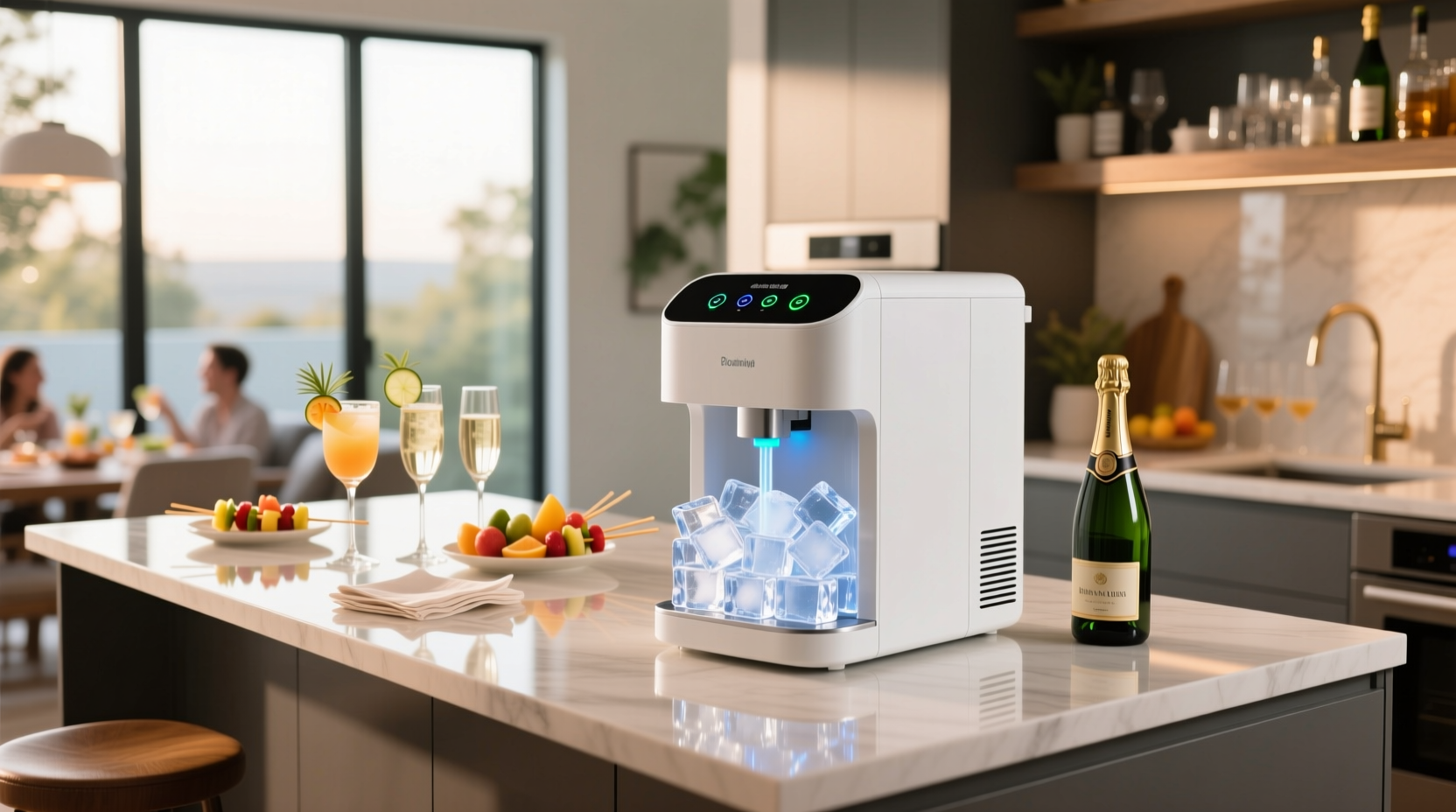
Unlike built-in under-counter units or freezer-mounted dispensers, countertop ice makers are standalone appliances that connect only to power and water (some require manual filling; others can be plumbed). They produce ice quickly—typically 20 to 50 pounds per day—using internal reservoirs and compact freezing systems. Most generate bullet-shaped or crescent cubes in cycles lasting 6 to 15 minutes.
These machines don’t store large quantities. Instead, they’re designed for rapid turnover: make ice, transfer it to a cooler or bucket, and keep producing more. Some models include a basket or bin that holds up to 2–3 pounds before needing to be emptied. Because they lack long-term freezing capabilities, they aren't replacements for freezers but rather supplements during high-demand periods.
Benefits of a Countertop Ice Maker for Parties
For frequent hosts, the advantages of a countertop ice maker go beyond convenience—they enhance the overall flow and quality of social gatherings.
- Instant supply without trips to the store: No more last-minute runs for $7 bags of ice. With a machine on hand, you're always prepared.
- Faster chilling of beverages: Large batches of cocktails, punches, or lemonade cool faster with abundant ice, preserving flavor and texture.
- Improved drink presentation: Clearer, consistently shaped ice elevates cocktails compared to cloudy, irregular store-bought cubes.
- Reduced freezer dependency: Frees up space in your main freezer for food instead of ice trays or bulky bags.
- Time savings during prep: While guests arrive, your ice maker runs autonomously, reducing pre-event stress.
According to hospitality expert Marcus Tran, “In professional settings, consistent ice availability separates a good host from a great one. Guests notice when drinks are properly chilled—and they remember the ones that aren’t.”
“In home entertaining, reliability matters just as much as ambiance. A countertop ice maker gives you control over one of the most overlooked yet critical elements: temperature.” — Marcus Tran, Beverage Service Consultant
Spatial Considerations: How Much Room Do They Really Take?
A standard countertop ice maker measures approximately 13–15 inches wide, 10–12 inches deep, and 12–14 inches tall. That’s roughly the footprint of a toaster oven—but unlike a toaster, it may sit unused for days or weeks between events.
If your kitchen has limited counter space, dedicating a permanent zone for an ice maker requires trade-offs. Will it displace your coffee station? Block cabinet access? Interfere with workflow near the sink?
However, many modern designs prioritize compactness and portability. Units like the Nugget Ice Maker by GE Opal or Costway Portable Ice Maker are engineered for easy storage. You can tuck them behind the fridge, slide them into a pantry, or wheel them out only when needed. For renters or those in small apartments, this flexibility makes a big difference.
| Model Type | Footprint (inches) | Ice Output per Day | Storage Notes |
|---|---|---|---|
| Compact Portable (e.g., Costway) | 13 x 11 x 13 | 26 lbs | Lightweight; easy to move |
| Mid-Size Crescent Cube (e.g., Kold-Draft K5) | 14 x 12 x 14 | 35 lbs | Bulkier; needs stable surface |
| Nugget Ice (e.g., Opal 2.0) | 14 x 13 x 15 | 24 hrs capacity: ~1 lb/hour | Chic design; often left out |
| Luxury Built-In Ready (e.g., Scotsman CU50PA) | 15 x 15 x 16 | 50+ lbs | Heavy; semi-permanent placement |
One homeowner in Austin, Texas, shared her experience: “I host monthly wine-and-cocktail nights. Before getting a portable ice maker, I’d spend hours freezing trays and hauling bags from the garage. Now, I store the unit in a closet and roll it out two hours before guests arrive. It takes five minutes to set up, and within 30 minutes, I have all the ice I need. The temporary footprint is worth the payoff.”
Step-by-Step Guide: Using a Countertop Ice Maker for a Party
Maximizing your ice maker’s utility starts well before the first guest rings the doorbell. Follow this timeline to ensure smooth operation:
- One Week Before: Clean the unit thoroughly. Run two cycles with vinegar solution to remove mineral buildup, then rinse with clean water.
- Two Days Before: Check water filter (if applicable) and replace if overdue. Ensure the area near your outlet and sink is clear.
- Day Of – 3 Hours Prior: Position the ice maker on a dry, level surface near a power source. Fill the reservoir or connect to a water line.
- 2 Hours Before Guests Arrive: Start the machine. Allow time for initial cycle completion and discard the first batch (recommended by manufacturers).
- 1 Hour Before: Begin transferring ice to insulated coolers or metal buckets lined with towels to slow melting.
- During the Event: Monitor output. Empty the basket every 30–45 minutes to prevent overflow. Keep spare containers nearby.
- After the Party: Turn off and unplug. Drain remaining water. Wipe down exterior and leave lid open for ventilation.
When a Countertop Ice Maker Isn’t Worth It
Despite their appeal, these appliances aren’t ideal for everyone. Consider skipping one if:
- You entertain less than four times a year.
- Your kitchen counters are already overcrowded with essential appliances.
- You have a full-size refrigerator with a built-in ice maker and dispenser.
- Water hardness in your area leads to rapid scaling, requiring constant maintenance.
- Budget is tight—the average price ranges from $150 to $500, with premium nugget models exceeding $600.
In such cases, buying bagged ice remains more practical. At $5–$8 per 10-pound bag, even a large gathering rarely exceeds $20 in ice costs. Compare that to the upfront investment and ongoing electricity usage (typically 100–200 watts per hour), and the math may not justify ownership.
Checklist: Should You Buy a Countertop Ice Maker?
Use this checklist to evaluate your specific needs:
- ☐ Do you host parties, BBQs, or cocktail events more than four times a year?
- ☐ Is running out of ice during events a recurring problem?
- ☐ Do you serve drinks that require large amounts of ice (e.g., punch bowls, frozen cocktails)?
- ☐ Can you dedicate temporary or permanent space on your countertop or in a nearby storage area?
- ☐ Are you willing to perform monthly cleaning and descaling?
- ☐ Does your current freezer struggle to keep up with ice demand?
- ☐ Would owning one reduce stress and improve your hosting experience?
If you answered “yes” to four or more, a countertop ice maker likely offers tangible value.
FAQ
Can I leave my countertop ice maker on all the time?
Most manufacturers advise against leaving the unit powered continuously when not in active use. While some models have auto-shutoff features, prolonged operation without harvesting ice can lead to clumping, motor strain, or mold growth. It’s best to run it only during events or preparation windows.
Do countertop ice makers make clear ice?
Generally, no. Due to rapid freezing methods and hard water exposure, most produce cloudy or slightly opaque cubes. For crystal-clear ice, dedicated slow-freeze systems (like the Luma Comfort IM200SS) or boiled/distilled water can help—but results vary. True clarity usually requires commercial-grade equipment.
How noisy are they during operation?
Noise levels range from 40 to 60 decibels—similar to a refrigerator hum or light conversation. While not disruptive in outdoor or loud environments, they may be noticeable in quiet indoor spaces. Place the unit away from seating areas if noise sensitivity is a concern.
Real Example: Hosting a Summer Backyard Bash
Jamila, a marketing executive in Denver, throws an annual July 4th cookout for 40 friends and family. In past years, she relied on three 10-pound bags of store-bought ice. By mid-afternoon, the coolers were half-melted, drinks were tepid, and refills meant another grocery run.
Last year, she invested in a mid-range crescent cube ice maker ($220). She set it up early in the morning on a folding table near the patio. Over six hours, it produced over 30 pounds of fresh ice. She used it to replenish drink stations every 90 minutes and even made ice cones for kids’ slushies.
“It paid for itself in sanity,” she said. “No more tracking ice levels obsessively. I could focus on grilling and talking to guests instead of playing bartender-janitor. And yes, it took space—but it was temporary, and the guests loved watching it work.”
Conclusion: Balancing Convenience and Space
A countertop ice maker isn’t a universal necessity—but for regular hosts, it’s a game-changer. The ability to generate ice on demand transforms how you prepare for and manage events. No more guessing how many bags to buy, no more melted messes, and no last-minute panic.
Yes, it occupies counter space. But that space doesn’t have to be permanent. Treat the ice maker like any seasonal appliance—a waffle iron in winter, a blender for smoothie season—and store it strategically when idle. When used wisely, the convenience far outweighs the footprint.
If you value seamless entertaining, beverage quality, and time efficiency, a countertop ice maker is absolutely worth it. Evaluate your habits, measure your space, and choose a model that fits both your kitchen and your lifestyle. The next time you hear laughter around a perfectly chilled punch bowl, you’ll know the small machine on the counter played a big role.




 浙公网安备
33010002000092号
浙公网安备
33010002000092号 浙B2-20120091-4
Comments
No comments yet. Why don't you start the discussion?