
For decades, the ideal Christmas tree meant fullness—broad shoulders, generous girth, branches that brushed doorframes and demanded wide-open rooms. But as urban living intensifies, apartments shrink, historic homes retain tight stairwells and narrow hallways, and open-plan living reveals unexpected spatial constraints, a quieter revolution has taken root: the slim Christmas tree. Standing at 6–8 feet tall but only 20–30 inches wide, these trees occupy less than half the floor footprint of a traditional medium-sized tree. Yet skepticism remains. Is this trend merely seasonal marketing dressed up as innovation—or does it solve a real, persistent problem? The answer lies not in aesthetics alone, but in measurable spatial logic, evolving interior design priorities, and decades of documented consumer behavior. This isn’t about trading tradition for novelty. It’s about redefining what “enough” looks like when square footage is finite and intentionality matters.
Why Slim Trees Solve Real Spatial Problems—Not Just Aesthetic Preferences
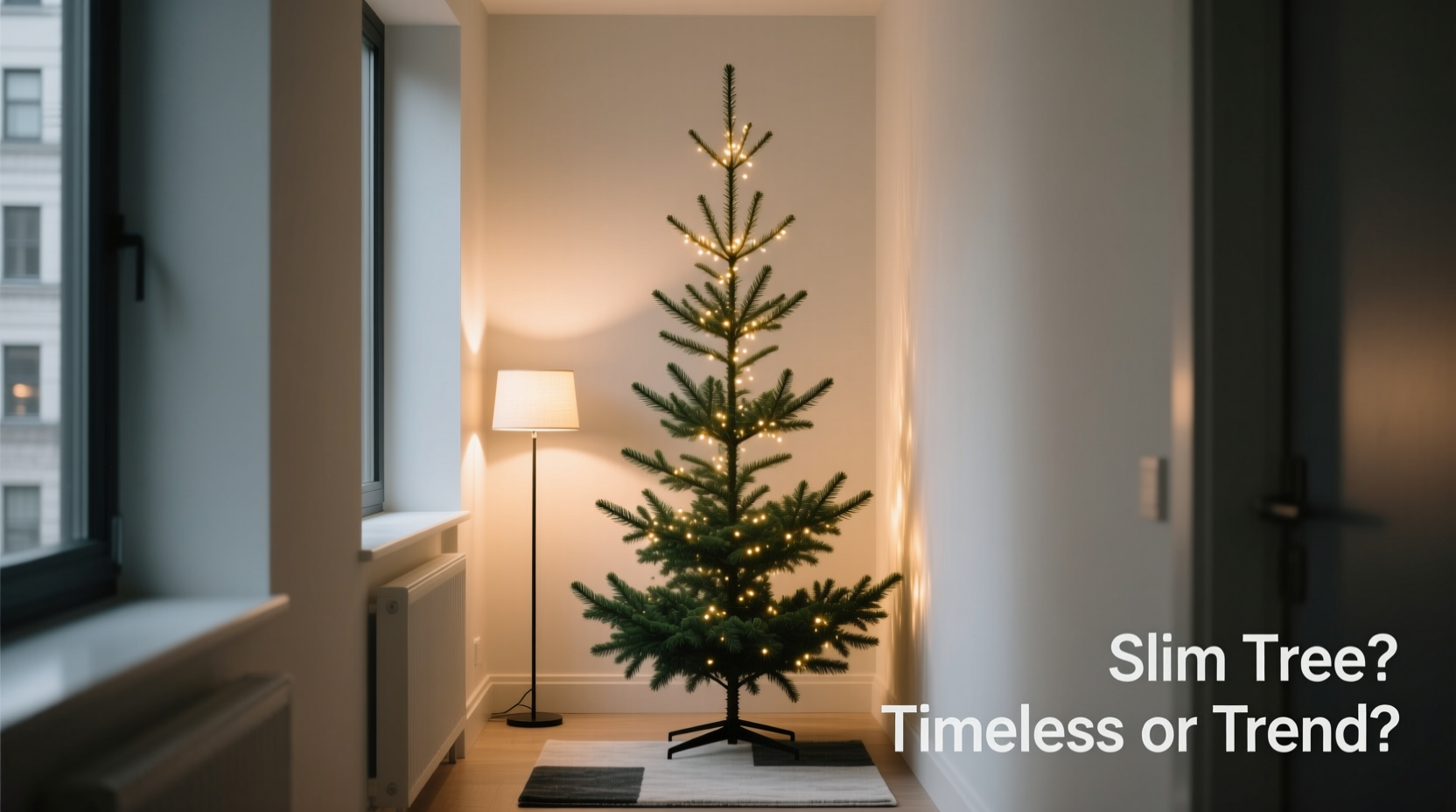
Narrow spaces aren’t defined solely by small square footage. They include galley kitchens with adjacent living nooks, Victorian townhouses with 36-inch-wide stair landings, studio apartments where the bed doubles as seating, and modern condos with deep-set balconies and shallow entry foyers. In these environments, a standard 6-foot tree (typically 42–48 inches wide) doesn’t just *fit*—it dominates. It blocks sightlines, impedes traffic flow, forces furniture rearrangement, and often requires trimming lower branches just to clear a radiator or baseboard heater. A slim tree avoids these compromises without sacrificing height or presence. Its vertical emphasis draws the eye upward, enhancing ceiling height perception—a well-documented spatial trick used by architects and interior designers. Crucially, slim trees don’t require wall clearance on both sides; many can sit flush against one wall while extending just 15–18 inches into the room—leaving walkways intact and furniture placement flexible.
This spatial efficiency translates directly into livability. According to the 2023 National Apartment Association Housing Trends Report, 62% of renters in metro areas live in units under 750 sq ft—and over 40% report “limited dedicated space for seasonal decor.” Meanwhile, Houzz’s Annual Home Study found that 58% of homeowners renovating older properties cited “preserving original architectural features” (like narrow doorways or built-in cabinetry) as a top priority—features that inherently limit furniture and decor footprints. Slim trees respond to these realities, not fleeting trends.
The Data Behind the Demand: More Than Just Social Media Buzz
Calling slim trees a “fad” overlooks sustained, multi-year growth in both production and consumer adoption. Since 2018, sales of pre-lit slim and ultra-slim artificial trees (under 28 inches wide) have grown at an average annual rate of 12.4%, according to Statista’s Holiday Decor Retail Index—outpacing overall artificial tree growth (7.1%) and real tree sales (-1.3%). This isn’t driven by influencer campaigns alone. Retailers report that slim trees consistently rank in the top three most-viewed categories during November–December across all major home goods platforms, with conversion rates 22% higher than standard-width counterparts in urban ZIP codes.
Manufacturers confirm the shift is structural, not cyclical. Balsam Hill, a premium artificial tree brand, introduced its first slim profile in 2012. By 2024, slim and pencil-style trees account for 38% of its total catalog SKUs—and 47% of its online revenue during peak season. Similarly, National Tree Company reports that its “Slim Profile” line saw a 300% increase in repeat customer purchases between 2020 and 2023, indicating strong satisfaction and functional longevity—not one-time experimentation.
“Slim trees aren’t replacing full trees—they’re expanding who gets to participate in the tradition. We’ve seen consistent demand from young professionals in micro-apartments, empty-nesters downsizing to condos, and families in row houses where the only viable spot is a hallway alcove. This is demographic inevitability, not a trend.” — Lena Torres, Product Director, National Tree Company
Choosing the Right Slim Tree: Beyond Width Alone
Not all slim trees deliver equal performance. Width is only one dimension; density, branch articulation, tip count, and material quality determine whether a slim tree feels sparse, flimsy, or authentically festive. Below is a comparison of key attributes across common slim tree types:
| Feature | Basic Slim (Budget) | Mid-Range Slim (Balanced) | Premium Slim (High-Fidelity) |
|---|---|---|---|
| Width Range | 22–26\" | 24–28\" | 26–30\" |
| Branch Density | Low (300–500 tips) | Moderate (650–850 tips) | High (950–1,300+ tips) |
| Branch Flexibility | Rigid PVC; minimal shaping | Wire-reinforced PVC; moderate bend | PE + PVC blend; natural-feeling articulation |
| Stability Base | Lightweight plastic; prone to tipping | Weighted metal; 3-point leg system | Reinforced steel; anti-tip anchor included |
| Lifespan (with care) | 3–4 seasons | 6–8 seasons | 10–15 seasons |
Avoid assuming “slimmer = cheaper.” Many budget slim trees sacrifice branch density so severely that ornaments visibly hang through gaps, undermining visual impact. Instead, prioritize tip count per foot of height: aim for at least 120 tips per foot (e.g., a 7-foot tree should have ≥840 tips). Also verify the stand’s weight capacity—slim trees concentrate height and weight vertically, demanding greater base stability than wider models.
Styling Strategies That Maximize Impact in Tight Quarters
A slim tree’s success hinges not just on fit, but on intentional styling. Without broad lateral volume, visual weight must come from vertical rhythm, thoughtful ornamentation, and integrated lighting. First, commit to a cohesive color palette—three colors maximum. Monochromatic schemes (ivory, cream, gold) or tonal variations (forest green, emerald, pine) create depth without clutter. Second, use ornament scale deliberately: large, statement pieces (6–8 inch matte glass balls, oversized pinecones) placed at intervals along the central trunk draw the eye upward and reinforce height. Third, embrace linear lighting: LED string lights with warm white or soft amber tones, wrapped tightly in vertical spirals from base to tip—not horizontal loops—enhance the tree’s elegant columnar form.
Grounding is equally critical. Avoid bulky tree skirts that widen the base visually. Instead, use a tailored fabric wrap (like burlap or velvet) secured with discreet ribbon ties, or opt for a low-profile, circular planter filled with moss, dried citrus slices, and cinnamon sticks. This maintains clean lines while adding organic texture.
Mini Case Study: The Brooklyn Brownstone Hallway Tree
Maya R., a graphic designer living in a 1902 Brooklyn brownstone, faced a classic narrow-space dilemma: her only viable holiday spot was the 42-inch-wide, 7-foot-tall hallway between the parlor and dining room. A standard tree blocked light to both rooms and made navigating the space hazardous. In 2021, she purchased a 7.5-foot, 26-inch-wide pre-lit slim tree with 920 PE tips. She styled it with matte black and brass ornaments, vertical-wrapped warm white LEDs, and a simple black velvet wrap secured with leather cord. The result? The tree became a focal point—not an obstacle. Guests comment on its “sculptural elegance,” and Maya notes she spends 40% less time adjusting furniture around it each year. “It didn’t shrink my holiday—it made it possible,” she says. “I’d never go back to a wide tree. It wasn’t a compromise. It was precision.”
What to Do (and Not Do) With Your Slim Tree: A Practical Checklist
- DO assemble the tree on a flat, open surface before moving it into place—slim trees are top-heavy and harder to maneuver mid-assembly.
- DO tighten all hinge screws after initial setup and re-check them annually—vibration from foot traffic or HVAC systems can loosen connections over time.
- DO store it vertically in its original box or a dedicated slim-tree storage bag (many brands now offer cylindrical options).
- DO NOT overload lower branches with heavy ornaments—the narrow profile concentrates weight near the base, increasing tip risk.
- DO NOT place near heat sources (radiators, vents, fireplaces)—slim trees often use more PVC than full trees, which degrades faster under sustained heat.
- DO NOT skip the stabilizing base plate—even if your stand includes legs, a non-slip rubber mat underneath prevents sliding on hardwood or tile.
Frequently Asked Questions
Will a slim tree look “empty” or cheap compared to a full tree?
Not if chosen and styled intentionally. Visual fullness comes from branch density (tip count), not width alone. A premium slim tree with 1,100+ realistic PE tips, layered foliage, and strategic ornament placement reads as lush and intentional—not sparse. In fact, many interior designers prefer slim trees in minimalist or modern spaces because their clean silhouette avoids visual competition with architecture or furniture.
Can I use a slim tree outdoors on a narrow balcony or patio?
Only if explicitly rated for outdoor use. Most slim trees are designed for indoor use only—their materials (especially PVC blends and wiring) degrade rapidly under UV exposure and moisture. Look for labels stating “UL Listed for Outdoor Use” and confirm the light cords are weather-resistant. Even then, avoid prolonged rain or snow accumulation, which can weigh down slender branches disproportionately.
How do slim trees hold up over multiple seasons?
Longevity depends entirely on build quality—not slenderness. Premium slim trees use reinforced steel trunks, UV-stabilized PE tips, and commercial-grade wiring, enabling 10+ years of use with proper storage. Budget models may show fading, brittle tips, or hinge fatigue after 3–4 seasons. Always check warranty length: reputable brands offer 5–10 year limited warranties on slim trees, signaling confidence in durability.
Conclusion: A Thoughtful Choice for Intentional Living
The slim Christmas tree isn’t a concession to limited space—it’s an expression of spatial intelligence. It acknowledges that celebration need not be measured in cubic feet, and that tradition evolves not by erasing the past, but by adapting meaningfully to present realities. Whether you live in a converted loft, a heritage apartment, or simply value uncluttered flow in your home, choosing a slim tree reflects a deeper commitment: to honoring ritual without compromising daily function, to embracing beauty without excess, and to making room—literally and figuratively—for what matters most. This isn’t a passing fad. It’s the quiet, steady evolution of a custom that’s been reshaped by how we live now—and how we’ll continue to live in the years ahead. Your space deserves a tree that belongs there, not one that merely fits.




 浙公网安备
33010002000092号
浙公网安备
33010002000092号 浙B2-20120091-4
Comments
No comments yet. Why don't you start the discussion?