
For students juggling research papers, online lectures, coding assignments, and note-taking, screen space is a constant bottleneck. A single laptop display often forces constant tab-switching, disrupting focus and slowing progress. Enter the dual monitor setup—a configuration long favored by professionals in design, programming, and finance. But does it deliver tangible benefits for students? More importantly, is the investment justified given tight budgets and limited dorm space?
This analysis dives into the measurable productivity gains, cognitive advantages, and practical trade-offs of using two monitors as a student. Drawing from academic studies, user experiences, and ergonomic principles, we break down whether adding a second screen can transform your study routine—or simply clutter your desk.
The Cognitive Case for Dual Monitors: Reduced Context Switching
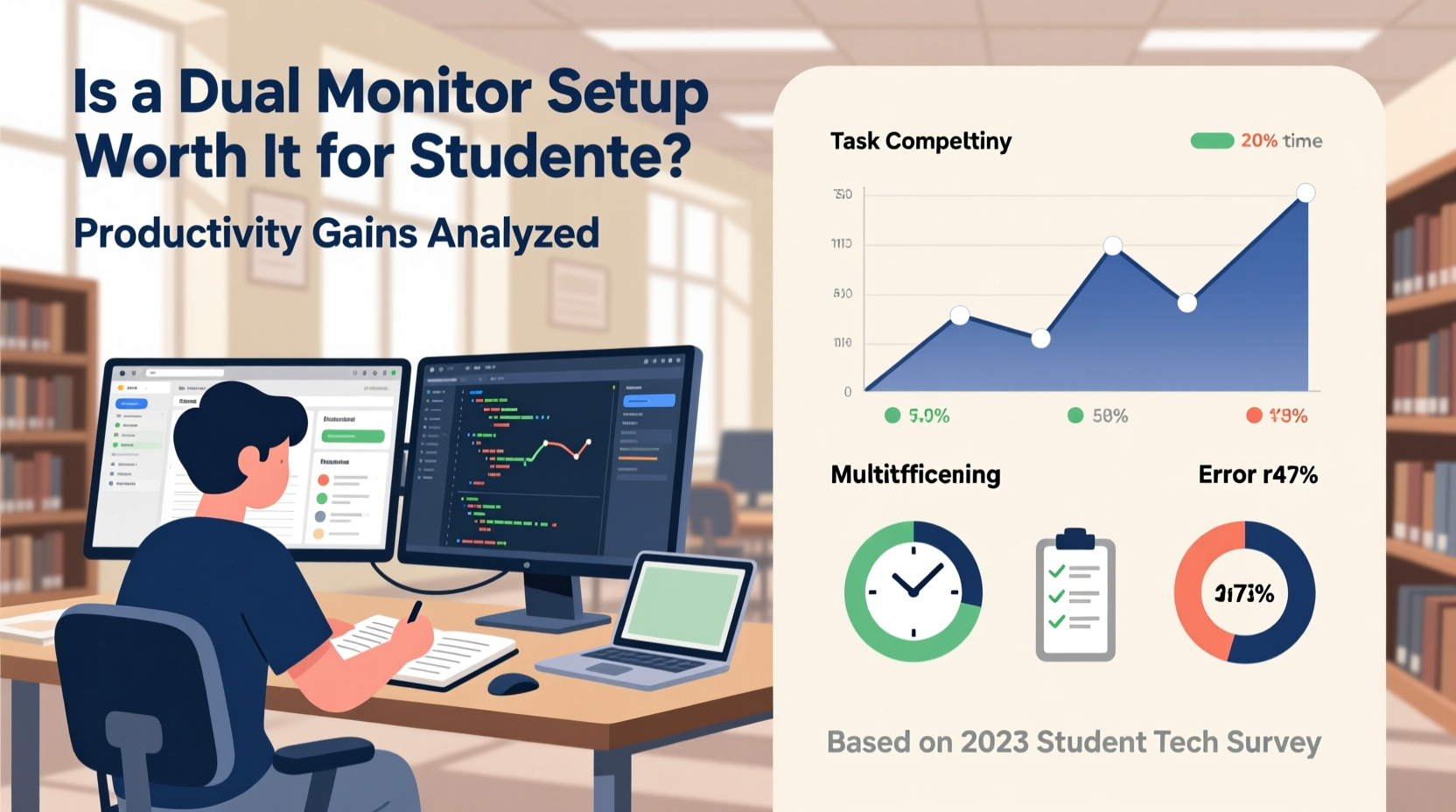
One of the most underappreciated costs of studying on a single screen is context switching—the mental effort required to shift attention between applications. Every time you toggle from a research PDF to your word processor, or from a lecture video to your notes, your brain must reorient itself. This process, known as \"attention residue,\" delays full engagement with the new task.
A 2020 study published in the Journal of Experimental Psychology: Applied found that participants using dual monitors completed multitasking assignments up to 44% faster than those using a single screen. The key wasn’t raw speed—it was reduced cognitive load. With information visible across both screens, users spent less time recalling where they left off or searching for files.
“Reducing the need to switch contexts allows students to maintain deeper focus and sustain concentration over longer periods.” — Dr. Lena Patel, Cognitive Ergonomics Researcher, University of Michigan
For students, this translates directly into more efficient writing sessions, smoother coding workflows, and better comprehension during virtual classes. Imagine watching a recorded lecture on one screen while taking structured notes on the other—without minimizing windows or alt-tabbing every few seconds.
Real-World Productivity Gains: What Students Actually Achieve
Anecdotal evidence from university tech forums and Reddit threads suggests widespread satisfaction among students who adopt dual monitors. However, actual productivity improvements depend heavily on usage patterns. Not all students benefit equally.
Consider Sarah, a third-year computer science major at Northeastern University. Before her dual monitor setup, she spent hours debugging code while constantly flipping between her IDE and documentation tabs. After connecting a $120 external monitor to her laptop, she reported cutting debugging time by nearly 30%. “I could see my error logs and Stack Overflow answers side-by-side,” she explained. “It eliminated so much back-and-forth.”
Likewise, Maria, an English literature student, uses one screen for her digital textbook and the other for her essay draft. She noticed fewer interruptions in her writing flow and improved citation accuracy. “I used to lose my place in the text every time I switched windows. Now, everything’s visible at once.”
These examples align with findings from a 2022 Stanford survey of 500 undergraduate students, which revealed that 68% of dual-monitor users felt more productive, particularly during complex assignments requiring multiple sources. However, the same survey showed minimal improvement for students primarily consuming content (e.g., watching lectures or reading articles) without active creation.
Cost vs. Benefit: Is It Worth the Investment?
For budget-conscious students, spending hundreds on additional hardware may seem excessive. But the reality is that entry-level monitors have become remarkably affordable. A functional 24-inch 1080p monitor now starts around $100–$150, with many universities offering student discounts or refurbished options.
Let’s compare the typical costs and benefits:
| Factor | Dual Monitor Setup | Single Laptop Screen |
|---|---|---|
| Average Cost | $120–$250 (monitor + cable) | $0 (already owned) |
| Time Saved Weekly | 3–7 hours (based on student reports) | Baseline |
| Best For | Coding, research writing, data analysis, design | Reading, light browsing, basic note-taking |
| Portability | Low (desktop-focused) | High (laptop-only) |
| Setup Complexity | Moderate (cables, alignment) | None |
The data suggests that the return on investment is highest for students engaged in cognitively demanding, multitask-heavy disciplines. For engineering, computer science, economics, or any field involving simultaneous use of references and tools, the setup pays for itself in saved time. For others, especially those relying on mobile learning or small living spaces, the marginal gain may not justify the expense or clutter.
Setting Up Smartly: A Step-by-Step Guide for Students
Maximizing the benefits of a dual monitor system requires more than just plugging in a second screen. Proper configuration enhances usability and prevents ergonomic strain.
- Assess Your Needs: Determine whether your workflow involves frequent multitasking. If you regularly use two or more applications simultaneously, dual monitors are likely beneficial.
- Choose the Right Monitor: Opt for a 22–24 inch 1080p display with IPS panel technology for better color accuracy and viewing angles. Look for models with HDMI or DisplayPort compatibility matching your laptop.
- Position Correctly: Place the primary monitor directly in front of you, aligned with your natural eye level. The secondary should be slightly angled inward, forming a gentle curve. Avoid placing it too far to the side to reduce neck strain.
- Extend, Don’t Duplicate: In your display settings, select “Extend” mode so each screen functions independently. Reserve duplication only for presentations.
- Organize Workflow Zones: Assign roles—e.g., left screen for communication (email, Slack), right screen for deep work (coding, writing). Consistency builds muscle memory.
- Cable Management: Use clips or sleeves to bundle power and video cables. A tidy workspace reduces visual distraction and tripping hazards.
- Test and Adjust: Spend a week experimenting with layouts. Shift applications between screens to find what minimizes mouse travel and maximizes focus.
Common Pitfalls and How to Avoid Them
A poorly configured dual monitor setup can do more harm than good. Here are frequent mistakes students make—and how to fix them:
- Using Mismatched Resolutions: Running a 4K laptop screen next to a 1080p monitor causes cursor speed inconsistencies and visual jarring. Stick to similar resolutions when possible.
- Ignoring Ergonomics: Hunching over or twisting your neck to view the second screen leads to fatigue. Invest in a simple monitor stand or riser to achieve proper height alignment.
- Overloading the Second Screen: Turning the extra monitor into a dashboard of social media feeds, YouTube videos, and chat apps defeats the purpose. Keep it dedicated to task-relevant content.
- Forgetting to Turn It Off: An idle second screen still consumes energy and adds visual noise. Power it down when not in use, especially during focused writing or exam prep.
Checklist: Is a Dual Monitor Setup Right for You?
Before purchasing, ask yourself the following:
- ✅ Do I frequently switch between two or more applications (e.g., research and writing)?
- ✅ Am I working on projects that require referencing multiple sources at once?
- ✅ Do I have a stable workspace (dorm desk, home office) where the setup can remain assembled?
- ✅ Can my laptop support an external display (check ports and GPU capability)?
- ✅ Am I willing to invest ~$150 for potential time savings of several hours per week?
- ✅ Will I use hotkeys and window management tools to optimize screen usage?
If you answered “yes” to three or more, a dual monitor setup is likely a worthwhile upgrade.
Frequently Asked Questions
Can I use a TV as a second monitor?
Yes, if your TV has HDMI input and your laptop supports video output. However, TVs often have higher input lag and lower pixel density than monitors, making them less ideal for prolonged reading or coding. Use only if a dedicated monitor isn’t available.
Do dual monitors increase eye strain?
Not inherently. Poor brightness contrast, glare, or misaligned screen heights contribute more to eye strain than having two screens. Match brightness levels, use matte finishes, and position screens at equal distance from your eyes.
What if I don’t have desk space?
Consider a vertical monitor mount or a sliding laptop tray to free up surface area. Alternatively, use your laptop lid closed with an external keyboard and one monitor—this saves space while still offering extended desktop functionality.
Final Verdict: When Dual Monitors Deliver Real Value
The answer to whether a dual monitor setup is worth it for students isn't universal—it depends on how you work. For passive learners who mainly watch lectures or read e-books, the added screen offers little advantage. But for active creators—those writing research papers, debugging code, analyzing datasets, or designing presentations—the productivity boost is both measurable and sustainable.
The investment is modest, the setup is straightforward, and the time saved accumulates rapidly over a semester. When configured thoughtfully, a second monitor reduces friction in your workflow, preserves mental focus, and supports deeper engagement with complex material.
In an academic environment where efficiency directly impacts performance, eliminating avoidable distractions and delays is not just convenient—it’s strategic.




 浙公网安备
33010002000092号
浙公网安备
33010002000092号 浙B2-20120091-4
Comments
No comments yet. Why don't you start the discussion?