
LED strip lights have become a staple in modern homes, offices, and entertainment spaces. Their flexibility, low power consumption, and vibrant color options make them ideal for accent lighting, task illumination, or creating ambient moods. However, as their use becomes more widespread—especially in bedrooms and living areas—a common question arises: Is it safe to leave LED strip lights on overnight?
The short answer is generally yes—for most high-quality, properly installed LED strips, leaving them on overnight poses minimal risk. But safety isn't guaranteed across all products or setups. The real answer depends on the quality of the components, installation methods, environmental conditions, and duration of use. This article breaks down the key factors that determine whether overnight operation is truly safe and provides actionable guidance for responsible usage.
How LED Strip Lights Work and Why They’re Considered Safe
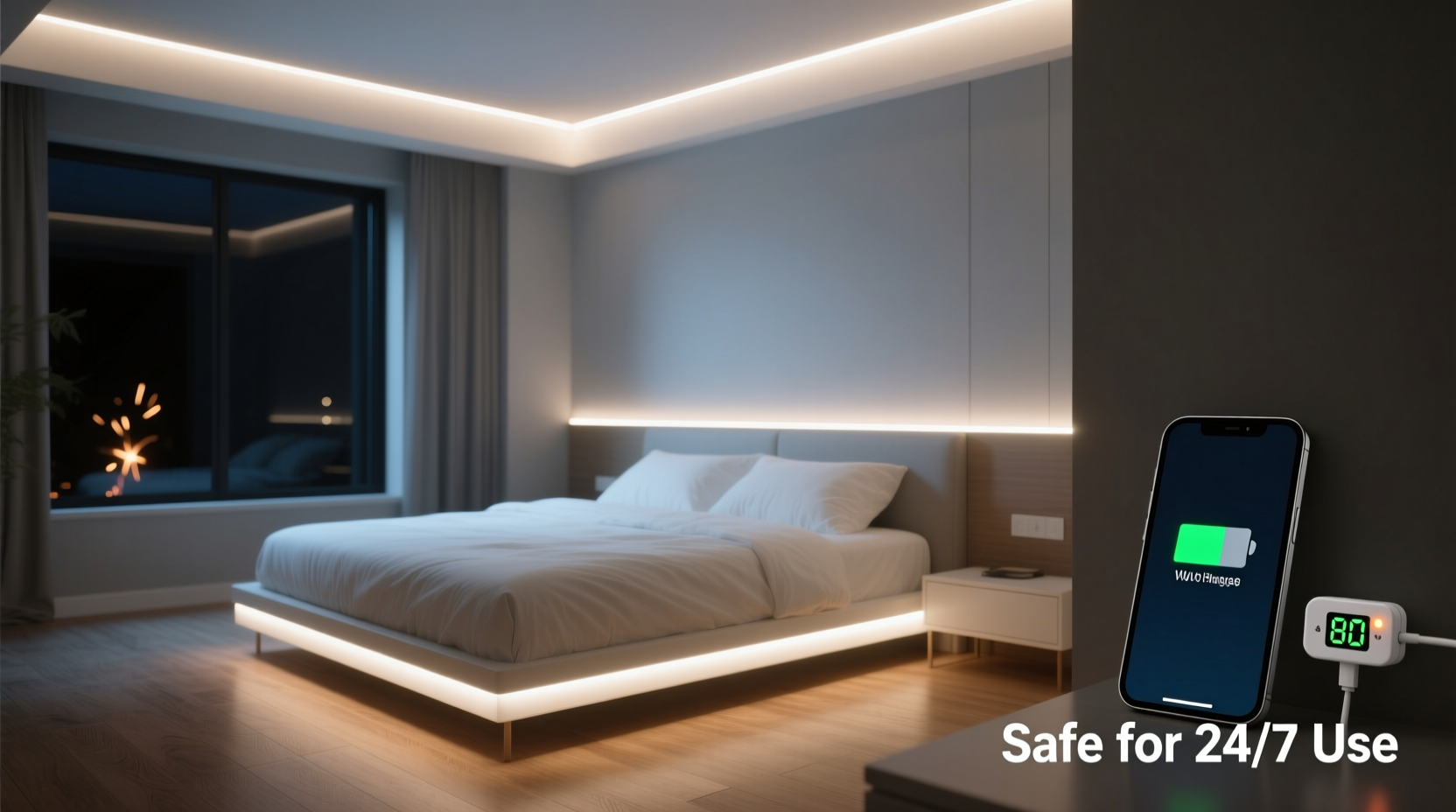
Unlike traditional incandescent or halogen bulbs, LED (light-emitting diode) technology produces light through electroluminescence, which generates significantly less heat. LEDs convert most of their energy into light rather than heat, making them far more efficient and inherently safer for prolonged use.
LED strip lights consist of small diodes mounted on a flexible circuit board, usually powered by a low-voltage DC source (typically 12V or 24V). This low voltage reduces electrical hazards compared to standard household AC circuits. When paired with a proper power supply (transformer), these systems operate within safe thermal and electrical parameters.
According to the U.S. Department of Energy, LED lighting uses at least 75% less energy than incandescent lighting and lasts up to 25 times longer. Their efficiency contributes not only to cost savings but also to reduced fire risk due to lower operating temperatures.
“Modern LED strips, when used as directed, are among the safest lighting options available for continuous operation.” — Dr. Alan Reyes, Electrical Safety Consultant, National Fire Protection Association (NFPA)
Key Safety Factors to Consider
While LEDs are inherently safer than older lighting technologies, several variables influence whether it’s truly safe to leave them on overnight:
- Quality of the LED strips: Cheap, uncertified strips may use substandard materials, lack proper insulation, or have inconsistent soldering, increasing the risk of overheating or short circuits.
- Power supply compatibility: Using an underpowered or overpowered adapter can stress the system, leading to premature failure or thermal runaway.
- Installation environment: Strips installed near flammable materials (e.g., curtains, paper, bedding) or in enclosed spaces without ventilation are at higher risk.
- Usage duration: While LEDs are designed for long life, constant 24/7 operation without breaks can accelerate lumen depreciation and component wear.
- Presence of smart controls: Timers, motion sensors, or dimmers can enhance safety by limiting unnecessary runtime.
Risks of Leaving LED Strips On Overnight
Despite their reputation for safety, potential risks do exist—particularly when cutting corners on quality or installation.
Fire Hazard (Rare but Possible)
Although rare, fires caused by LED strips have been documented. In most cases, the root cause was not the LEDs themselves but faulty wiring, poor-quality power supplies, or improper installation. For example, daisy-chaining multiple strips beyond the recommended length can overload the circuit, causing excessive heat buildup.
A 2022 report from the Electrical Safety Foundation International (ESFI) noted that while LED-related incidents are extremely uncommon, misuse accounts for nearly all reported cases. Overheating typically occurs when:
- The strip is covered or insulated (e.g., tucked under bedding or inside a sealed enclosure).
- Low-grade adhesive fails, causing the strip to sag onto a heat-sensitive surface.
- Non-waterproof strips are used in damp environments like bathrooms, leading to corrosion and short circuits.
Reduced Lifespan and Performance Degradation
Most LED strips are rated for 30,000 to 50,000 hours of operation. If left on 24/7, a 50,000-hour strip would last about 5.7 years. However, continuous operation without thermal cycling (on/off periods) can lead to faster lumen depreciation—the gradual dimming of light output over time.
Additionally, electronic components like capacitors in the power supply degrade more quickly under constant load, potentially leading to flickering or failure.
Energy Waste and Cost Accumulation
Even though LED strips consume little power, leaving them on unnecessarily adds up. A typical 5-meter 12V strip consumes around 24 watts. If left on 8 hours per night, that’s approximately 7 kWh per month, costing roughly $0.84/month at $0.12/kWh. While not exorbitant, it's avoidable waste.
“We see many clients who assume their ‘low-energy’ LEDs justify leaving them on all night. But over months, that idle consumption becomes significant—both financially and environmentally.” — Sarah Lin, Energy Efficiency Advisor, Green Home Institute
Safety Checklist Before Leaving LED Strips On Overnight
To ensure safe and responsible use, follow this practical checklist before deciding to run your LED strips overnight:
- ✅ Verify that the product is UL-listed or ETL-certified.
- ✅ Use the correct, appropriately rated power supply (check voltage and amperage).
- ✅ Install in well-ventilated areas—avoid enclosing or covering the strip.
- ✅ Keep away from flammable materials (curtains, bedding, papers).
- ✅ Avoid daisy-chaining more than three standard 5m reels unless using amplifiers.
- ✅ Secure the strip properly so it won’t fall or shift during use.
- ✅ Test for excessive heat after 30 minutes of operation—surface should be warm, not hot.
- ✅ Consider using a timer or smart plug to limit runtime automatically.
Best Practices for Overnight Use
If you choose to leave LED strip lights on overnight—for ambiance, nightlights, or decorative purposes—follow these best practices to minimize risk and maximize longevity.
Use Smart Automation
Instead of running lights all night, set a timer or use a smart plug to turn them off after a few hours. Many Wi-Fi-enabled LED systems allow scheduling via smartphone apps. For example, setting the lights to fade out after 2–3 hours maintains convenience while reducing exposure time.
Install in Low-Risk Zones
Place strips in locations where they are unlikely to come into contact with people or combustible items. Ideal placements include:
- Under cabinets (with airflow underneath)
- Along ceiling coves
- Behind TVs or monitors (ensure space for heat dissipation)
- Inside non-flammable shelving units
Choose High-Quality Components
Invest in reputable brands known for reliability. Look for features like:
- Aluminum backing for better heat dissipation
- IP65 or higher rating for moisture resistance (if used in kitchens/bathrooms)
- Individually addressable LEDs with built-in current regulation
Real-World Example: A Bedroom Setup Gone Wrong
In 2021, a homeowner in Austin, Texas installed non-certified LED strips behind their headboard for ambient lighting. The strips were covered by fabric draping and connected to a generic, unbranded power adapter. After two weeks of nightly use, the owner noticed a burning smell. Upon inspection, the adhesive had failed, and part of the strip had shifted onto a cotton pillow. The area showed signs of charring, though no fire occurred.
An electrician later determined that the power supply was delivering unstable voltage, and the lack of ventilation caused localized overheating. The homeowner replaced the setup with UL-listed strips, added a timer, and relocated the lights to an open shelf above the bed. Since then, no issues have arisen—even with regular overnight use.
This case underscores how seemingly minor oversights—using uncertified gear, poor placement, and inadequate ventilation—can create real hazards, even with low-power devices.
Comparison Table: Safe vs. Unsafe LED Strip Usage
| Factor | Safe Practice | Unsafe Practice |
|---|---|---|
| Product Certification | UL, ETL, or CE listed | No certification, unknown brand |
| Power Supply | Correct voltage, sufficient amperage | Overloaded or mismatched adapter |
| Installation Location | Well-ventilated, away from fabrics | Covered, near bedding or curtains |
| Runtime Control | Timer or smart plug used | Left on indefinitely |
| Heat Management | Strip feels warm, not hot | Strip too hot to touch after 30 min |
Frequently Asked Questions
Can LED strip lights catch fire?
It is highly unlikely under normal conditions with quality components. However, fire risk increases with poor-quality strips, incorrect power supplies, or installations near flammable materials. Properly installed, certified LED strips pose negligible fire risk.
Do LED strips use a lot of electricity if left on all night?
No, they are very energy-efficient. A typical 5-meter strip uses about 24 watts. Running it for 8 hours consumes 0.192 kWh, costing less than $0.03 per night. Still, turning them off when not needed saves energy and extends lifespan.
How long can I safely leave LED strip lights on?
High-quality LED strips can be left on for up to 72 hours continuously without issue, provided they are well-ventilated and correctly powered. For indefinite use, incorporate timers or motion sensors to reduce runtime and monitor for heat buildup regularly.
Final Recommendations and Action Plan
Leaving LED strip lights on overnight is generally safe—but only when done responsibly. To protect your home and ensure long-term reliability, adopt the following action plan:
- Inspect your current setup: Are your strips certified? Is the power supply matched? Are they in a ventilated area?
- Upgrade if necessary: Replace uncertified strips or adapters with reputable, safety-tested models.
- Add automation: Use a timer, smart plug, or app-based control to limit runtime.
- Monitor heat: Run the lights for 30 minutes and check temperature. If too hot, reposition or reduce load.
- Review monthly: Check for loose connections, discoloration, or flickering—early signs of trouble.
Conclusion
LED strip lights offer a safe, efficient way to enhance your space—but safety isn’t automatic. It requires informed choices about product quality, installation, and usage habits. By choosing certified products, avoiding risky placements, and using smart controls, you can enjoy ambient lighting overnight without compromising peace of mind.




 浙公网安备
33010002000092号
浙公网安备
33010002000092号 浙B2-20120091-4
Comments
No comments yet. Why don't you start the discussion?