
Batting average is one of the most recognized statistics in baseball, often used to measure a player’s consistency at the plate. While newer metrics have emerged, batting average remains a fundamental tool for players, coaches, and fans alike. Understanding how to calculate it—and what it truly means—can help you evaluate performance more accurately and set realistic goals for improvement. This guide breaks down the formula, explains its limitations, and shows how to use it effectively within a broader evaluation framework.
What Is Batting Average?
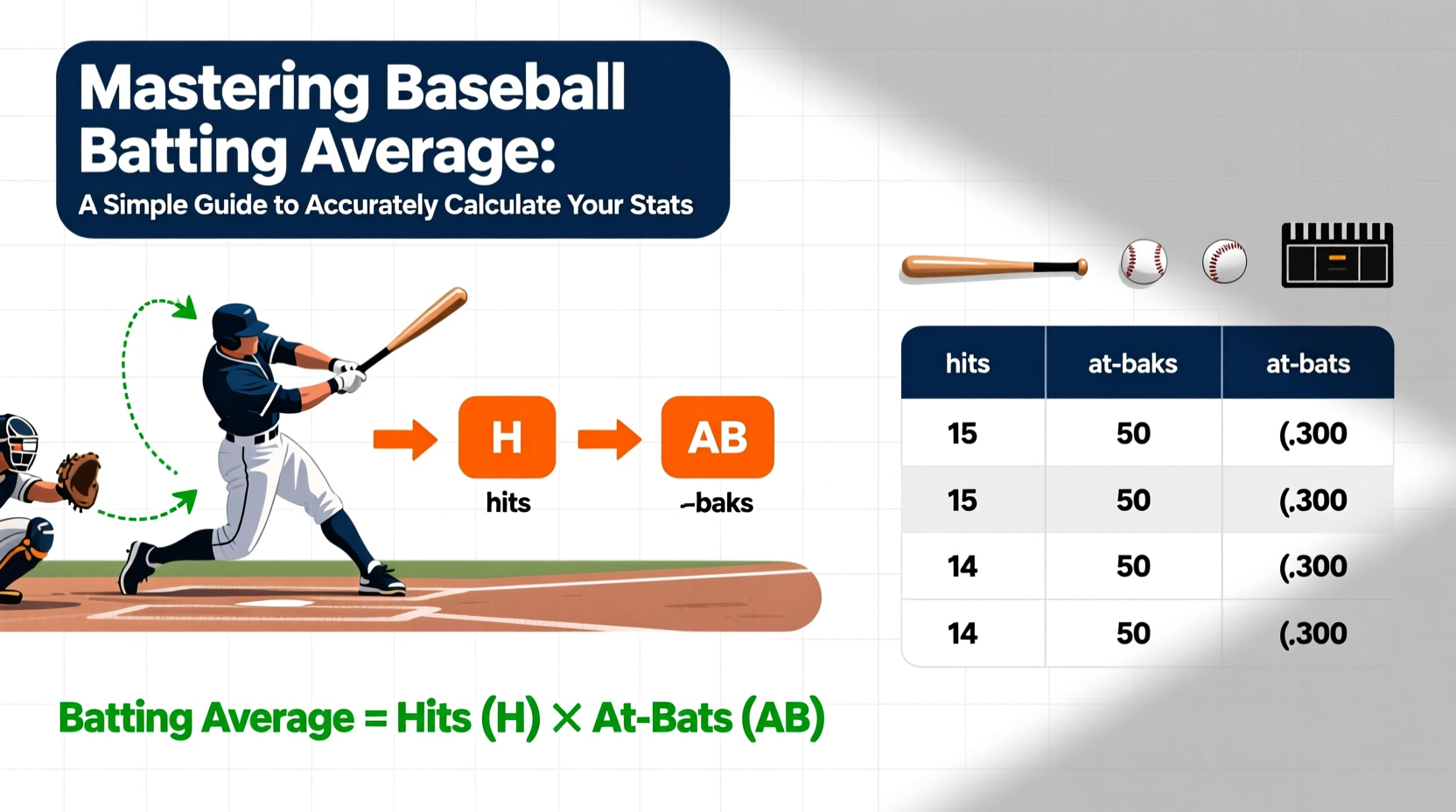
Batting average (BA) measures how frequently a batter gets a hit during official at-bats. It’s calculated by dividing a player’s total number of hits by their total number of at-bats. The result is expressed as a three-digit decimal, such as .300, which means the player gets a hit in 30% of their at-bats.
The simplicity of batting average makes it accessible, but it doesn’t account for walks, hit-by-pitches, or extra-base hits. A home run and a bunt single are both counted equally in the calculation. Despite these limitations, BA remains a widely used benchmark because it reflects contact consistency—a crucial skill in high-pressure situations.
“Batting average tells you who’s making consistent contact. In close games, that’s often who delivers.” — Tony La Russa, Hall of Fame Manager
How to Calculate Batting Average: Step-by-Step
Calculating batting average is straightforward if you understand the components involved. Follow this step-by-step process to get an accurate figure:
- Gather your stats: Collect the total number of hits and official at-bats from game logs or scorebooks.
- Use only at-bats: Exclude walks, sacrifices (sacrifice bunts and sacrifice flies), and hit-by-pitches from the denominator.
- Apply the formula: Divide hits by at-bats.
- Round to three decimals: Round up if the fourth digit is 5 or higher.
- Express as a decimal: Omit the leading zero (e.g., write .275, not 0.275).
Example Calculation
If a player has 85 hits in 300 at-bats:
85 ÷ 300 = 0.2833… → Rounded to .283
This player’s batting average is .283, considered strong in most levels of play.
Understanding What the Numbers Mean
While the math is simple, interpreting the results requires context. Here’s a general guideline for evaluating batting averages across amateur and professional levels:
| Batting Average | Interpretation | Typical Level |
|---|---|---|
| .300+ | Excellent | Major League standard for elite hitters |
| .275–.299 | Very Good | Strong professional or college performer |
| .250–.274 | Average | Competent at most competitive levels |
| .225–.249 | Below Average | Needs improvement or relies on power |
| Below .225 | Poor | Risk of reduced playing time without other strengths |
In youth leagues, averages tend to be lower due to developing skills, while in collegiate and professional settings, even small differences (.010) can significantly impact evaluations.
Common Mistakes When Calculating Batting Average
Even experienced scorekeepers sometimes make errors that distort batting average. Avoid these common pitfalls:
- Including walks in at-bats: Walks do not count as at-bats and should never be included in the denominator.
- Counting sacrifice bunts or flies as at-bats: These are excluded by rule, so they don’t affect batting average.
- Forgetting to round properly: Always round to three decimal places using standard rounding rules.
- Mixing up plate appearances with at-bats: Plate appearances include walks, sacrifices, and hit-by-pitches; at-bats do not.
Real-World Example: Tracking Progress Over a Season
Consider Maya Rodriguez, a high school sophomore playing center field. At the start of the season, her coach encouraged players to track individual stats. After 20 games, Maya had:
- 68 official at-bats
- 18 hits (including 3 doubles and 1 triple)
- 12 walks (not counted in BA)
- 4 sacrifice flies (also not counted)
Calculation: 18 ÷ 68 = 0.2647 → Rounded to .265
Her .265 average placed her third on the team and above the league average of .248. This motivated her to focus on improving pitch recognition, especially against fastballs. By midseason, she raised her average to .288 through disciplined hitting and better two-strike approaches. Her progress demonstrated how tracking BA over time provides measurable feedback and goal-setting opportunities.
Complementary Stats: Going Beyond Batting Average
While batting average is useful, it doesn’t tell the whole story. To gain a fuller picture of offensive contribution, consider combining it with other key statistics:
- On-Base Percentage (OBP): Includes hits, walks, and hit-by-pitches. Measures how often a player reaches base.
- Slugging Percentage (SLG): Weighs hits by bases gained (singles=1, doubles=2, etc.). Reflects power.
- On-base Plus Slugging (OPS): Adds OBP and SLG for a comprehensive offensive metric.
A player with a modest .250 batting average but a high OBP due to frequent walks may be more valuable than a .270 hitter who rarely draws a walk. Coaches increasingly use this trio—BA, OBP, SLG—to assess overall effectiveness.
Checklist: How to Accurately Track and Improve Your Batting Average
Follow this checklist each week to ensure accuracy and drive improvement:
- Record every at-bat immediately after the game.
- Verify that walks and sacrifices are excluded from at-bat totals.
- Calculate your current BA weekly to monitor trends.
- Compare your average against team and league benchmarks.
- Identify patterns (e.g., low average against left-handed pitchers).
- Set specific goals (e.g., “Raise my average from .240 to .260 by June”).
- Work with your coach on swing mechanics and plate discipline.
Frequently Asked Questions
Does a home run count more than a single in batting average?
No. In batting average, all hits are weighted equally. A home run and a bunt single both count as one hit in one at-bat. For power measurement, refer to slugging percentage instead.
Why isn’t batting average enough to judge a hitter?
Batting average ignores walks and the value of extra-base hits. A player who hits .260 with 15 home runs and 60 walks may contribute more offensively than a .280 singles hitter with few walks. Modern analysis uses multiple stats for a balanced view.
Can I calculate batting average during a game?
Yes. If a player has 2 hits in 5 at-bats during a game, their average for that game is .400. However, season-long averages require cumulative data and stabilize over time—small samples can be misleading.
Conclusion: Use Batting Average Wisely
Batting average is a timeless statistic that rewards consistent contact and offers a clear benchmark for performance. When calculated correctly and interpreted with context, it becomes a powerful tool for growth. But it’s just one piece of the puzzle. Pair it with on-base percentage, slugging, and situational awareness to build a complete picture of your offensive game.




 浙公网安备
33010002000092号
浙公网安备
33010002000092号 浙B2-20120091-4
Comments
No comments yet. Why don't you start the discussion?