
Numbers are everywhere—in reports, emails, articles, and daily conversations. Yet, many people struggle with when to spell them out and when to use numerals. Inconsistent number formatting can undermine credibility, confuse readers, and weaken the professionalism of your writing. Whether you're drafting a business proposal, editing a research paper, or posting on social media, mastering the rules for writing numbers ensures clarity, consistency, and authority in your message.
Understanding the Core Principles
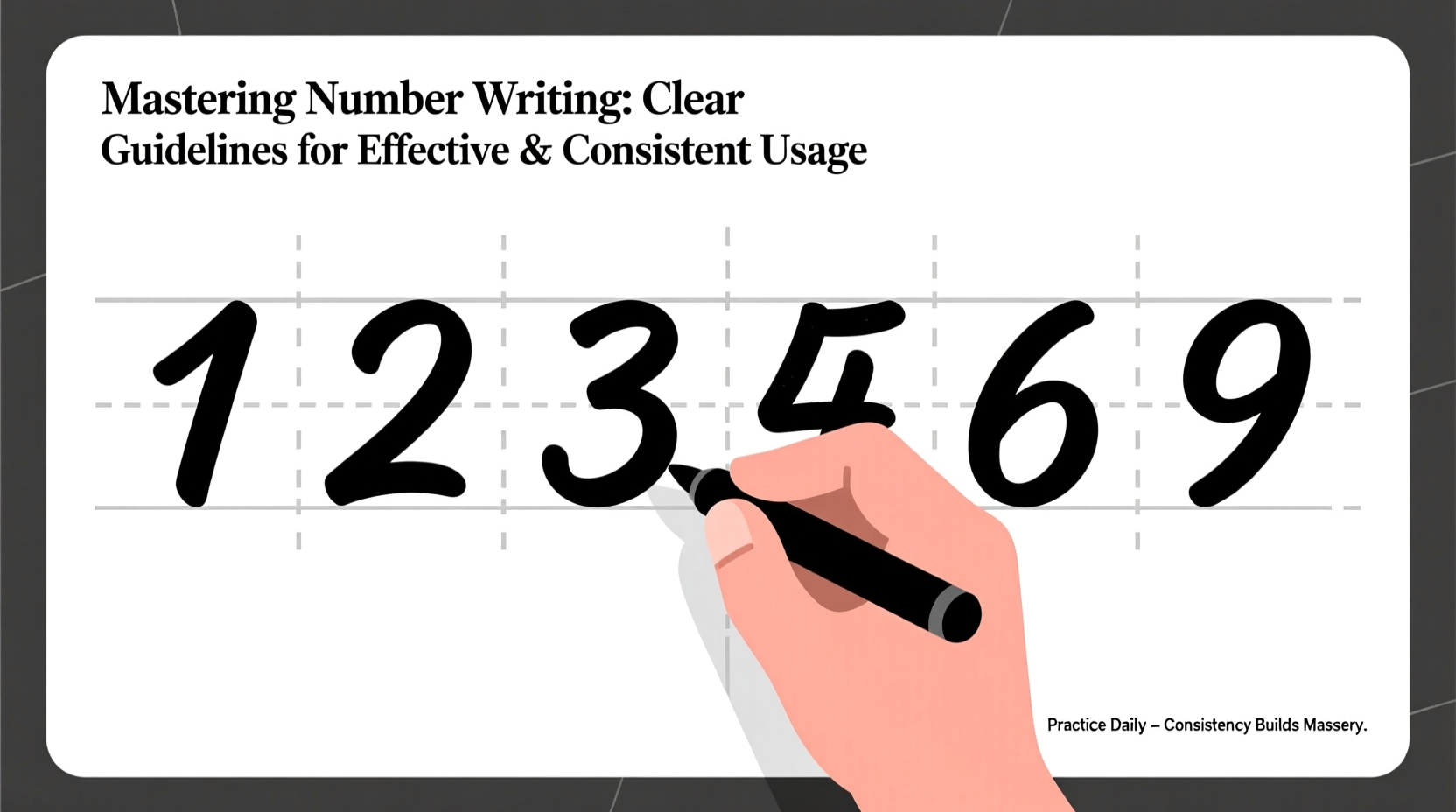
The way you present numbers depends on context, audience, and style guide. While no universal rule applies across all scenarios, several widely accepted conventions exist. The key is choosing one standard and applying it consistently throughout your document.
Major style guides—such as The Chicago Manual of Style, AP Stylebook, and APA Publication Manual—offer slightly different recommendations. For example, AP Style favors numerals for all numbers 10 and above, while Chicago recommends spelling out numbers from zero through one hundred in most cases. Knowing which guide aligns with your purpose helps streamline decision-making.
“Clarity trumps cleverness when it comes to numbers. Consistent formatting prevents distraction and builds trust.” — Dr. Linda Chen, Technical Communication Professor, University of Washington
When to Spell Out Numbers vs. Use Numerals
The most common point of confusion lies in deciding whether to write “twenty-five” or “25.” General best practices suggest the following:
- Spell out numbers that can be written in one or two words (e.g., one, fifteen, three hundred) when they appear at the beginning of a sentence.
- Use numerals for precise measurements, dates, times, percentages, and statistics (e.g., 3.7%, 14 kg, 9:45 a.m.).
- Favor numerals in tables, charts, and technical documents where speed of comprehension matters.
- Remain consistent within categories—even if mixing formats elsewhere.
Style Guide Comparison: A Quick Reference
| Context | AP Style | Chicago Style | APA Style |
|---|---|---|---|
| Numbers under 10 | Spell out (e.g., five) | Spell out (e.g., five) | Spell out (e.g., five) |
| Numbers 10 and above | Numerals (e.g., 12) | Numerals (e.g., 12) | Numerals (e.g., 12) |
| Beginning of sentence | Spell out | Spell out | Spell out or reword |
| Percentages | 5% (numeral + symbol) | Five percent (spell out unless scientific) | 5% (numeral + %) |
| Dates and years | Aug. 5, 2023; 1990s | August 5, 2023; the 1990s | Same as Chicago |
| Measurements | 6 inches, 10 mph | 6 inches, 10 miles per hour | 6 in., 10 mph (abbreviated) |
Practical Applications: Real-World Scenarios
Consider a marketing manager preparing a quarterly report. She must present sales data clearly while maintaining a professional tone. Her company follows AP Style, so she writes:
Total revenue increased by 18% compared to last year, reaching $2.3 million. Twenty-seven new clients were acquired during Q2.
Notice how “18%” and “$2.3 million” use numerals for precision, while “Twenty-seven” is spelled out because it starts the sentence. This mix maintains readability without sacrificing accuracy.
In contrast, a novelist describing a character’s age might write: “She was thirty-two, though everyone assumed she was closer to forty.” Here, both numbers are spelled out to preserve narrative flow and stylistic tone—common in fiction writing regardless of style guide.
Step-by-Step Guide to Formatting Numbers Correctly
- Identify your audience and purpose. Is this academic, journalistic, creative, or technical writing? Choose a relevant style guide accordingly.
- Select a primary style guide. Stick with AP, Chicago, or APA based on your field.
- Decide on number thresholds. Know when to spell out (e.g., one to nine) versus use numerals (e.g., 10+).
- Check sentence beginnings. Never start a sentence with a numeral—rewrite or spell it out.
- Apply consistency within categories. If listing ages, use the same format for all (e.g., 5, 8, and 12 years old).
- Review units and symbols. Use correct spacing and abbreviations (e.g., 5 kg, not 5kg; 7 p.m., not 7pm).
- Edit for exceptions. Addresses, phone numbers, and legal documents often follow their own rules.
Common Mistakes to Avoid
- Inconsistent formatting: Writing “seven employees” in one paragraph and “12 employees” in the next without cause.
- Mixing styles mid-document: Switching between AP and Chicago rules haphazardly.
- Starting sentences with numerals: “15 participants showed improvement” should be rewritten.
- Overusing numerals in narrative text: “I bought 3 apples, saw 2 dogs, and walked 1 mile” reads mechanically. Prefer “three,” “two,” and “one” in descriptive prose.
- Ignoring context: Using informal number formats in formal reports (e.g., “100K” instead of “100,000” or “$100,000”).
Essential Checklist for Number Usage
- ✅ Spell out numbers at the beginning of a sentence.
- ✅ Use numerals for exact figures, statistics, and technical data.
- ✅ Follow your chosen style guide consistently.
- ✅ Maintain uniformity within lists or comparisons.
- ✅ Format decimals, percentages, and currencies correctly.
- ✅ Avoid mixing styles unless required by context (e.g., dialogue vs. narration).
- ✅ Proofread specifically for number formatting errors.
Frequently Asked Questions
Should I write “twenty-one” or “21”?
It depends on context. In formal writing following Chicago or APA style, spell out “twenty-one” for general use under 100. In journalism or technical contexts using AP style, “21” is preferred for numbers 10 and above. Always consider readability and consistency.
How do I handle mixed numbers in a sentence?
If you’re comparing values, maintain the same format. For example: “We received 7 inquiries yesterday and 15 today.” Although “7” is below ten, using numerals for both enhances parallel structure and clarity.
What about fractions?
Simple fractions are usually spelled out in prose: “one-half,” “two-thirds.” Use numerals in technical or scientific contexts: “The solution contained 1/3 liter.” Hyphenate spelled-out fractions when used as adjectives (“a two-thirds majority”) but not as nouns (“Two thirds of the group agreed.”).
Final Thoughts and Call to Action
Writing numbers correctly may seem minor, but it significantly impacts how your content is perceived. Clear, consistent formatting reflects attention to detail and respect for your reader’s time. Whether you're composing an email, publishing an article, or compiling a report, applying these guidelines strengthens your communication and enhances your professionalism.
Start today by auditing a recent piece of your writing. Highlight every number and evaluate whether it follows a consistent, appropriate format. Make adjustments based on your audience and goals. Then, share your insights—how has proper number usage improved your writing clarity? Join the conversation and help others master this essential skill.




 浙公网安备
33010002000092号
浙公网安备
33010002000092号 浙B2-20120091-4
Comments
No comments yet. Why don't you start the discussion?