
Earring stacking has evolved from a subtle trend into a full-fledged form of self-expression. No longer limited to a single pair of studs or hoops, today’s fashion-forward individuals are curating entire ear landscapes—layering delicate studs with dynamic spirals to create dimension, rhythm, and personality. The key to standout styling lies in thoughtful pairing: balancing minimalism with movement, symmetry with asymmetry, and texture with tone. When done right, combining studs and spirals transforms your ears into a wearable art installation.
This guide dives deep into the nuances of earring stacking, focusing on how to harmonize static studs with fluid spirals. From understanding ear anatomy to mastering proportion and material cohesion, you’ll learn how to craft looks that are cohesive, eye-catching, and uniquely yours.
The Anatomy of a Stacked Ear
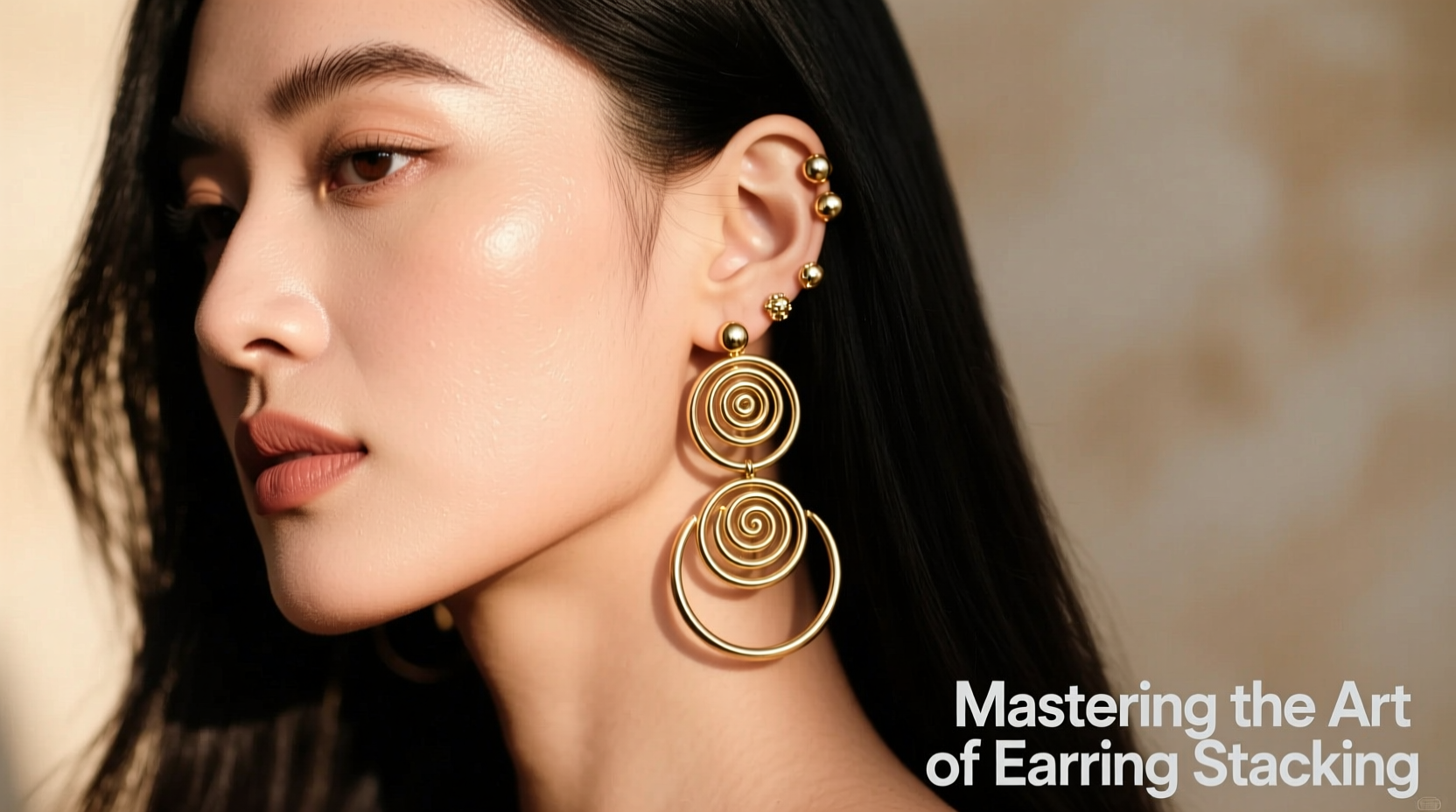
Before selecting earrings, it helps to understand the structure of the ear. Most people have multiple piercing points: lobe, forward helix, upper helix, tragus, conch, daith, and anti-helix. Each offers a different canvas for design.
Studs are ideal for anchor points—they provide definition and grounding. Spiral earrings, with their coiled motion and kinetic energy, work best where movement is visible: mid-ear placements or as statement pieces near the lobe. A successful stack uses both types strategically across these zones.
Consider this layout:
- Lobe: Start with a small stud or a medium spiral for visual weight.
- Forward Helix: Use tiny studs to outline the curve.
- Upper Helix: Introduce a slightly larger spiral for drama.
- Conch: Opt for a textured stud or geometric shape to contrast soft spirals.
- Tragus: A micro-stud adds subtle sparkle without overcrowding.
Choosing the Right Studs and Spirals
Not all studs and spirals are created equal. Material, finish, size, and shape determine how well they work together.
Studs should act as punctuation marks—clear, defined, and intentional. Diamonds, pearls, cubic zirconia, or minimalist metal domes work well. Avoid overly large studs if you’re pairing them with bold spirals; let one element lead.
Spirals, on the other hand, bring motion. They can be open coils, tight corkscrews, or asymmetrical twists. Look for designs that follow the natural curve of your ear for seamless integration. Sterling silver, gold-filled, or titanium spirals offer durability and polish.
“Balance isn’t about symmetry—it’s about visual harmony. A single spiral can offset three small studs if the weight feels even.” — Lena Torres, Jewelry Stylist & Founder of EarCurate Studio
Dos and Don’ts of Material Pairing
| Do | Don't |
|---|---|
| Mix metals intentionally (e.g., rose gold studs with yellow gold spirals) | Mix too many finishes (e.g., silver, gold, gunmetal, and matte black) |
| Stick to two dominant tones max | Pair highly polished spirals with brushed studs unless intentionally contrasting |
| Use hypoallergenic materials for sensitive ears | Wear low-quality alloys that tarnish quickly and irritate skin |
Step-by-Step Guide to Building Your Stack
Creating a compelling earring stack isn’t random—it’s a deliberate process. Follow this timeline to build a look that feels intentional and polished.
- Assess your piercing map. Note which holes are healed and available. Sketch a rough diagram if needed.
- Choose a focal point. Decide whether your lobe, helix, or conch will carry the main spiral piece.
- Select your anchor stud. Place a simple, elegant stud at the most prominent spot (often the lobe) to ground the design.
- Add complementary spirals. Pick one or two spirals that flow naturally from the ear’s curve. Ensure they don’t overpower adjacent studs.
- Fill gaps with micro-studs. Use tiny studs to connect elements, like stepping stones between larger pieces.
- Step back and evaluate. Check balance from multiple angles. Does one side feel heavier? Adjust spacing or swap sizes.
- Test for comfort. Wear the stack for 30 minutes. If any piece pulls or catches, reconsider placement.
Real-Life Example: Maya’s Festival Look
Maya, a 28-year-old creative director, wanted an edgy yet elegant look for a music festival. She had four healed piercings per ear: lobe, forward helix, upper helix, and conch.
She started with a 4mm diamond solitaire stud in her lobe—her foundation. Then, she added a delicate 10mm open-gold spiral to her upper helix, its curve echoing the ear’s natural arc. To bridge the space, she used a tiny barbell in her forward helix and a matte disc stud in her conch.
The result? A curated asymmetry that caught light with every turn. “People kept asking if I worked for a jewelry brand,” she said. “It felt personal, not overdone.”
Her secret: restraint. She skipped her tragus and anti-helix piercings to avoid clutter, proving that sometimes less enhances more.
Checklist: Build a Balanced Earring Stack
- ☐ Map out available piercings
- ☐ Choose one statement spiral
- ☐ Select 2–3 complementary studs
- ☐ Stick to two metal tones maximum
- ☐ Ensure secure fastenings on all pieces
- ☐ Balance visual weight across the ear
- ☐ Test wearability for at least 30 minutes
- ☐ Photograph the look from multiple angles
Frequently Asked Questions
Can I mix different metals in my earring stack?
Yes, but do so intentionally. Combining rose gold studs with a yellow gold spiral can add depth, but limit yourself to two metals to maintain cohesion. Avoid mixing more than two unless you're aiming for an eclectic, maximalist effect.
How do I keep my spirals from tangling in hair?
Opt for closed or semi-closed spiral designs if you have long or fine hair. Position spirals higher on the ear (like the upper helix) where they’re less likely to catch. You can also use a light hairspray to tame flyaways around the ear area.
Is earring stacking suitable for professional settings?
Absolutely—just scale down. Try a single spiral paired with a classic stud on one ear, or keep stacks minimal with small, matching pieces. Metallic cohesion and subtlety make stacked earrings office-appropriate.
Final Thoughts: Make It Yours
Earring stacking isn’t about following rules—it’s about rewriting them. The magic happens when you combine the stillness of a stud with the motion of a spiral, creating a rhythm that mirrors your personality. Whether you prefer minimalist elegance or bold asymmetry, the combination of studs and spirals offers endless possibilities.
Start small. Experiment often. Pay attention to what feels balanced, what draws compliments, and what makes you feel confident. Over time, your ear will tell a story—one twist, one sparkle at a time.




 浙公网安备
33010002000092号
浙公网安备
33010002000092号 浙B2-20120091-4
Comments
No comments yet. Why don't you start the discussion?