
Quoting someone may seem straightforward—just repeat what they said, right? But in practice, quoting accurately and ethically requires attention to detail, respect for context, and an understanding of language mechanics. Whether you're writing an article, crafting a speech, or citing sources in academic work, misquoting—even unintentionally—can distort meaning, damage credibility, and mislead audiences. Mastering the art of quoting means doing more than copying words; it means preserving intent, tone, and truth.
Why Accurate Quotation Matters
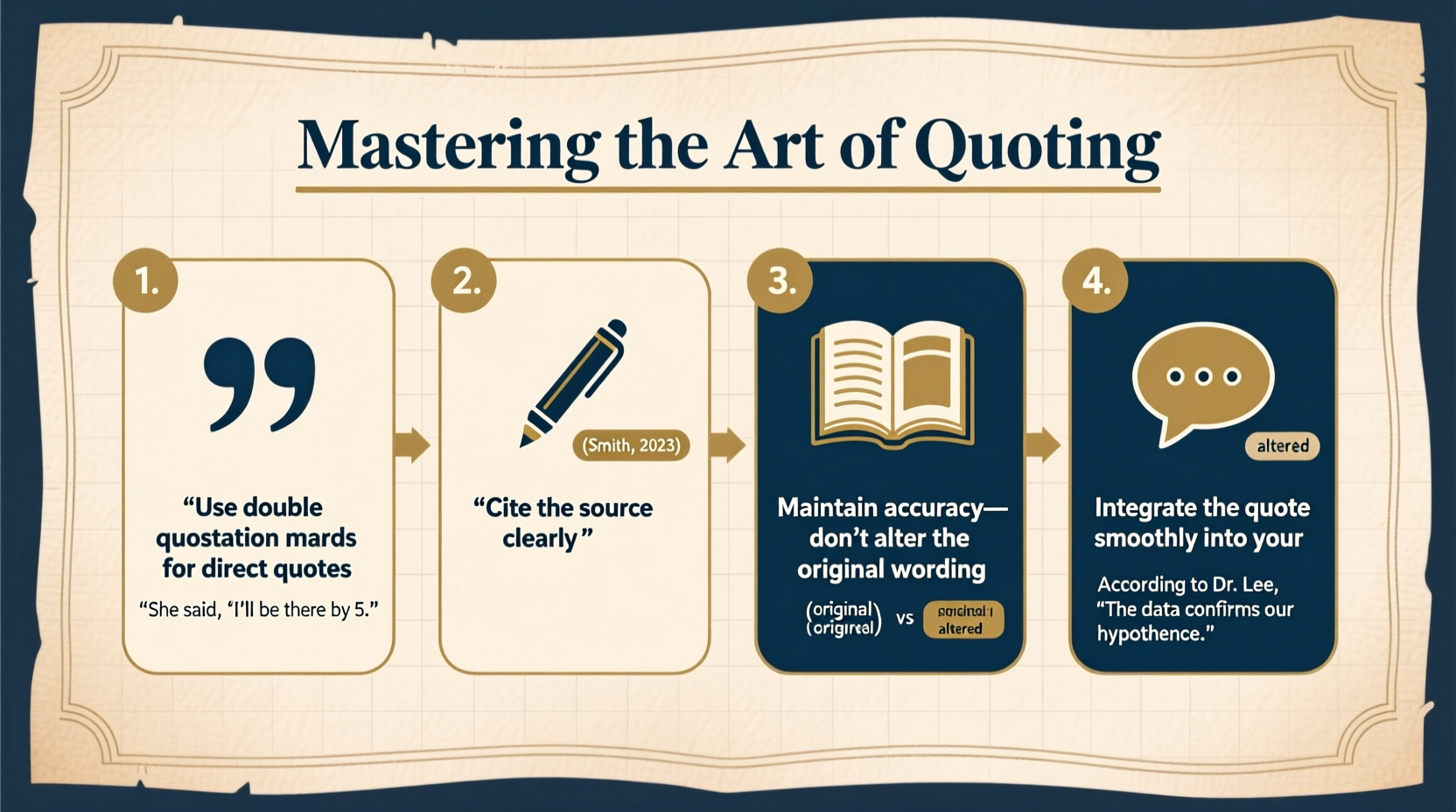
Quotes serve as evidence, inspiration, and connection. When used correctly, they lend authority to your writing and give voice to others. However, inaccurate or out-of-context quotes can do real harm. A single misquoted phrase might change the perceived stance of a public figure, misrepresent research findings, or alter the emotional weight of a personal story.
Journalists, educators, researchers, and content creators have a responsibility to quote with integrity. This includes verifying exact wording, maintaining original context, and using proper punctuation and attribution. The consequences of getting it wrong extend beyond grammar—they touch on ethics, trust, and professional reputation.
“Quotation is a powerful tool. Used well, it illuminates truth. Used carelessly, it spreads misinformation.” — Dr. Lena Torres, Media Ethics Professor, University of Chicago
The Mechanics of Correct Quotation
Before diving into style or strategy, it's essential to understand the basic structure of quoting in written English. Proper formatting ensures clarity and helps readers distinguish between your words and those of others.
In American English, double quotation marks (“ ”) are standard for direct quotes:
- She said, “I’ll be there by noon.”
- According to the report, “Sales increased by 17% last quarter.”
If the quote contains another quote, use single quotation marks (‘ ’) inside the double:
- He recalled, “She told me, ‘This is the most important decision we’ve ever made.’”
Punctuation typically goes inside the closing quotation mark, even if it’s not part of the original quote. For example:
- Did she really say, “I’m stepping down”? (Note: question mark outside because it applies to your sentence, not the quote)
- She announced, “I’m stepping down.” (Period inside the quote)
Step-by-Step Guide to Quoting Someone Correctly
Follow this five-step process to ensure every quote you use is accurate, ethical, and impactful.
- Locate the Original Source: Avoid secondhand quotes. Whenever possible, go directly to the speech, interview, book, or recording where the statement was made. Secondary sources may contain errors or paraphrasing.
- Transcribe Word-for-Word: Copy the exact phrasing, including contractions, slang, or grammatical quirks. Do not “clean up” spoken language unless using ellipses or brackets appropriately (see below).
- Add Context: Introduce the quote with enough background so readers understand who said it, when, and why. For example: “In her 2023 TED Talk on climate resilience, marine biologist Dr. Amara Lin stated…”
- Attribute Clearly: Name the speaker immediately before or after the quote. Use verbs like “explained,” “argued,” “noted,” or “emphasized” to reflect tone.
- Verify Accuracy: Cross-check your quote against the original. If publishing online, consider linking to the source audio or transcript.
Editing Quotes Ethically: Brackets and Ellipses
Sometimes, a full sentence or paragraph isn’t needed. You may need to shorten a quote or clarify pronouns. In these cases, use standardized editing tools—but only if they don’t alter the speaker’s intended meaning.
| Tool | Use Case | Example |
|---|---|---|
| Ellipsis (...) | To indicate omitted words within a quote | Original: “We cannot stand by and watch this happen while pretending everything is fine.” → Edited: “We cannot stand by… while pretending everything is fine.” |
| Brackets [ ] | To insert clarifying words or adjust grammar | Original: “They didn’t listen to us.” → Edited: “They didn’t listen to [the safety team].” |
| No tool | Never use to fabricate meaning or reverse sentiment | ❌ Misuse: “I love this policy…” … “but it will fail under scrutiny.” → “I love this policy…will fail.” |
Remember: An ellipsis should never hide a contradiction or create a false impression. Brackets should clarify—not manipulate.
Common Quoting Mistakes and How to Avoid Them
Even experienced writers slip up. Here are frequent errors and how to fix them:
- Misattribution: Saying someone said something they didn’t. Always verify quotes attributed to historical figures or celebrities—many viral quotes are fake.
- Out-of-Context Quoting: Pulling a line that seems strong but ignores surrounding statements. Example: Quoting “I support drastic action” without noting it was said sarcastically in debate.
- Overquoting: Relying too heavily on others’ words instead of providing analysis. Use quotes to support your point, not replace it.
- Incorrect Punctuation: Placing commas or periods outside quotation marks in American English.
Real Example: A Journalist’s Dilemma
A freelance reporter was covering a city council meeting where a council member said: “Given the current data, I believe we should pause the project temporarily to reassess our long-term impact.”
The editor wanted a stronger headline. They shortened it to: “Council Member: ‘Pause the project.’” While technically true, this stripped away the nuance—the emphasis on data and long-term thinking—and made the stance appear reactionary rather than thoughtful.
The revised version kept accuracy and impact: “Council Member Calls for Project Pause to Reassess Long-Term Impact, Citing New Data.” The quote was preserved in full later in the article, with proper context.
This case shows how brevity must never come at the cost of truth.
Checklist: Before You Publish a Quote
- ✅ Confirmed the quote comes from a primary source
- ✅ Verified the exact wording (audio, transcript, or published text)
- ✅ Included proper attribution (who, when, where)
- ✅ Preserved the original meaning and tone
- ✅ Used ellipses and brackets only for clarity, not manipulation
- ✅ Ensured punctuation follows standard conventions
- ✅ Provided enough context so readers aren’t misled
Frequently Asked Questions
Can I change a word in a quote to make it fit my sentence?
You can use square brackets to insert minor adjustments, such as changing pronouns for clarity. For example: “She [the manager] approved the request.” Never alter a word to change meaning, such as turning “unlikely” into “likely.”
What if the person said something grammatically incorrect?
Quote it exactly as spoken. You can add “[sic]” immediately after the error to indicate it’s in the original: “They done [sic] their best.” This preserves authenticity while signaling awareness of the mistake.
Is it okay to paraphrase instead of quoting directly?
Yes, but only when a direct quote isn’t necessary. Paraphrasing should still be accurate and attributed. Use direct quotes when the exact wording carries significance—emotion, authority, or unique phrasing.
Conclusion: Quote with Integrity
Mastering the art of quoting isn’t just about following rules—it’s about respecting voices, honoring truth, and communicating with precision. Every quote you use reflects not only on the speaker but on you as a writer. Whether quoting a Nobel laureate or a community activist, your responsibility remains the same: represent them fairly, accurately, and clearly.




 浙公网安备
33010002000092号
浙公网安备
33010002000092号 浙B2-20120091-4
Comments
No comments yet. Why don't you start the discussion?