
Logarithms are foundational in algebra, calculus, and real-world applications like finance, acoustics, and computer science. Yet many students struggle when faced with logarithmic expressions that don’t use standard bases like 10 or e. The change of base formula is the key to unlocking these problems. When applied correctly, it transforms complex logarithmic calculations into manageable ones using calculators or known values. This guide walks through the logic, mechanics, and practical uses of the change of base method—equipping you to simplify any logarithm with confidence.
Understanding the Change of Base Formula
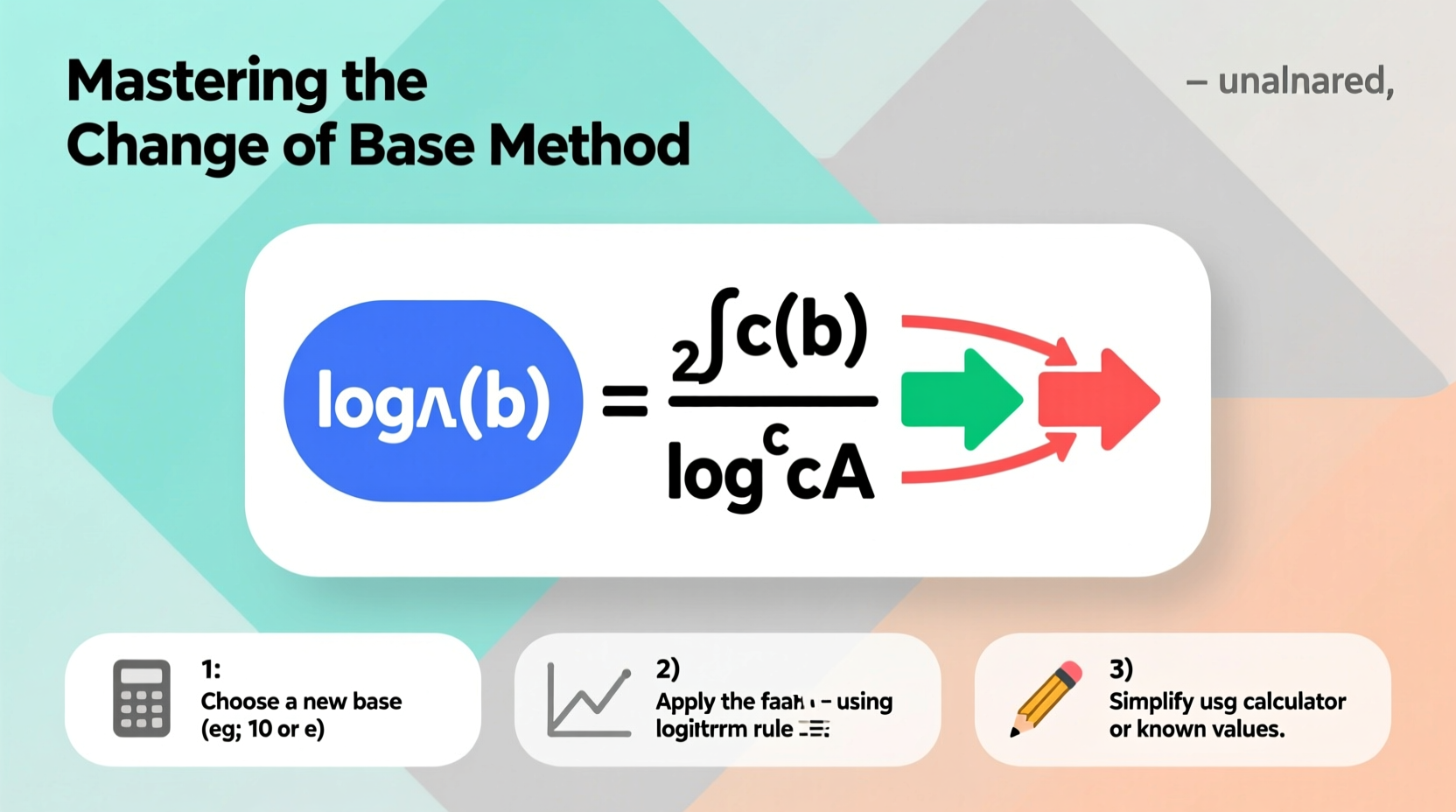
The change of base formula allows you to rewrite a logarithm in terms of logarithms with a different base. It’s especially useful when your calculator only supports base 10 (common log) or base e (natural log). The formula is:
logb(a) = logc(a)⁄logc(b)
Here, a is the argument, b is the original base, and c is the new base—typically 10 or e. The beauty of this identity lies in its flexibility: as long as all logs share the same new base c, the ratio remains equal to the original logarithm.
This formula stems from the inverse relationship between exponents and logarithms. Suppose y = logb(a). Then by definition, by = a. Taking the logarithm of both sides with respect to a new base c:
logc(by) = logc(a)
Using the power rule for logarithms (log(xn) = n·log(x)):
y·logc(b) = logc(a)
Solving for y:
y = logc(a)⁄logc(b)
Thus, logb(a) = logc(a)⁄logc(b).
Step-by-Step Guide to Applying the Change of Base Method
Follow this clear sequence to convert and evaluate any logarithm using the change of base formula.
- Identify the original logarithm. Determine the base and argument. For example, in log7(45), the base is 7 and the argument is 45.
- Choose a new base. Use base 10 (log) or base e (ln), depending on your calculator’s capabilities. Both will yield the same result.
- Rewrite using the formula. Apply log7(45) = log(45)⁄log(7) or equivalently ln(45)⁄ln(7).
- Evaluate each logarithm. Use a scientific calculator to find log(45) ≈ 1.6532 and log(7) ≈ 0.8451.
- Divide the results. 1.6532 ÷ 0.8451 ≈ 1.956.
- Interpret the answer. So, log7(45) ≈ 1.956, meaning 71.956 ≈ 45.
This process works regardless of how unusual the base or argument may seem. With practice, converting logs becomes second nature.
Practical Applications and Real-World Examples
The change of base method isn't just theoretical—it appears in various technical and financial contexts.
Mini Case Study: Calculating Investment Doubling Time
Sophia invests $5,000 at an annual interest rate of 6%, compounded annually. She wants to know how many years it will take for her investment to reach $12,000. Using the compound interest formula:
A = P(1 + r)t
12000 = 5000(1.06)t
Dividing both sides: 2.4 = (1.06)t
Taking the logarithm of both sides: log(2.4) = t·log(1.06)
Now solve for t: t = log(2.4)⁄log(1.06)
Using a calculator: log(2.4) ≈ 0.3802, log(1.06) ≈ 0.0253 → t ≈ 15.03 years.
Without the ability to compute non-standard logarithms via change of base, Sophia wouldn’t be able to determine this timeline precisely.
“Understanding logarithmic transformations empowers students to tackle exponential growth problems across disciplines—from biology to economics.” — Dr. Alan Reyes, Mathematics Educator
Common Pitfalls and How to Avoid Them
Even experienced learners make errors when applying the change of base formula. Below is a comparison of correct practices versus frequent mistakes.
| Do’s | Don’ts |
|---|---|
| Always place the log of the argument in the numerator. | Switching numerator and denominator (e.g., writing log(b)/log(a) instead of log(a)/log(b)). |
| Use consistent bases across both logs in the fraction. | Mixing base 10 in the numerator and base e in the denominator without conversion. |
| Round only at the final step to preserve accuracy. | Rounding intermediate logarithmic values too early, leading to cumulative error. |
| Verify your result by exponentiating: if logb(a) = x, then bx should be close to a. | Accepting results without checking reasonableness (e.g., log2(8) should be exactly 3). |
Checklist for Mastering the Change of Base Method
- ☐ Recognize when a logarithm has a non-standard base (not 10 or e).
- ☐ Recall the change of base formula accurately.
- ☐ Choose either common log (base 10) or natural log (base e) consistently.
- ☐ Input expressions into a calculator with proper parentheses.
- ☐ Verify results by raising the original base to the computed power.
- ☐ Practice with fractional arguments, decimal bases, and variables.
Frequently Asked Questions
Can I use any base when applying the change of base formula?
Yes, as long as the same base is used in both the numerator and denominator. However, bases 10 and e are most practical because they’re supported by virtually all calculators.
Why does the change of base formula work for all positive bases except 1?
Because logarithmic functions are only defined for positive bases not equal to 1. A base of 1 would produce a constant function (1x = 1 for all x), which has no inverse and thus no logarithm.
Is the change of base formula needed if I have a graphing calculator?
Modern calculators often include a built-in function for arbitrary logarithms (e.g., log□(□)), but understanding the underlying principle ensures you can verify results and work without technology when necessary.
Conclusion: Simplify Logarithms with Confidence
The change of base method is more than a calculator trick—it's a bridge between abstract logarithmic concepts and real computational power. By mastering this technique, you gain the ability to simplify, compare, and solve logarithmic expressions that appear in advanced math, science, and everyday decision-making. Whether you're analyzing data growth, calculating pH levels, or modeling population dynamics, this skill will serve you well. Don’t just memorize the formula; understand its derivation, practice its application, and test your answers. The deeper your fluency, the more effortlessly you’ll navigate the world of exponents and logarithms.




 浙公网安备
33010002000092号
浙公网安备
33010002000092号 浙B2-20120091-4
Comments
No comments yet. Why don't you start the discussion?