
The night sky has guided explorers, shaped calendars, and inspired philosophers for millennia. Long before GPS and digital maps, humans relied on the stars to find their way across deserts, oceans, and continents. Today, understanding the stars remains not only a survival skill but also a gateway to deeper awareness of our place in the universe. This guide provides a hands-on approach to reading the stars—how to identify key constellations, determine direction and time, and gain insight from celestial patterns using only your eyes and basic tools.
Understanding the Celestial Sphere
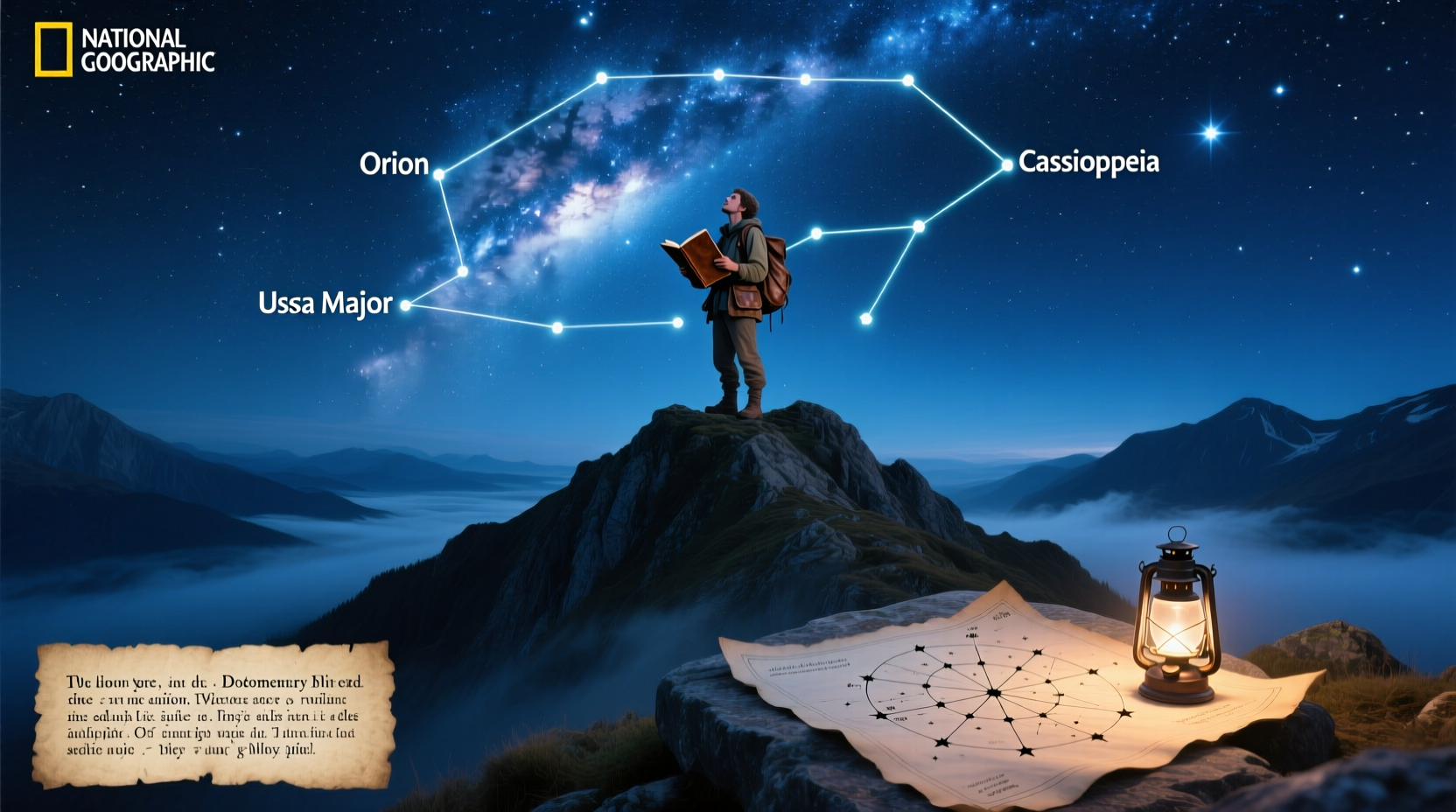
To navigate by the stars, you must first understand the concept of the celestial sphere—a conceptual dome surrounding Earth where stars appear fixed in position. Although stars move over vast timescales, they seem stationary night-to-night, rotating around Earth’s axis due to planetary rotation. The North Star (Polaris) sits nearly above Earth’s North Pole, making it a reliable anchor point in the northern hemisphere.
Stars rise in the east and set in the west, just like the sun, but their paths arc differently depending on your latitude. Observing these motions allows you to estimate both direction and time. For example, at 40°N latitude, Polaris appears about 40 degrees above the northern horizon—roughly four fist-widths held at arm’s length.
Locating Key Stars and Constellations
Familiarity with prominent constellations is essential for orientation. In the northern hemisphere, start with the Big Dipper (part of Ursa Major), which rotates around Polaris throughout the year. The two outer stars of the Dipper’s bowl—Dubhe and Merak—form the “pointer stars” that lead directly to Polaris when extended northward.
In summer, look for the Summer Triangle formed by Vega (in Lyra), Deneb (in Cygnus), and Altair (in Aquila). This asterism spans much of the eastern sky and helps orient observers during warm months. In winter, Orion the Hunter dominates the southern sky, easily recognized by his three-star belt and bright shoulder and foot stars.
| Season | Key Constellation | Primary Use |
|---|---|---|
| Spring | Leo | Tracking equatorial sky; locating Regulus |
| Summer | Cygnus & Lyra | Identifying Milky Way core direction |
| Fall | Pegasus | Marking transition to winter skies |
| Winter | Orion | Navigation via Betelgeuse and Rigel alignment |
Finding True North Using Polaris
Once you locate Polaris, you’ve found true north. Unlike magnetic north (which varies by location and shifts over time), Polaris offers a stable reference. To confirm its identity:
- Find the Big Dipper in the northern sky.
- Identify the two stars forming the outer edge of the cup.
- Draw an imaginary line through them, extending five times the distance between them.
- The bright star at the end of this line is Polaris.
South of the equator, Polaris is not visible. Instead, use the Southern Cross (Crux) to approximate south. Extend the long axis of the cross four and a half times downward from its base to reach an imaginary point above the southern horizon.
Navigating Without Instruments: A Step-by-Step Guide
You don’t need technology to travel confidently under the stars. With practice, you can determine direction, estimate time, and even gauge latitude—all through observation.
“Before compasses, Polynesian navigators crossed thousands of miles of open ocean using only wave patterns, bird flight, and star positions.” — Dr. Mārama Johnson, Cultural Astronomy Scholar
Step-by-Step Night Navigation Process
- Assess visibility: Ensure minimal light pollution and clear skies. Allow 20 minutes for your eyes to adapt to darkness.
- Identify the celestial pole: In the north, find Polaris; in the south, locate the Southern Cross or use Achernar as a secondary marker.
- Determine cardinal directions: Face Polaris—north is ahead, south behind, east to your right, west to your left.
- Select guiding stars: Choose bright stars rising or setting along your intended path. For east-west travel, follow stars near the celestial equator.
- Monitor progress: Note how constellations shift over time. A star moving upward is rising; one descending is setting.
- Estimate local time: Stars rotate 15 degrees per hour. If Orion crosses the meridian (highest point), it’s roughly midnight in December.
Using the Stars for Insight and Timekeeping
Beyond navigation, the stars offer insight into natural cycles. Ancient cultures aligned agriculture, rituals, and architecture with stellar events. The heliacal rising of Sirius signaled the Nile flood in Egypt; the Pleiades’ appearance marked planting seasons in Mesoamerica.
You can apply similar principles today. Track when certain stars first appear before dawn or dominate the evening sky. These transitions correlate with seasonal changes. For instance, when Orion rises at sunset, winter is approaching in the northern hemisphere.
Creating a personal star journal enhances observational depth. Record dates, times, weather conditions, and notable alignments. Over months, you’ll detect patterns in brightness, color, and movement that deepen your connection to the cosmos.
Real Example: Solo Trek Across the Utah Desert
In 2021, hiker Elena Reyes ran out of battery power on her GPS while traversing the Escalante wilderness. With no trail markers and fading daylight, she waited until nightfall to reorient. Recognizing Cassiopeia forming a ‘W’ high in the northeast, she located Polaris between Cassiopeia and the Big Dipper. By aligning her watchlight with Polaris and walking perpendicular to it, she maintained a westerly course and reached a ranger station by dawn. Her knowledge of basic stellar geometry saved critical time and energy.
Avoiding Common Mistakes
Even experienced stargazers make errors when under pressure. Here are frequent pitfalls and how to avoid them:
- Mistaking bright planets for stars: Planets like Venus or Jupiter often outshine actual stars but do not twinkle and remain near the ecliptic plane.
- Confusing mirror-image constellations: The Little Dipper (Ursa Minor) resembles the Big Dipper but is smaller and dimmer, with Polaris at the tip of its handle.
- Ignoring precession: Over centuries, Earth’s axis wobbles, shifting the position of the celestial poles. Polaris won’t always be the pole star—it will be Gamma Cephei in about 2,000 years.
- Relying solely on memory: Always verify star positions with multiple reference points. Use Orion’s belt or the Summer Triangle as cross-checks.
“The stars don’t change, but our perception of them does. Clarity comes from repeated observation, not instant mastery.” — Dr. Arun Patel, Astrophysicist and Outdoor Educator
Essential Checklist for Stellar Navigation
Before heading into dark skies, ensure you’re prepared:
- ☑ Know your latitude to anticipate star heights
- ☑ Learn 3–5 major constellations for your region and season
- ☑ Practice identifying Polaris or the Southern Cross
- ☑ Bring a red-light flashlight (preserves night vision)
- ☑ Carry a simple star chart or analog planisphere
- ☑ Allow time for eyes to adjust—avoid phone screens
- ☑ Record observations in a field journal
FAQ
Can I navigate by stars in cities with light pollution?
Heavily lit urban areas obscure all but the brightest stars. However, you can still identify Polaris, Sirius, or Orion’s Belt if you face away from downtown lights and allow full dark adaptation.
Do the stars change position every night?
Yes—but subtly. Stars rise approximately four minutes earlier each night, completing a full cycle over a year. This means constellations visible at midnight in January will rise at dusk by July.
Is stargazing safe alone at night?
Always inform someone of your plans, carry emergency supplies, and stay aware of terrain. Avoid steep edges or wildlife zones. Combine celestial skills with map-and-compass backup.
Conclusion: Reconnect with the Cosmos
Mastering the night sky is more than a survival technique—it’s a reclamation of ancestral wisdom and a practice of mindfulness. Each star tells a story of distance, time, and motion far beyond daily concerns. Whether you're hiking remote trails, sailing coastal waters, or simply stepping into your backyard on a clear night, the ability to read the stars fosters confidence, wonder, and perspective.




 浙公网安备
33010002000092号
浙公网安备
33010002000092号 浙B2-20120091-4
Comments
No comments yet. Why don't you start the discussion?