
In an age dominated by smartphones and smartwatches, the ability to read traditional timepieces—especially analog watches—is becoming a lost skill. Yet, understanding how to tell time from both analog and digital formats remains a fundamental life competency. Whether you're preparing for a job interview where punctuality is judged by your wristwatch, helping a child learn time-telling, or simply want to disconnect from screens, mastering watch time is both practical and empowering.
This guide breaks down the mechanics of analog and digital watches in plain, accessible language. You’ll learn not only how to read them but also how to teach others, avoid common mistakes, and build confidence in interpreting time at a glance.
Understanding Analog Watches: The Basics of Clock Hands
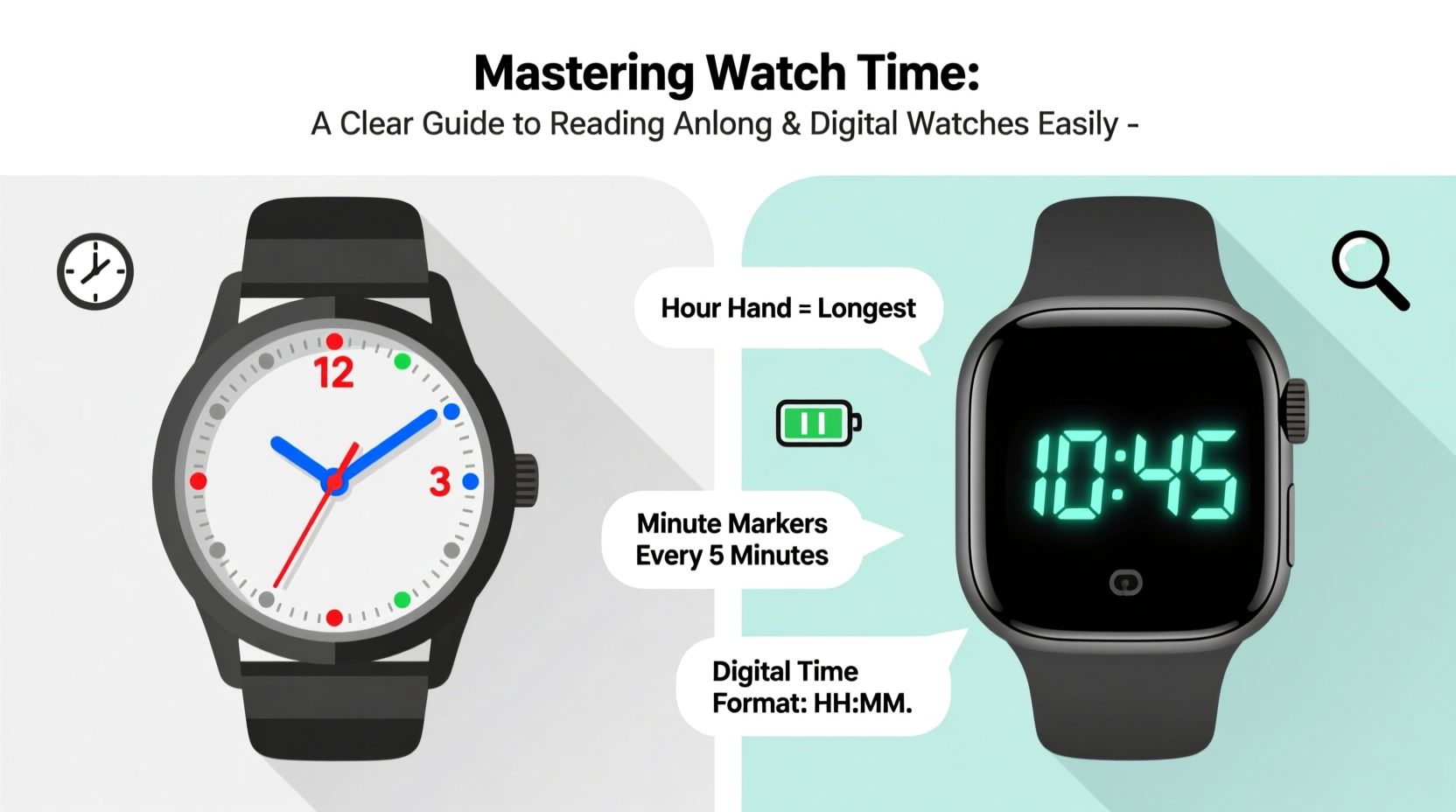
Analog watches feature a circular dial marked with numbers from 1 to 12, representing the hours in a 12-hour cycle. Three hands typically move around this dial:
- Hour hand – Shortest and thickest; indicates the current hour.
- Minute hand – Longer than the hour hand; points to the minutes past the hour.
- Second hand – Thinnest and often red or distinct in color; tracks seconds (not always present).
The dial is divided into 60 segments: 12 larger sections for hours and 60 smaller tick marks for minutes. Each number represents five-minute intervals. For example, when the minute hand points to the 3, it’s 15 minutes past the hour (3 × 5 = 15).
Step-by-Step Guide to Reading Analog Time
- Identify the hour: Look at the position of the hour hand. If it's between 4 and 5, the hour is 4.
- Determine the minutes: Check where the minute hand points. Multiply the number it’s closest to by 5, then add any extra ticks.
- Combine the values: Say the hour first, then the minutes. For example, hour hand near 4, minute hand at 7 (7 × 5 = 35) = 4:35.
- Note AM or PM: Most analog watches don’t display this, so context matters—morning vs. evening.
A common mistake is confusing the hour and minute hands. Remember: the shorter hand tells the hour, the longer one tells the minutes.
Digital Watches: Simplicity with Precision
Digital watches display time numerically, usually in the format HH:MM or HH:MM:SS. They eliminate interpretation and are ideal for quick glances. Most use either a 12-hour or 24-hour format.
| Format | Example | Meaning |
|---|---|---|
| 12-hour (AM) | 7:45 AM | 45 minutes past 7 in the morning |
| 12-hour (PM) | 7:45 PM | 45 minutes past 7 in the evening |
| 24-hour | 19:45 | Same as 7:45 PM; no AM/PM needed |
To convert 12-hour to 24-hour time: add 12 to any PM hour after 12:00. So, 1:00 PM becomes 13:00, 2:30 PM becomes 14:30, and so on. Midnight is 00:00, and noon is 12:00.
Common Challenges and How to Overcome Them
Even simple time-telling can trip people up. Children often struggle with elapsed time, while adults may misread analog dials under pressure. Here are frequent issues and solutions:
- Misreading \"quarter past\" and \"quarter to\": Teach that “quarter past” means 15 minutes after the hour, “half past” is 30 minutes, and “quarter to” is 15 minutes before the next hour.
- Confusing 12-hour and 24-hour clocks: Use real-life examples—train schedules often use 24-hour time, while household clocks use 12-hour.
- Estimating time between ticks: Practice estimating by dividing the space between numbers into five equal parts mentally.
“Time literacy is just as important as reading literacy. Being able to interpret a clock face builds cognitive skills like estimation, sequencing, and spatial reasoning.” — Dr. Linda Ruiz, Educational Psychologist
Mini Case Study: Learning with Leo
Leo, a 7-year-old student, struggled to tell time during his math lessons. His teacher introduced a hands-on approach: using a practice clock with movable hands. Each morning, Leo set the clock to match the classroom digital display. Within three weeks, he could confidently read both analog and digital times and even began calculating elapsed time for homework assignments. The key was repetition, visual aids, and connecting time to daily routines—like lunch at 12:15 or dismissal at 3:00.
Practical Tips for Teaching and Mastering Watch Time
Whether you’re teaching a child, relearning yourself, or training employees in time management, these strategies help solidify understanding:
Checklist: Building Confidence in Time-Telling
- ✅ Practice reading both analog and digital watches daily for 5–10 minutes.
- ✅ Use a labeled practice clock or app to manipulate hour and minute hands.
- ✅ Translate digital times into analog positions (and vice versa).
- ✅ Learn key phrases: “quarter past,” “half past,” “ten to,” etc.
- ✅ Test yourself with random times and verify accuracy.
- ✅ Teach someone else—explaining reinforces your own knowledge.
Frequently Asked Questions
Why do analog watches still matter in the digital age?
Analog watches enhance time awareness. Unlike digital displays that show exact numbers, analog faces visually represent the passage of time—how much has passed, how much remains. This spatial understanding supports better time management and is often required in academic and professional settings.
How do I read a watch without numbers?
Some minimalist watches lack numerals. In such cases, rely on the relative position of the hands. The top of the dial is 12, right side is 3, bottom is 6, and left is 9. Use these anchor points to estimate the hour and minute positions accurately.
Can I use my smartphone to practice analog time?
Yes. Many clock apps include analog displays. Set your phone’s clock widget to analog mode or download a learning app that simulates rotating hands. It’s a convenient way to practice without needing a physical watch.
Conclusion: Take Control of Your Time
Mastering watch time isn’t about nostalgia—it’s about competence. The ability to read both analog and digital watches fluently empowers you to navigate schedules, improve punctuality, and support cognitive development in everyday life. These skills are timeless, practical, and surprisingly foundational.
Start today: pick up a watch, pause for a moment, and read the time consciously. Practice until it becomes second nature. Share what you’ve learned with a child, a colleague, or a friend who might need a refresher. Time waits for no one, but with clarity and confidence, you can stay perfectly in sync.




 浙公网安备
33010002000092号
浙公网安备
33010002000092号 浙B2-20120091-4
Comments
No comments yet. Why don't you start the discussion?