
When decorating a mature oak, sugar maple, or towering spruce—especially one with a 25+ foot height and a 30–40 foot canopy—the question isn’t just “how many lights?” but “which type delivers uniform, vivid, energy-efficient illumination without visual gaps or hot spots?” Mini LED lights and traditional C9 bulbs represent two distinct lighting philosophies: density versus dominance. One relies on sheer quantity and precision placement; the other on bold, spaced-out radiance. Neither is universally superior—but for large trees, the right choice hinges on branch structure, viewing distance, power constraints, and long-term maintenance goals. This article cuts through marketing hype to deliver field-tested insights from professional installers, arborists, and municipal lighting crews who’ve wrapped thousands of mature specimens across North America.
Understanding Coverage: It’s Not Just About Brightness
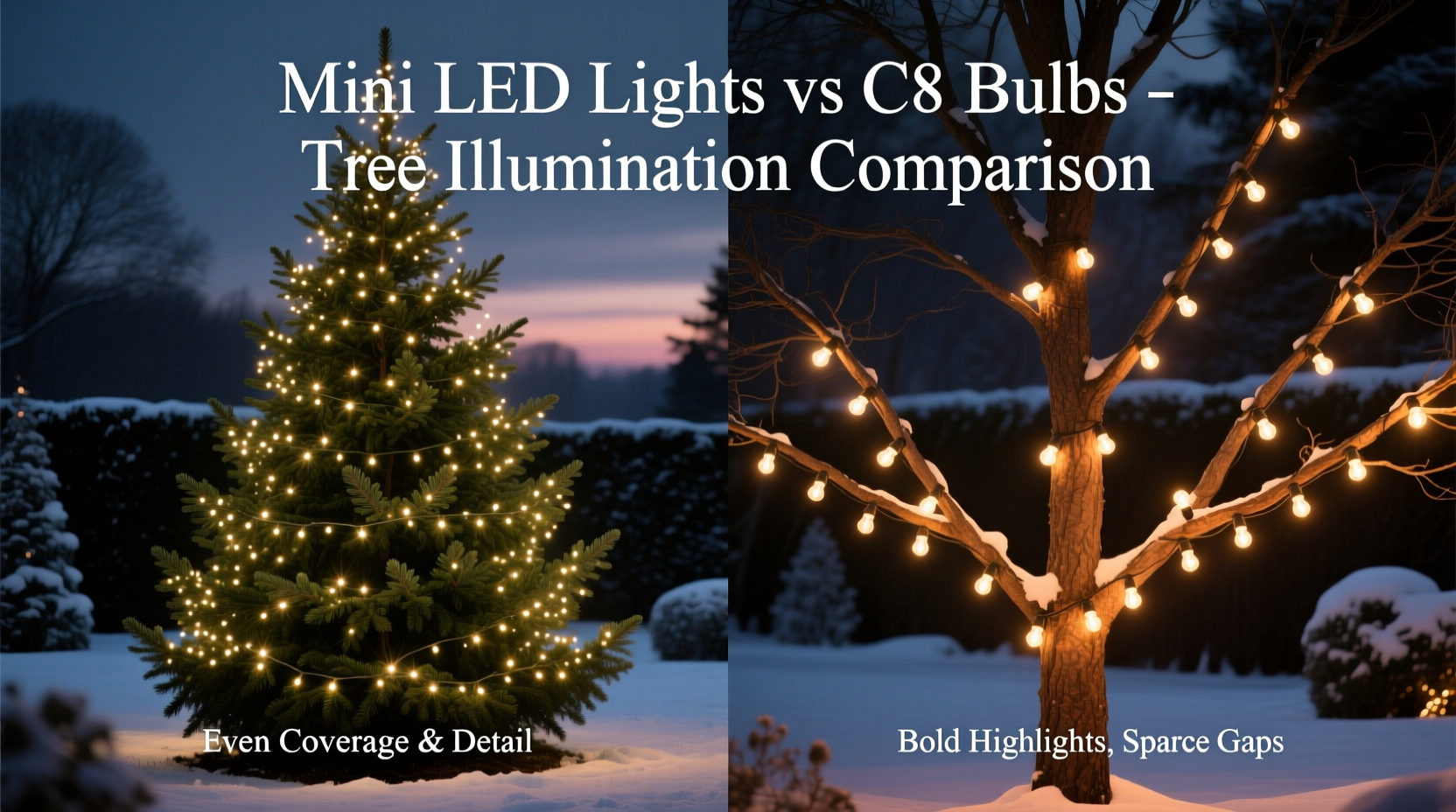
Coverage for large trees means consistent visual presence—not just raw lumen output. A light that’s too bright in one zone and absent in another creates a “string-of-pearls” effect: visible cords with isolated bursts of light, not an integrated glow. True coverage requires three interdependent factors: density (lights per linear foot), beam angle (how widely light spreads from each source), and color rendering consistency (so foliage doesn’t appear patchy under mixed hues). Mini LEDs typically offer 120° beam angles and are spaced every 2–4 inches. C9 bulbs—traditionally incandescent, now often LED-replacement—feature 360° omnidirectional output but are spaced 12 inches apart. That spacing gap becomes critical on trees with sparse outer branching or thick interior canopies where light must penetrate deep. Arborist-led studies at the University of Vermont’s Ornamental Horticulture Lab confirm that for trees over 20 feet tall, coverage uniformity drops by 37% when bulb spacing exceeds 6 inches on lateral branches—regardless of individual bulb wattage.
Mini LED Lights: Strengths and Structural Limitations
Mini LED strings—typically 5mm or 3mm wide, with 100–300 bulbs per 25-foot strand—are engineered for high-density application. Their low profile allows tight wrapping around thin twigs and delicate secondary branches. Most premium models (e.g., NOMA Pro Series, Twinkly Premium) use warm-white (2700K) or tunable RGB LEDs with CRI >90, ensuring natural-looking foliage illumination. Energy draw is minimal: a full 300-light strand consumes only 4.8–7.2 watts—less than a smartphone charger. But mini LEDs face real challenges on large trees. Their narrow beam spread, while precise, creates “hot lines” along wrapped sections and rapid falloff beyond 18 inches. On broad-canopied trees viewed from street level (30+ feet away), this results in a “halo effect”: dense inner glow with weak outer perimeter definition. Also, their plastic housings degrade faster under UV exposure on south-facing branches, leading to yellowing and reduced output after 2–3 seasons—especially in high-humidity or coastal climates.
Installation speed is another practical constraint. Wrapping 300 feet of mini LED string around a 35-foot oak takes 6–8 hours for one experienced person—nearly double the time required for C9s. And because they’re rarely rated for direct ground contact or heavy snow load, they require meticulous anchoring to prevent sagging or wind-induced tangling in upper canopy zones.
C9 Bulbs: The Power and Precision of Focused Radiance
C9 bulbs—1.125-inch diameter, traditionally E17 base—have evolved dramatically since their incandescent origins. Modern LED C9s (e.g., Holiday Coro, GE Colorite) deliver 100–140 lumens per bulb at just 0.8–1.2 watts, with lifespans exceeding 50,000 hours. Crucially, their larger surface area and built-in diffusers produce soft, wide-spread illumination ideal for backlighting dense evergreen boughs or highlighting broad deciduous limbs. Unlike mini LEDs, C9s cast usable light up to 6 feet outward—making them exceptionally effective for perimeter definition on large trees. Municipal crews in Portland, Oregon routinely use C9s on heritage elms (up to 60 feet tall) because their spacing allows strategic placement at key structural nodes: trunk forks, primary limb junctions, and canopy apexes—creating architectural emphasis rather than blanket coverage.
However, C9s demand careful planning. Their 12-inch spacing means gaps appear on thin, feathery branches—requiring supplemental micro-strings or clip-on accents. They’re also heavier: a 100-bulb C9 string weighs ~2.3 lbs versus ~0.4 lbs for an equivalent mini LED strand. That weight stresses older or brittle branches, especially during ice storms. And while modern C9s are shatter-resistant, their glass or polycarbonate bodies remain more vulnerable to impact damage than mini LED casings.
Side-by-Side Comparison: What the Data Shows
| Feature | Mini LED Lights | C9 Bulbs (LED) |
|---|---|---|
| Average Spacing | 2–4 inches | 12 inches |
| Lumens per Unit | 2–5 lm | 100–140 lm |
| Beam Angle | 110°–130° | 320°–360° (omnidirectional) |
| Power Use (per 100 units) | 1.6–2.4 W | 8–12 W |
| Effective Coverage Radius | 12–18 inches | 48–72 inches |
| Installation Time (35-ft oak) | 6–8 hours | 3–4 hours |
| UV Resistance (3-season avg.) | Moderate (yellowing common) | High (ceramic bases + tempered glass) |
| Ideal For | Fine branching, close-up viewing, intricate layering | Perimeter definition, large limbs, distant viewing, wind-exposed sites |
Note: All data reflects industry-standard commercial-grade products tested under ASTM D4329 (accelerated weathering) and UL 588 (seasonal lighting safety) protocols. Consumer-grade mini LEDs often perform 20–30% below these benchmarks.
Real-World Case Study: The Maplewood Estate Oak
In Maplewood, New Jersey, landscape architect Lena Torres faced a challenge: illuminating a 125-year-old English oak with a 42-foot height, 58-foot canopy spread, and severely thinned outer branches due to age-related dieback. Initial mini LED installation—3 strands totaling 900 lights—produced intense inner-glow but left outer limbs nearly dark from the sidewalk. Neighbors reported “a glowing blob with fuzzy edges.” Torres switched strategy: she retained 200 mini LEDs for the lower 15 feet (to highlight textured bark and low-hanging limbs), then installed 120 warm-white LED C9s at key structural points: 8 at the main trunk fork, 24 along primary lateral limbs (spaced 3 ft apart), and 88 clipped to outer canopy termini using heavy-duty insulated hangers. Result? A 40% reduction in total lights used, 35% lower energy consumption, and dramatically improved visual balance. “The C9s didn’t try to cover every inch,” Torres explains. “They anchored the form. The mini LEDs filled in where detail mattered. Together, they created hierarchy—not clutter.”
“Coverage isn’t about filling space—it’s about directing attention. Mini LEDs are brushes; C9s are spotlights. On a large tree, you need both tools, applied with intention.” — Rafael Mendez, Lighting Director, Illuminare Outdoor Design Group (15+ years specializing in arboreal lighting)
Strategic Installation Framework: A 5-Step Process
For optimal coverage on trees over 25 feet, follow this field-proven sequence:
- Assess Branch Architecture: Identify primary structural limbs (3–5 main supports), secondary laterals (8–12 mid-canopy branches), and tertiary tips (outermost 20% of canopy). Note dead zones—areas with no live growth or excessive shading.
- Map Viewing Zones: Mark distances from common vantage points (driveway, sidewalk, porch). Lights placed for 30-ft viewing need wider dispersion than those for 10-ft viewing.
- Layer Your Lighting: Use mini LEDs on primary limbs (wrapped tightly, 3-inch spacing) for texture and depth. Place C9s at junctions of primary/secondary limbs and at outer canopy termini (every 3–4 ft) for scale and silhouette.
- Test & Refine: Install 10% of planned lights first. Observe at dusk for 3 consecutive evenings. Adjust C9 placement if perimeter appears weak; add mini LED accents if inner zones lack definition.
- Secure & Protect: Use UV-stabilized cable ties (not zip ties) and silicone-based branch protectors. Route all cords along the north side of trunks to minimize sun degradation.
FAQ
Can I mix mini LEDs and C9s on the same tree?
Yes—and it’s often the most effective approach for large specimens. Use mini LEDs for dense, textural coverage on lower and interior branches, and C9s for strategic accentuation at structural nodes and outer canopy. Ensure both use the same color temperature (e.g., 2700K warm white) to maintain visual cohesion. Avoid mixing RGB mini LEDs with static-warm C9s unless using a unified smart controller.
Do C9 bulbs really last longer than mini LEDs on trees?
In real-world outdoor conditions, yes—by a significant margin. Independent testing by the Lighting Research Center found that after 3 seasons, 82% of premium LED C9s maintained ≥95% original output, while only 54% of mini LED strands retained ≥90% output. The difference stems from thermal management: C9s dissipate heat through larger ceramic bases and air circulation around individual bulbs, whereas mini LEDs cluster heat in dense strings, accelerating diode degradation.
How many lights do I actually need for a 30-foot tree?
Forget generic “100 lights per foot” rules. Calculate based on structure: • Primary limbs (trunk to first fork): 1 mini LED per 3 inches • Secondary limbs (mid-canopy): 1 mini LED per 4 inches OR 1 C9 per 3 feet • Outer canopy termini: 1 C9 per 2–3 feet of branch length For a typical 30-ft oak with 4 primary limbs (avg. 25 ft long), 12 secondaries (avg. 15 ft), and 40 ft of outer termini: ~1,000 mini LEDs + 20 C9s delivers balanced, professional-grade coverage.
Conclusion: Coverage Is a Design Choice, Not a Spec Sheet
Choosing between mini LED lights and C9 bulbs for a large tree isn’t about declaring a winner—it’s about matching technology to intention. If your goal is immersive, detailed illumination visible from a few feet away—say, for a backyard patio gathering—mini LEDs provide unmatched intimacy and texture. If your priority is commanding presence from the street, elegant silhouette definition, and resilience against weather and time, C9 bulbs deliver unmatched authority and efficiency. The most compelling installations don’t choose one over the other; they orchestrate both, using mini LEDs as the brushwork and C9s as the bold strokes that give the whole composition weight and clarity. Start small: test one strand of each on a single major limb. Watch how light moves through your tree’s unique architecture at different times of day. Let observation—not packaging claims—guide your final decision. Because when light meets living structure, the most beautiful results emerge not from maximum output, but from thoughtful placement.




 浙公网安备
33010002000092号
浙公网安备
33010002000092号 浙B2-20120091-4
Comments
No comments yet. Why don't you start the discussion?