
When it comes to illuminating large outdoor trees—whether towering pines, oaks, or spruces—the choice between mini lights and C7 bulbs can dramatically alter the final aesthetic. While both options are widely used in holiday and year-round landscape lighting, their visual weight, coverage, and overall impact differ significantly. For homeowners, event planners, or professional decorators aiming to create a memorable display, understanding these differences is essential. The decision isn’t just about personal taste; it’s about scale, visibility, energy efficiency, and long-term maintenance.
A 30-foot evergreen demands more than decorative sparkle—it needs presence. Mini lights may blanket it in shimmer, but C7s can define its silhouette with bold, rhythmic pulses of light. This article breaks down the functional and visual distinctions between these two popular bulb types, helping you determine which delivers a “bigger” impact when dressing large trees.
Brightness and Visibility: How Light Output Compares
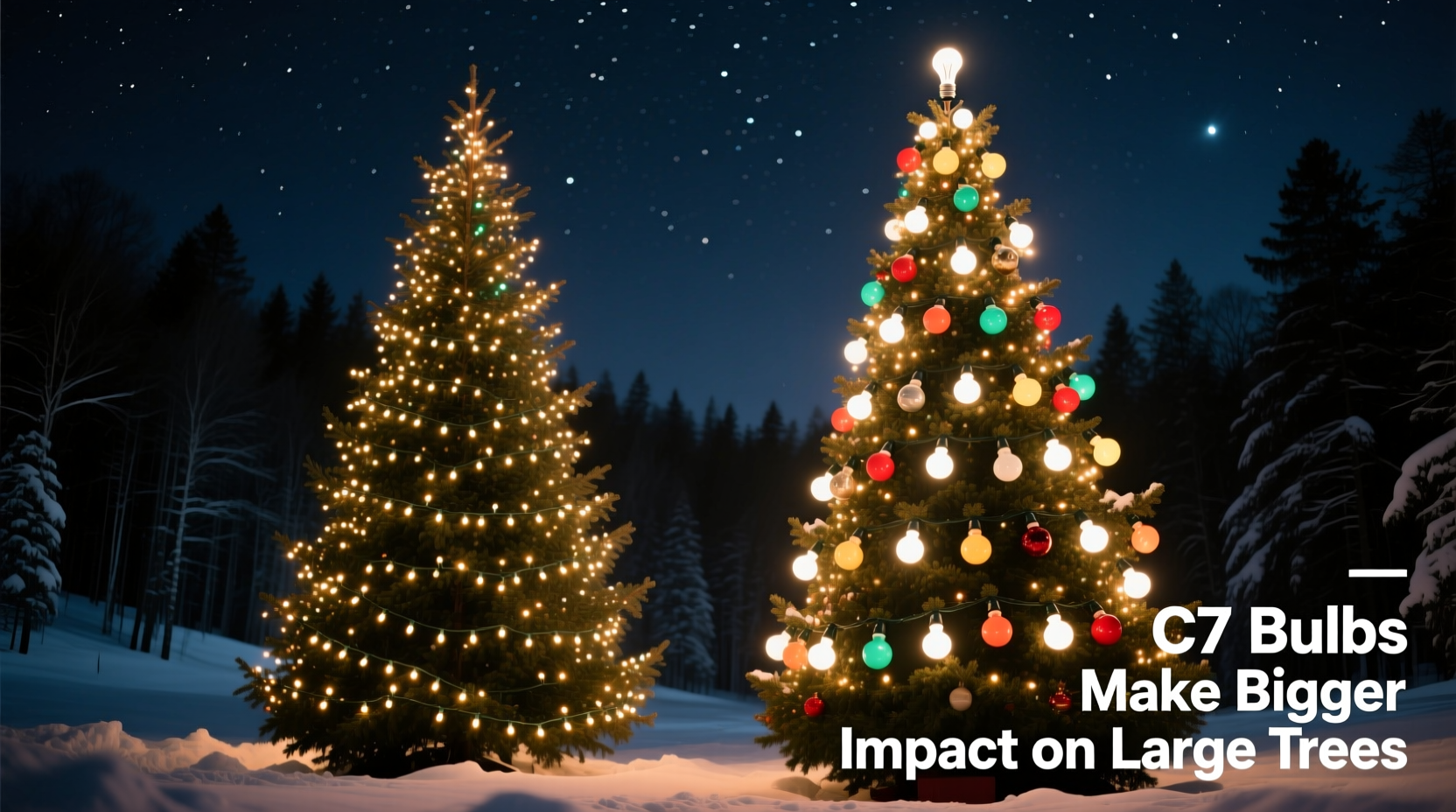
The most immediate difference between mini lights and C7 bulbs lies in luminosity. Mini lights, often referred to as \"fairy\" or \"twinkle\" lights, typically use incandescent or LED bulbs measuring around 5mm in diameter. These emit a soft, diffused glow ideal for delicate detailing. In contrast, C7 bulbs are larger—approximately 1.5 inches long with an E12 candelabra base—and produce significantly more lumens per bulb.
On a large tree, visibility from a distance becomes critical. Mini lights, even when densely strung, tend to blend into a continuous shimmer up close but can appear faint from across the yard or street. C7 bulbs, however, are designed for projection. Their larger filament (in incandescent versions) or high-output LED chips make them visible from greater distances, especially in low-light environments.
In practical terms, a single C7 bulb can emit between 40–70 lumens (depending on wattage and type), while a standard mini light produces only 1–4 lumens. That means you’d need at least 10–20 strands of mini lights to match the total output of one properly spaced string of C7s on a large conifer.
Coverage and Installation: Efficiency vs. Effort
Installing lights on a large tree is a labor-intensive task. The method and material you choose directly affect not only the time required but also the uniformity of coverage.
Mini lights are commonly sold in strings of 100 bulbs (25 feet), allowing for tight wrapping around branches. On a tree with dense foliage, such as a Douglas fir, this can create a snow-dusted effect. However, achieving full coverage on a tree over 20 feet tall may require 10 to 20 strings—or more—depending on spacing preferences. This translates to hundreds of connection points, increased wire bulk, and higher risk of failure due to circuit overload or moisture ingress.
C7 bulbs, by contrast, are usually spaced 6 inches apart on commercial-grade cords and come in longer runs—often 25 or 50 feet with 25 or 50 bulbs per string. Because each bulb is brighter, fewer are needed to achieve visual impact. A decorator might use five strings of C7s strategically placed along major limbs to outline the tree’s form, rather than attempting full coverage.
This approach emphasizes structure over saturation. Instead of hiding the tree under light, C7s highlight its natural shape, creating depth and dimension. From an installation standpoint, fewer strings mean faster setup, reduced tangling, and easier troubleshooting.
“With large specimen trees, I rarely use mini lights anymore. The labor-to-impact ratio just doesn’t justify it. C7s give me control, visibility, and drama with half the effort.” — Marcus Tran, Professional Landscape Lighting Designer
Comparison Table: Mini Lights vs C7 Bulbs for Large Trees
| Feature | Mini Lights | C7 Bulbs |
|---|---|---|
| Bulb Size | ~5mm diameter | ~1.5 inches long, E12 base |
| Lumens per Bulb | 1–4 | 40–70 |
| Typical String Length | 25 ft (100 bulbs) | 25–50 ft (25–50 bulbs) |
| Best For | Dense coverage, subtle glow | Bold outlines, long-distance visibility |
| Installation Time (Large Tree) | High (6–10+ hours) | Moderate (3–5 hours) |
| Durability | Moderate (fragile bulbs, thin wire) | High (thicker insulation, robust bases) |
| Energy Use (LED Equivalent) | Low per bulb, high in aggregate | Higher per bulb, lower total count |
Durability and Weather Resistance
Outdoor lighting must endure wind, rain, snow, and temperature fluctuations. C7 bulbs are generally built for commercial applications and feature thicker PVC-coated cords, sealed sockets, and weather-resistant housings. Many are rated for permanent outdoor use and can withstand sub-zero temperatures without cracking.
Mini lights, particularly older incandescent models, are more vulnerable. Thin wires fray easily, and individual bulbs can pop off during high winds. Even modern LED mini lights, while more efficient and cooler-running, often use lighter-duty wiring that degrades over multiple seasons. Moisture infiltration at connection points is a common cause of failure.
For a large tree where access is difficult—requiring ladders, lifts, or scaffolding—durability isn’t just a convenience factor. It affects safety, maintenance frequency, and replacement costs. A set of C7 strings lasting five to seven years outperforms ten sets of mini lights replaced every two years.
Real-World Example: Lighting a 35-Foot Blue Spruce
A homeowner in Colorado wanted to illuminate a majestic blue spruce in their front yard, visible from the street and neighboring homes. Initially, they installed 15 strands of LED mini lights, carefully weaving them through the lower two-thirds of the tree. While striking up close, neighbors commented that the tree “looked dark” from the road.
The following year, they switched strategy. They purchased six 50-foot strings of commercial-grade LED C7 bulbs in warm white, spacing them vertically along primary branches to follow the natural taper of the tree. Each string was secured with UV-resistant twist ties, and connections were elevated above ground level in waterproof junction boxes.
The result was transformative. The tree now stood out clearly at night, with rhythmic columns of light guiding the eye upward. Total installation time dropped from 10 hours to 4, and energy consumption decreased despite higher per-bulb wattage because fewer bulbs were needed. Most importantly, the visual impact increased dramatically—so much so that the local newspaper featured it in a holiday spotlight.
This case illustrates a key principle: for large-scale displays, perceived brightness matters more than total light count. Strategic placement of fewer, stronger sources often outperforms dense but dim coverage.
Step-by-Step Guide: Choosing and Installing Lights for a Large Tree
- Assess Viewing Distance: Determine where the tree will be seen from. If beyond 30 feet, prioritize brightness (C7s).
- Measure Tree Height and Canopy Spread: Use a laser measure or trigonometric estimation to calculate approximate linear footage needed.
- Choose Bulb Type: Select C7s for bold impact and easier installation, or mini lights for intricate, all-over sparkle.
- Calculate Quantity: For C7s, plan one string per major quadrant (e.g., four strings for even coverage). For mini lights, estimate 100 bulbs per vertical foot of tree height.
- Check Power Requirements: Ensure circuits can handle load. C7s draw more per string; use GFCI outlets and avoid daisy-chaining beyond manufacturer limits.
- Install Safely: Use stable platforms, wear gloves, and work with a partner. Start from the trunk and move outward.
- Secure Wiring: Use insulated hooks or plastic ties—never nails or staples. Keep cords away from sharp edges.
- Test Before Finalizing: Turn on lights during daylight to spot dead bulbs or gaps.
- Weatherproof Connections: Elevate junctions and cover with waterproof caps or silicone sealant.
- Schedule Maintenance: Inspect annually for damage, corrosion, or loose fittings.
FAQ: Common Questions About Mini Lights and C7s
Can I mix mini lights and C7s on the same tree?
Yes, but with caution. Mixing bulb types can create visual imbalance unless done intentionally. A recommended approach is using C7s to outline the main structure and mini lights to accentuate inner branches or specific zones like the base or tips. Ensure both systems operate on compatible voltages and are on separate circuits to avoid overloading.
Are C7 bulbs more expensive than mini lights?
Individually, yes—C7 strings typically cost 2–3 times more than equivalent-length mini light strands. However, because fewer are needed for large trees, the total project cost can be similar or even lower. Factor in longer lifespan and reduced labor to assess true value.
Do LED C7 bulbs look too harsh for residential use?
Not if chosen wisely. Modern LED C7s offer color temperatures from 2700K (warm white) to 5000K (daylight). For a residential setting, warm white or soft amber provides elegance without glare. Avoid cool white in neighborhoods unless aiming for a commercial or theatrical effect.
Final Considerations: Impact Beyond Illumination
The word “impact” encompasses more than brightness. It includes emotional resonance, neighborhood presence, and seasonal tradition. Mini lights evoke nostalgia—the delicate charm of childhood Christmases, twinkling softly in the frost. C7s command attention, suggesting celebration, abundance, and craftsmanship.
For a large tree, the goal is often dominance within the landscape—a beacon rather than a whisper. In this context, C7s inherently possess greater visual authority. They are the choice of municipalities, shopping centers, and public displays for a reason: they scale well and maintain clarity under real-world conditions.
That said, mini lights still have a place. Layering them beneath C7 outlines can add texture and depth. Used alone, they suit smaller trees or intimate settings. But when the objective is unmistakable presence on a large specimen, C7s deliver a more powerful statement with less material and effort.
“The right light doesn’t just illuminate a tree—it transforms it into a landmark.” — Lena Patel, Urban Landscape Architect
Conclusion: Make Your Statement with Confidence
Choosing between mini lights and C7s for a large tree ultimately hinges on intent. If subtlety and intricacy are your goals, mini lights can enchant. But if you want your tree to stand out boldly against the night sky—to be seen, remembered, and admired—C7 bulbs offer unmatched impact.
They provide superior brightness, require less labor for meaningful coverage, and last longer under demanding conditions. When scaled appropriately, they turn a backyard tree into a neighborhood focal point.




 浙公网安备
33010002000092号
浙公网安备
33010002000092号 浙B2-20120091-4
Comments
No comments yet. Why don't you start the discussion?