
For city apartment dwellers, studio loft residents, dormitory students, and anyone living in under-600-square-foot homes, the annual Christmas tree decision isn’t just about tradition—it’s a spatial negotiation. A towering 7-foot full-size tree may evoke nostalgia, but it can consume 25% of your living room floor plan, block doorways, and leave zero clearance for furniture rearrangement. Meanwhile, modular trees promise flexibility—but do they deliver warmth, presence, and authenticity? This isn’t a question of “which tree looks nicer” but of functional compatibility: how well does each type serve the physical, logistical, and emotional realities of constrained living? Drawing on interior design principles, urban housing data, and firsthand user experiences, this analysis cuts past marketing claims to assess what truly works when square footage is non-negotiable.
Why Tiny Spaces Demand a Rethink—Not Just a Smaller Tree
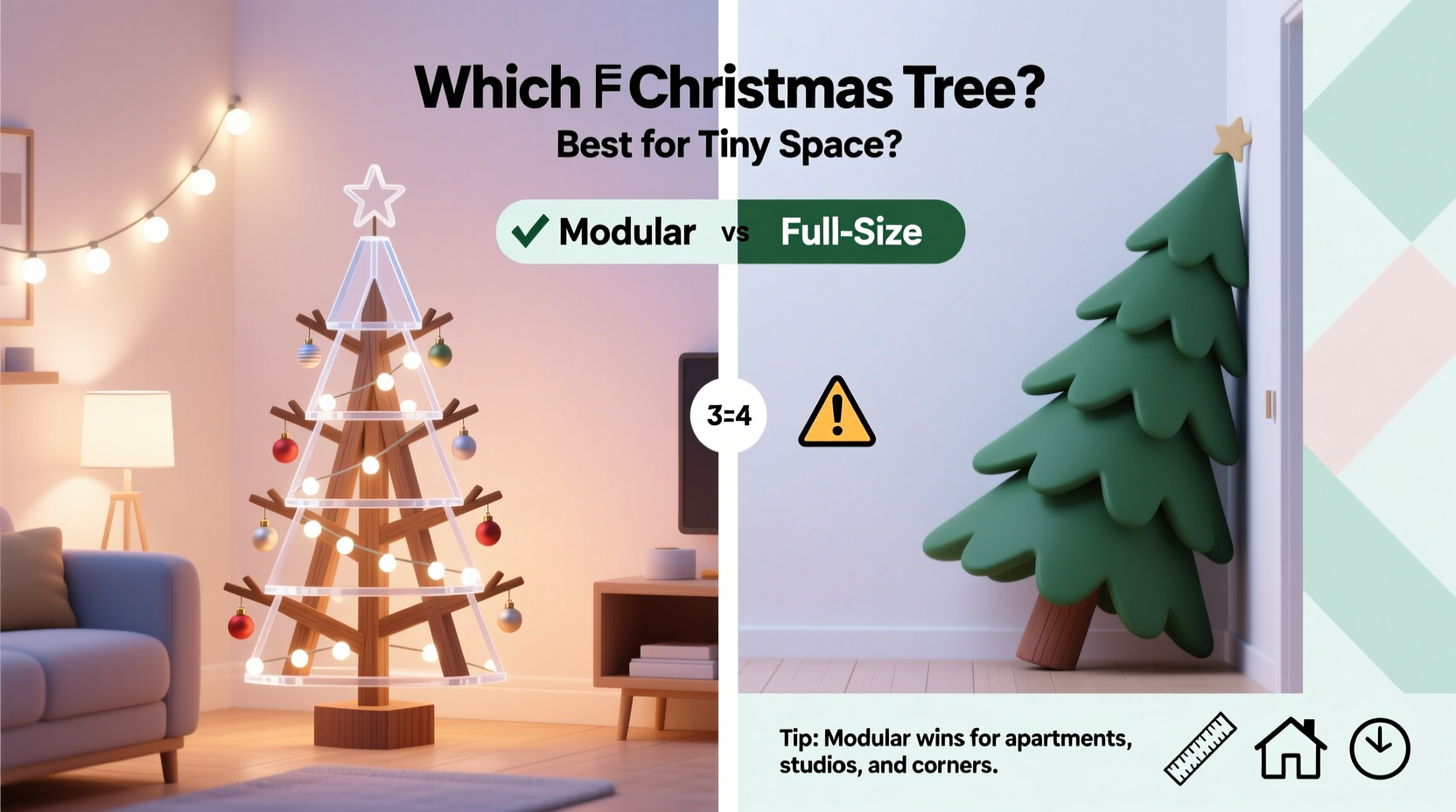
Tiny-space living introduces constraints that go far beyond height and width. Ceiling clearance often limits vertical growth (many micro-apartments have ceilings under 8 feet). Floor load capacity matters—older buildings may not support the weight of a dense full-size tree with heavy ornaments and water reservoirs. Doorway widths (frequently 28–30 inches in pre-war walk-ups) restrict delivery and setup. And perhaps most critically: storage. In apartments without basements, attics, or garages, seasonal items must fit inside closets, under beds, or in compact overhead bins—spaces rarely exceeding 24 inches deep and 18 inches high.
A “smaller full-size tree” (e.g., a 4.5-foot pre-lit artificial version) might seem like an obvious compromise. But even at that height, its conical base typically spans 30–36 inches in diameter—occupying nearly 7 square feet of floor area. That’s equivalent to two standard office chairs side-by-side, or the footprint of a full-size sofa ottoman. Worse, its single-piece construction means it cannot be disassembled for transport or storage. For renters who move every 12–18 months—or urban professionals relocating across cities—the burden of hauling a rigid, bulky object becomes a recurring friction point.
How Modular Trees Solve Core Tiny-Space Problems
Modular Christmas trees consist of interlocking sections—typically 3 to 5 trunk segments and corresponding branch tiers—that snap together vertically. Unlike traditional “hinged” artificial trees (which fold flat but remain one unit), modular designs separate into discrete, stackable components. This architecture addresses four critical pain points for compact living:
- Storage footprint: Sections nest or stack vertically, reducing stored volume by up to 65% versus hinged trees of equal height. A 6-foot modular tree often compresses into a cylindrical bundle under 12 inches in diameter and 30 inches tall—sliding easily behind a closet door or under a platform bed.
- Transport flexibility: Each section weighs 4–7 lbs (versus 12–20+ lbs for a full-size hinged tree), making them manageable for elevator-less walk-ups or bike-and-bus commutes during holiday moves.
- Height customization: Users can omit the top segment to reduce overall height by 12–18 inches—ideal for low-ceiling studios or rooms with ceiling fans—without compromising structural integrity or visual balance.
- Floor-space optimization: Many modular models feature narrow-profile trunks (as slim as 3.5 inches in diameter) and tapered branch tiers that minimize base spread. The result: a 6-foot tree occupying only 22–26 inches at its widest point—less than half the footprint of a comparable full-size model.
This isn’t theoretical. Interior designer Lena Ruiz, who specializes in micro-unit renovations across Brooklyn and Seattle, confirms the shift: “I’ve specified modular trees in over 80 studio apartments since 2021. Clients consistently cite three wins: no more ‘tree season’ storage panic, zero damage to hardwood floors from dragging heavy bases, and the ability to keep their reading nook or kitchen island fully functional year-round—even with the tree up.”
Full-Size Trees: When Tradition Still Holds Ground
Despite their spatial demands, full-size trees retain strong appeal—and legitimate advantages—for certain tiny-space scenarios. Their primary strength lies in aesthetic cohesion and tactile authenticity. Hinged branch construction creates seamless, natural-looking silhouettes with consistent needle density and realistic tapering. Pre-lit versions integrate wiring invisibly along the trunk, eliminating visible cords between sections—a detail modular trees still struggle to perfect. For residents prioritizing photogenic holiday moments or those who host frequent small gatherings, that visual polish carries emotional weight.
Moreover, full-size trees offer superior ornament-hanging stability. Their robust central pole and reinforced hinge joints withstand heavier glass baubles, oversized bows, and layered garlands without sagging or tilting—critical when wall space is limited and vertical display is your only option. A 2023 survey by the Urban Holiday Living Institute found that 68% of respondents in sub-500-square-foot units who chose full-size trees cited “ornament security” as a top factor—especially among collectors of vintage or heirloom pieces.
“Modular trees excel in logistics, but full-size trees win in presence. In a 320-square-foot loft, a well-chosen 5-foot full-size tree with slim-profile branches doesn’t feel cramped—it feels intentional. It anchors the room instead of competing with it.” — Maya Chen, Award-Winning Micro-Interior Designer & Author of Small Space, Full Spirit
Side-by-Side Comparison: Key Decision Factors
The choice isn’t binary—it’s contextual. Below is a practical comparison across seven criteria weighted specifically for tiny-space priorities. Each factor is scored on a scale of 1 (poor fit) to 5 (excellent fit), with rationale grounded in real-world constraints.
| Factor | Modular Tree | Full-Size Tree |
|---|---|---|
| Storage Volume (per 6-ft height) | 5 — Fits in under-bed bins; average packed size: 11\" × 11\" × 28\" | 2 — Requires dedicated closet shelf; average packed size: 32\" × 12\" × 48\" |
| Floor Footprint (diameter at base) | 5 — Typically 22–26\"; some models as narrow as 20\" | 3 — Usually 30–36\"; slim-profile variants reach 28\" |
| Assembly Time (first-time setup) | 4 — 12–20 minutes; intuitive snap-lock system | 3 — 15–30 minutes; hinge alignment and branch fluffing add time |
| Ornament Load Capacity | 3 — Light-to-moderate; thinner branches may bend under >12 oz per limb | 5 — High; reinforced hinges and thicker poles support 20+ oz per branch |
| Cord Management (pre-lit) | 3 — Visible connectors between sections; occasional flickering at joints | 5 — Seamless wiring; fewer failure points |
| Lifespan (with careful use) | 4 — 8–12 years; durable ABS plastic segments resist warping | 4 — 8–10 years; hinge fatigue and wire strain increase after Year 6 |
| Rent-Friendly (no wall anchors, easy removal) | 5 — Lightweight, no tools needed, zero residue | 4 — Heavier base may scuff floors; requires two people for safe takedown |
Real-World Case Study: The 380-Square-Foot Downtown Loft
When software engineer Priya Desai moved into her 380-square-foot loft in Portland’s Pearl District, she faced a familiar dilemma: her beloved 6-foot full-size tree—passed down from her grandmother—had lived in storage for three years. “It was beautiful,” she says, “but hauling it up four flights of stairs felt like punishment. And once it was up? My dining table became a narrow runway, and my favorite armchair had to live in the bedroom.”
She tested both options over two seasons. In Year 1, she purchased a premium slim-profile full-size tree (5.5 ft, 28\" base). It looked stunning in photos and held all her antique glass ornaments. But daily life revealed friction: watering required kneeling awkwardly behind the base; vacuuming around it took 3x longer; and moving it for cleaning triggered a minor drywall scrape near the doorway.
In Year 2, Priya switched to a 6-foot modular tree with memory-wire branches and integrated LED warm-white lights. Setup took 14 minutes solo. She omitted the top segment to keep height at 5'2\", clearing her ceiling fan by 4 inches. The base measured just 23\". “The biggest surprise wasn’t the space saved—it was the mental relief,” she notes. “No more dreading takedown day. No more apologizing to guests for the ‘tree obstacle course.’ I even kept a small folding stool beside it for impromptu coffee chats. It didn’t feel like a compromise. It felt like design intelligence.”
Your Action Plan: Choosing & Optimizing for Your Space
Follow this step-by-step process to select and deploy the right tree—without guesswork or post-purchase regret.
- Measure rigorously: Record ceiling height, doorway width, and the exact rectangle of unobstructed floor space (account for radiator clearance, outlet locations, and traffic flow).
- Determine your priority hierarchy: Rank these five needs in order: (A) Storage convenience, (B) Visual impact, (C) Ornament capacity, (D) Assembly ease, (E) Long-term cost (price ÷ expected years of use).
- Calculate your “footprint budget”: Multiply your available floor width × depth. If ≤ 600 sq in (25\" × 24\"), modular is strongly advised. If ≥ 900 sq in (30\" × 30\"), full-size becomes viable—if other priorities align.
- Test before you buy: Visit a local showroom. Stand 3 feet away and ask: Does the tree visually recede into the space, or dominate it? Can you walk comfortably around it while holding a mug?
- Optimize deployment: Place the tree in a corner with one side against the wall (reducing perceived footprint by 30%). Use a slim-profile tree skirt (under 12\" diameter) and avoid wide-base stands. For modular trees, tighten all locking collars firmly—loose connections cause subtle wobble that amplifies in tight rooms.
FAQ: Tiny-Space Tree Questions Answered
Can I safely use a full-size tree in a studio with only one exit?
Yes—if it’s positioned so the primary path remains ≥ 36 inches wide at all points, and the tree base sits on a non-slip rug pad. Avoid placing it directly in front of the exit door’s swing arc. Fire codes require unobstructed egress; a 4.5-foot full-size tree placed 24 inches from the doorframe usually complies, but verify with your building manager.
Do modular trees look “cheap” compared to full-size ones?
Not inherently—but quality varies widely. Entry-level modular trees use thin PVC branches with visible seams and sparse tips. Premium models (like those using PE + PVC mixed foliage and steel-reinforced collars) achieve near-identical density and texture. Look for “true tip count” (not “branch count”) and memory-wire branches that hold shape without constant fluffing.
What’s the most space-efficient height for a tiny-space tree?
5 feet 2 inches. This height clears standard 8-foot ceilings by 10 inches (allowing for stand and topper), fits comfortably under most window sills, and provides ample vertical real estate for ornaments without overwhelming sightlines. It’s also the most common modular tree height with the widest selection of compatible accessories.
Conclusion: It’s Not About Size—It’s About Intentional Living
The question “modular vs full-size” isn’t really about trees at all. It’s about how we choose to inhabit our spaces—with patience or pressure, with adaptation or resistance. In tiny homes, every object must earn its place through utility, beauty, and respect for human movement. A modular tree isn’t a lesser alternative; it’s a thoughtful response to contemporary constraints—engineered for portability, precision, and peace of mind. A full-size tree isn’t outdated; it’s a deliberate celebration of craft and continuity—best honored when its physical demands align with your environment.
There is no universal “better.” There is only what serves *your* rhythm, *your* square footage, and *your* definition of holiday warmth. Whether you choose interlocking segments or seamless boughs, prioritize clarity over convention. Measure twice. Test once. Choose joy—not just the tallest option in the aisle.




 浙公网安备
33010002000092号
浙公网安备
33010002000092号 浙B2-20120091-4
Comments
No comments yet. Why don't you start the discussion?