
The Samsung Galaxy Note 10 Plus was a flagship powerhouse when it launched in 2019, offering premium design, a top-tier display, and one of the best S Pen experiences on the market. But shortly after its release, Samsung introduced a second variant: the Note 10 Plus 5G. At first glance, the naming suggests that 5G connectivity is the sole upgrade. However, the differences go beyond just network support. Understanding what truly sets these two models apart can help users make informed decisions—especially those considering buying a used or refurbished unit today.
Hardware Differences Beyond Network Support
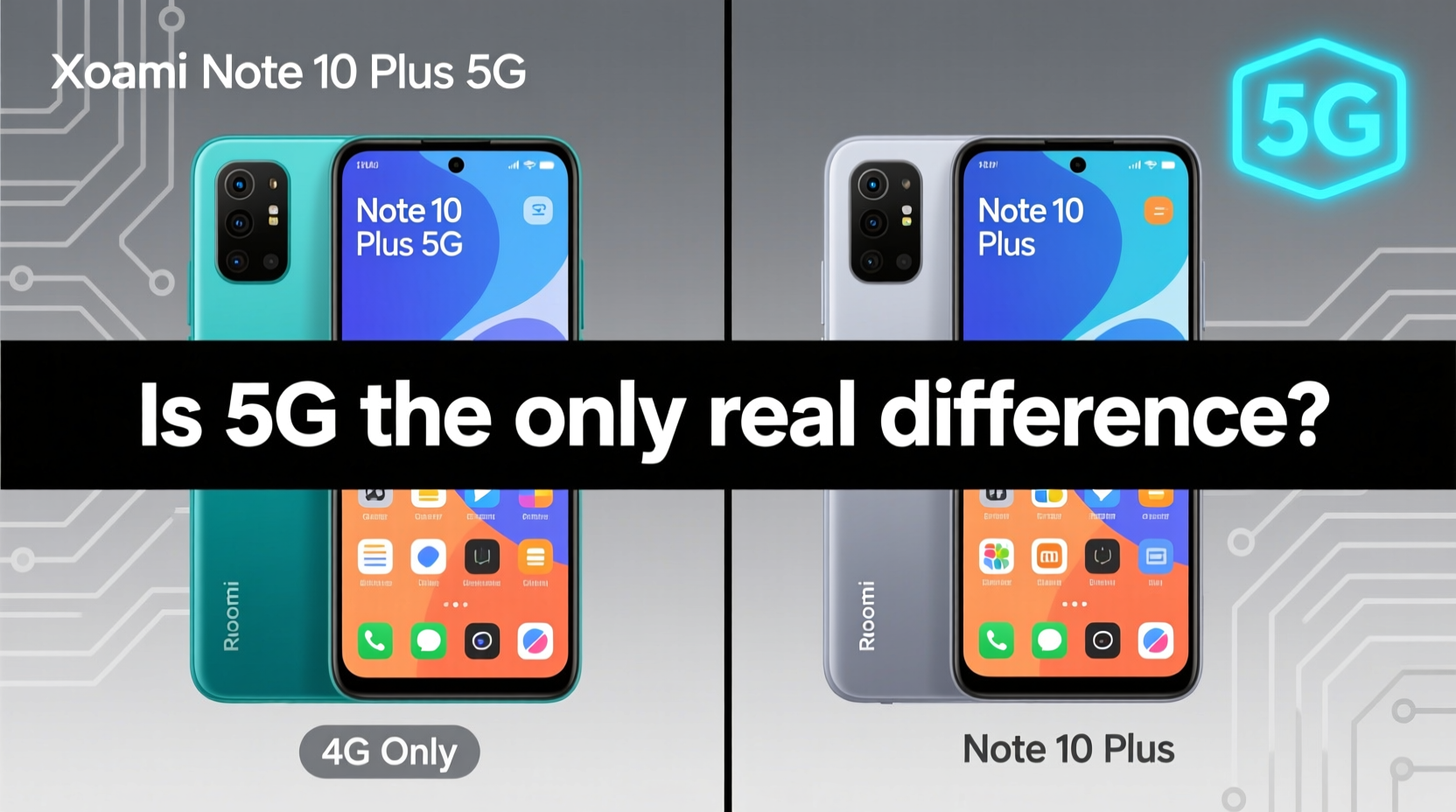
While both devices share nearly identical designs, displays, and camera systems, the core divergence lies in their internal hardware. The standard Note 10 Plus uses the Exynos 9825 (in most global markets) or the Snapdragon 855 (in select regions like the U.S.). In contrast, the Note 10 Plus 5G exclusively features the Snapdragon 855 chipset paired with the Snapdragon X50 5G modem.
This shift isn't just about enabling faster internet. The 5G model benefits from slightly better thermal management due to revised internal layout and additional shielding for the modem. Moreover, the 5G version includes mmWave support in certain regional variants (particularly in the U.S.), which allows for ultra-fast short-range connections where infrastructure exists.
Processor and Modem Configuration by Region
| Model | Chipset | Modem | 5G Support |
|---|---|---|---|
| Note 10 Plus (Global) | Exynos 9825 | Integrated LTE | No |
| Note 10 Plus (U.S.) | Snapdragon 855 | LTE Advanced | No |
| Note 10 Plus 5G (Global) | Snapdragon 855 | Snapdragon X50 | Yes (Sub-6GHz) |
| Note 10 Plus 5G (U.S.) | Snapdragon 855 | Snapdragon X50 + mmWave | Yes (mmWave & Sub-6) |
The move to Snapdragon-only for the 5G model also means more consistent performance across regions compared to the standard model, which suffered from variable benchmark results depending on whether it ran Exynos or Snapdragon silicon.
Battery and Thermal Performance
One often-overlooked consequence of adding 5G capability is increased power consumption. To compensate, Samsung equipped the Note 10 Plus 5G with a marginally larger battery—4,300mAh compared to the original’s 4,170mAh. While this increase seems minor, it helps offset the energy demands of the X50 modem, especially during sustained high-speed data transfers.
Thermal design also differs. The 5G model includes enhanced heat dissipation materials around the modem and processor area. This results in better sustained performance during intensive tasks such as video streaming over 5G or gaming while downloading large updates.
“Early 5G modems were notoriously inefficient. Adding dedicated cooling wasn’t optional—it was necessary to prevent throttling.” — Dr. Lin Zhao, Mobile Systems Engineer at TechInsight Group
Camera and Software: Are They Identical?
On paper, both models feature the same quad-camera array: a 12MP wide lens, 12MP telephoto, 16MP ultra-wide, and a VGA depth sensor. Image processing algorithms, night mode, and AR Doodle functionality via the S Pen are identical across both versions.
Software updates were delivered simultaneously to both models until Samsung ended major Android version support after Android 11. Security patches continued into 2022. No functional software differences exist between the two; they received the same firmware builds regardless of 5G capability.
However, real-world usage reveals subtle behavioral differences. Users reported slightly faster photo upload times to cloud services when using 5G, particularly with large RAW files or 4K videos. While the camera itself doesn’t change, the improved connectivity enhances workflow efficiency for professionals relying on instant backups.
Real-World Impact: Does 5G Make a Difference Today?
To assess whether the 5G upgrade matters now, consider a real example: Maria, a freelance photographer based in Chicago, purchased a Note 10 Plus 5G in early 2020. She frequently shoots events and needs to send high-resolution images to clients within minutes. Using mmWave 5G near downtown venues, she achieved upload speeds exceeding 300 Mbps—over five times faster than her previous LTE device.
For her, the 5G model wasn’t just future-proofing; it became a productivity tool. She could edit photos on-device and upload them directly without needing Wi-Fi or a laptop. In areas with weak 5G coverage, performance reverted to LTE levels, but hotspots with strong signals made a tangible difference.
That said, outside dense urban centers, 5G availability remains spotty. In rural or suburban areas, the practical benefit diminishes significantly. For most users who primarily rely on Wi-Fi at home and moderate mobile data elsewhere, the absence of 5G won’t hinder daily use.
Step-by-Step: How to Determine Which Model You Have or Should Buy
- Check the model number: Go to Settings > About Phone > Model Number. N970F = standard, N975F = 5G.
- Verify carrier compatibility: Some carriers locked 5G bands only to specific plans or devices.
- Assess your location: Use your carrier’s 5G coverage map to see if you’ll actually benefit.
- Evaluate usage patterns: Do you regularly transfer large files? Stream 4K video on the go? Need low-latency connections?
- Consider longevity: Even if 5G isn’t critical now, having it may extend the phone’s useful life another year or two.
Common Misconceptions About the Two Models
- Myth: The 5G model has a better camera — False. Hardware and software are identical.
- Myth: The 5G version charges faster — No, both support 25W wired and 12W wireless charging.
- Myth: It runs cooler because of newer tech — Actually, the 5G model runs warmer under load but manages heat better long-term.
- Myth: All Note 10 Plus 5G models support mmWave — Only U.S. variants include mmWave; others use Sub-6GHz only.
Frequently Asked Questions
Can the standard Note 10 Plus be upgraded to 5G?
No. 5G requires specific hardware—the Snapdragon X50 modem and compatible antennas—which are physically absent in the standard model. There is no software update or SIM swap that enables 5G on non-5G units.
Does the 5G model drain the battery much faster?
In active 5G use, yes—battery drain increases by approximately 15–20% compared to LTE. However, modern standby behaviors and adaptive connectivity (switching to LTE when 5G isn’t needed) help mitigate this in everyday scenarios.
Is the Note 10 Plus 5G still worth buying in 2024?
As a primary device, probably not. With no official Android 12+ updates and aging hardware, it’s best suited for secondary use, collectors, or budget-conscious buyers in regions with limited smartphone access. That said, its 5G capability gives it an edge over the standard model if priced similarly.
Final Verdict: Is 5G the Only Real Difference?
No—while 5G connectivity is the headline change, it triggers a chain reaction of supporting upgrades: a different chipset configuration, improved thermal design, a slightly larger battery, and region-specific mmWave support. These changes collectively enhance reliability, performance consistency, and future readiness.
For most consumers in 2019, the difference was academic. But today, with 5G networks expanding and cloud-based workflows becoming standard, the 5G model demonstrates greater staying power. It wasn’t just about speed; it was about preparing for a connected future.




 浙公网安备
33010002000092号
浙公网安备
33010002000092号 浙B2-20120091-4
Comments
No comments yet. Why don't you start the discussion?