
When Samsung released the Galaxy S20 Plus in early 2020, it arrived just months after the Note 10 Plus had solidified its place as a premium Android flagship. For users who invested in the Note 10 Plus—especially those drawn to its stylus, large display, and productivity features—the question quickly emerged: Is upgrading to the S20 Plus actually worthwhile? On paper, the S20 Plus brings newer hardware and advanced specs, but real-world value depends on individual needs, usage patterns, and how much you’ve already benefited from your current device.
This breakdown compares both phones across key categories—design, display, performance, camera, battery, and software—to help you determine whether the upgrade delivers meaningful improvements or simply offers incremental gains at a high cost.
Design and Build: Evolution Over Revolution
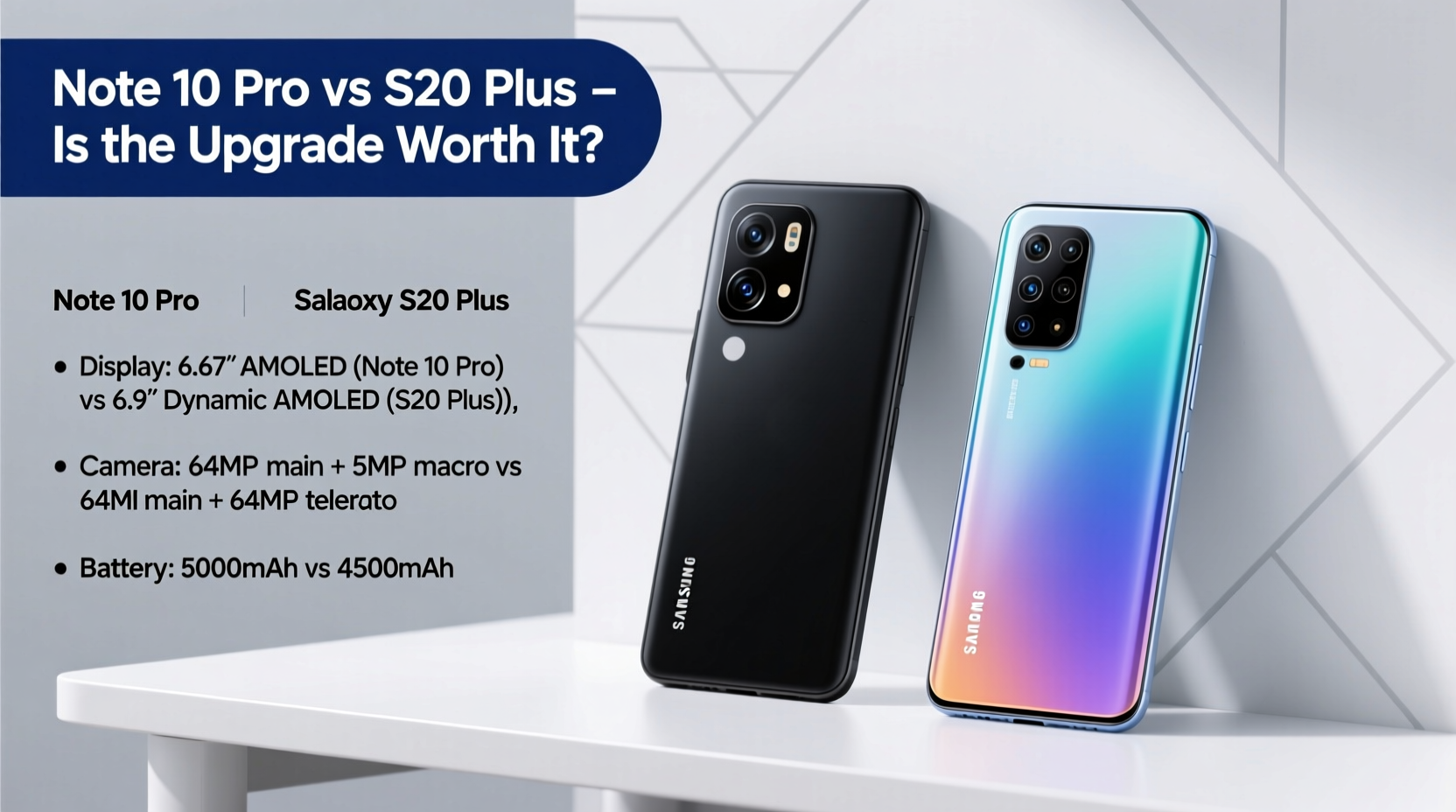
At first glance, both phones share Samsung’s signature glass-and-metal construction with curved displays and minimal bezels. However, subtle differences impact usability and feel.
The Note 10 Plus measures 162.3 x 77.2 x 7.9 mm and weighs 196 grams. It features a sleek, symmetrical design with a centered front camera punch-hole. In contrast, the S20 Plus is slightly taller at 166.9 x 76.0 x 7.8 mm but lighter at 186 grams. Its front-facing camera is off-center, which some find distracting during video calls or media viewing.
Both devices are IP68-rated for dust and water resistance and support wireless charging and reverse wireless charging. The S20 Plus introduces a more refined matte finish option on certain color variants, reducing fingerprint smudges—a small but appreciated upgrade.
Display and Refresh Rate: A Game-Changing Difference
One of the most significant upgrades in the S20 Plus is its 6.7-inch Dynamic AMOLED 2X display with a 120Hz refresh rate. The Note 10 Plus also has a 6.7-inch Dynamic AMOLED panel, but limited to 60Hz.
A higher refresh rate makes scrolling, gaming, and animations noticeably smoother. While not essential for all users, those sensitive to motion fluidity often find the 120Hz experience transformative once experienced. The S20 Plus dynamically switches between 60Hz and 120Hz to conserve battery, though early firmware limited adaptive switching until later updates.
Both screens offer QHD+ resolution, HDR10+ support, and excellent brightness (up to 1300 nits). Color accuracy and outdoor visibility remain top-tier on both. However, the S20 Plus’s higher peak refresh rate gives it a clear edge in modern user experience standards.
“The jump from 60Hz to 120Hz is one of the most tangible display improvements since moving from HD to Full HD.” — James Lee, Mobile Display Analyst at TechPulse Insights
Performance and Hardware: Power You Might Not Need
Under the hood, the S20 Plus is powered by either the Snapdragon 865 (U.S. models) or Exynos 990 (international), paired with 12GB of RAM. The Note 10 Plus uses the Snapdragon 855 or Exynos 9825 with 12GB of RAM.
The difference in real-world performance is measurable but often imperceptible. Day-to-day tasks like browsing, messaging, and app switching feel equally snappy on both devices. However, the S20 Plus shows advantages in sustained workloads, multitasking with multiple heavy apps, and future-proofing for upcoming software demands.
Storage options differ slightly: the Note 10 Plus starts at 256GB (expandable via microSD), while the S20 Plus launched with 128GB or 512GB options—also expandable. Both support UFS 3.0 storage, ensuring fast read/write speeds.
If you're a power user or plan to keep your phone beyond three years, the S20 Plus’s newer chipset provides longer relevance. Casual users may not notice the leap.
Camera Comparison: Incremental Gains With Trade-Offs
On paper, the S20 Plus appears to dominate the camera department. It features a 64MP primary sensor (vs. 12MP on the Note 10 Plus), a 12MP ultra-wide, and a new 64MP periscope telephoto lens offering up to 30x digital zoom (vs. 12MP telephoto with 2x optical zoom on the Note 10 Plus).
In practice, results vary. The Note 10 Plus continues to deliver excellent dynamic range, accurate colors, and reliable low-light performance. Its camera system, while older, was highly tuned through years of software updates.
The S20 Plus improves zoom capability significantly. At 10x hybrid zoom, it outperforms the Note 10 Plus, making distant subjects more accessible. However, image processing can be overly aggressive, resulting in loss of detail or unnatural textures in complex scenes. Low-light photos sometimes appear brighter but noisier compared to the Note 10 Plus’s more balanced approach.
For videographers, both phones support 4K at 60fps and excellent stabilization. The S20 Plus adds 8K video recording at 24fps—a novelty for most users given limited playback support and massive file sizes.
| Feature | Note 10 Plus | S20 Plus |
|---|---|---|
| Main Camera | 12MP, f/1.8, Dual Pixel AF | 64MP, f/1.8, PDAF |
| Ultra-Wide | 16MP, f/2.2, 123° FoV | 12MP, f/2.2, 120° FoV |
| Telephoto | 12MP, f/2.1, 2x optical zoom | 64MP, f/2.0, 3x hybrid / 30x digital zoom |
| Front Camera | 10MP, f/2.2 | 10MP, f/2.2, dual pixel AF |
| Video Recording | 4K@60fps, Super Steady | 8K@24fps, 4K@60fps, Super Steady+ |
Battery Life and Charging: Similar Endurance, Faster Options
The Note 10 Plus packs a 4,300mAh battery; the S20 Plus uses a slightly smaller 4,200mAh unit. Despite this, both deliver nearly identical battery life under mixed usage—about 1.2 days with moderate use.
Why the parity? The S20 Plus’s more efficient processor and adaptive refresh rate help offset the power demands of its higher-resolution display and faster screen refresh. In real-world testing, neither phone consistently outlasts the other by a significant margin.
Charging speeds are where differences emerge. The Note 10 Plus supports 45W fast charging (with compatible charger sold separately), capable of reaching 70% in 30 minutes. The S20 Plus maxes out at 25W fast charging, taking about 50 minutes for a full charge. Both support 15W wireless charging and reverse wireless charging.
If rapid top-ups matter to you, the Note 10 Plus still holds an advantage—even if its overall tech is older.
Software and Long-Term Value
Both devices launched with Android 9 and received updates to Android 12 and One UI 4. The S20 series was among the first to benefit from Samsung’s promise of four generations of OS upgrades, meaning it received Android 13 as well. The Note 10 Plus stopped at Android 12.
This extended update cycle gives the S20 Plus better long-term software support, improved security patch longevity, and access to newer features like enhanced DeX modes, better privacy controls, and updated multitasking tools.
Additionally, the S20 Plus integrates more tightly with Samsung’s ecosystem, including improved Find My Mobile, SmartThings, and multi-device workflows. These enhancements appeal to users deeply embedded in Samsung’s ecosystem.
Mini Case Study: Sarah’s Upgrade Dilemma
Sarah, a freelance designer, used her Note 10 Plus daily for sketching, client calls, and managing social media. She loved the S Pen for note-taking and quick edits. When she considered upgrading to the S20 Plus, she weighed pros and cons carefully.
She found the 120Hz display made navigating design apps smoother, and the improved zoom helped capture whiteboard sketches from a distance. However, she missed the centered front camera during video conferences and noticed slightly slower charging. Ultimately, she kept her Note 10 Plus for six more months, using the S20 Plus as a secondary device, realizing the upgrade wasn’t urgent but beneficial over time.
Frequently Asked Questions
Should I upgrade from the Note 10 Plus to the S20 Plus?
If you value a smoother display, better zoom photography, and longer software support, yes. But if you’re satisfied with your current device and don’t need 120Hz or 8K video, the upgrade may not justify the cost.
Does the S20 Plus have the S Pen?
Yes, but it's not stored internally. Unlike the Note 10 Plus, the S20 Plus doesn’t have a built-in slot for the S Pen, so you must carry it separately or attach it magnetically with a third-party case.
Is the camera better on the S20 Plus?
In daylight and mid-range zoom, yes. However, the Note 10 Plus often produces more natural-looking photos with better texture retention. The S20 Plus excels in telephoto reach but can oversharpen or overprocess images.
Checklist: Is the S20 Plus Right for You?
- ☐ Want a 120Hz display for smoother scrolling and gaming
- ☐ Frequently use digital zoom or photograph distant subjects
- ☐ Plan to keep your phone for 3+ years and want longer software updates
- ☐ Prefer lighter weight and slimmer bezels
- ☐ Don’t rely on ultra-fast charging (45W)
- ☐ Can adapt to an off-center front camera
Conclusion: Upgrade Only If Experience Matters Most
The Galaxy S20 Plus isn’t a revolutionary leap from the Note 10 Plus—it’s an evolution. It refines what worked, adds meaningful features like the 120Hz display and improved telephoto lens, and extends software longevity. But it sacrifices some conveniences, like internal S Pen storage and faster charging.
For users already happy with their Note 10 Plus, the upgrade is justified only if you prioritize display fluidity, future-proofing, and advanced camera capabilities. For everyone else, especially those within two years of purchase, holding onto the Note 10 Plus remains a smart, cost-effective choice.




 浙公网安备
33010002000092号
浙公网安备
33010002000092号 浙B2-20120091-4
Comments
No comments yet. Why don't you start the discussion?