
Choosing between the Porsche Macan and Cayenne isn’t just about price—it’s a decision that balances size, performance, comfort, and brand prestige. Both SUVs wear the same crest, share engineering DNA, and deliver the driving dynamics expected from Stuttgart. But with a significant price gap—often $20,000 to $40,000 depending on trims—the real question emerges: does the Cayenne offer enough more to justify its premium, or can the Macan satisfy even the most discerning Porsche enthusiast?
The answer depends on your priorities. If you value agility, lower running costs, and a sportier feel in urban environments, the Macan shines. But if space, refinement, and top-tier performance are non-negotiable, the Cayenne steps into its own as a true flagship SUV. Let’s break down where each excels—and where the overlap might surprise you.
Size and Practicality: The Real-World Difference
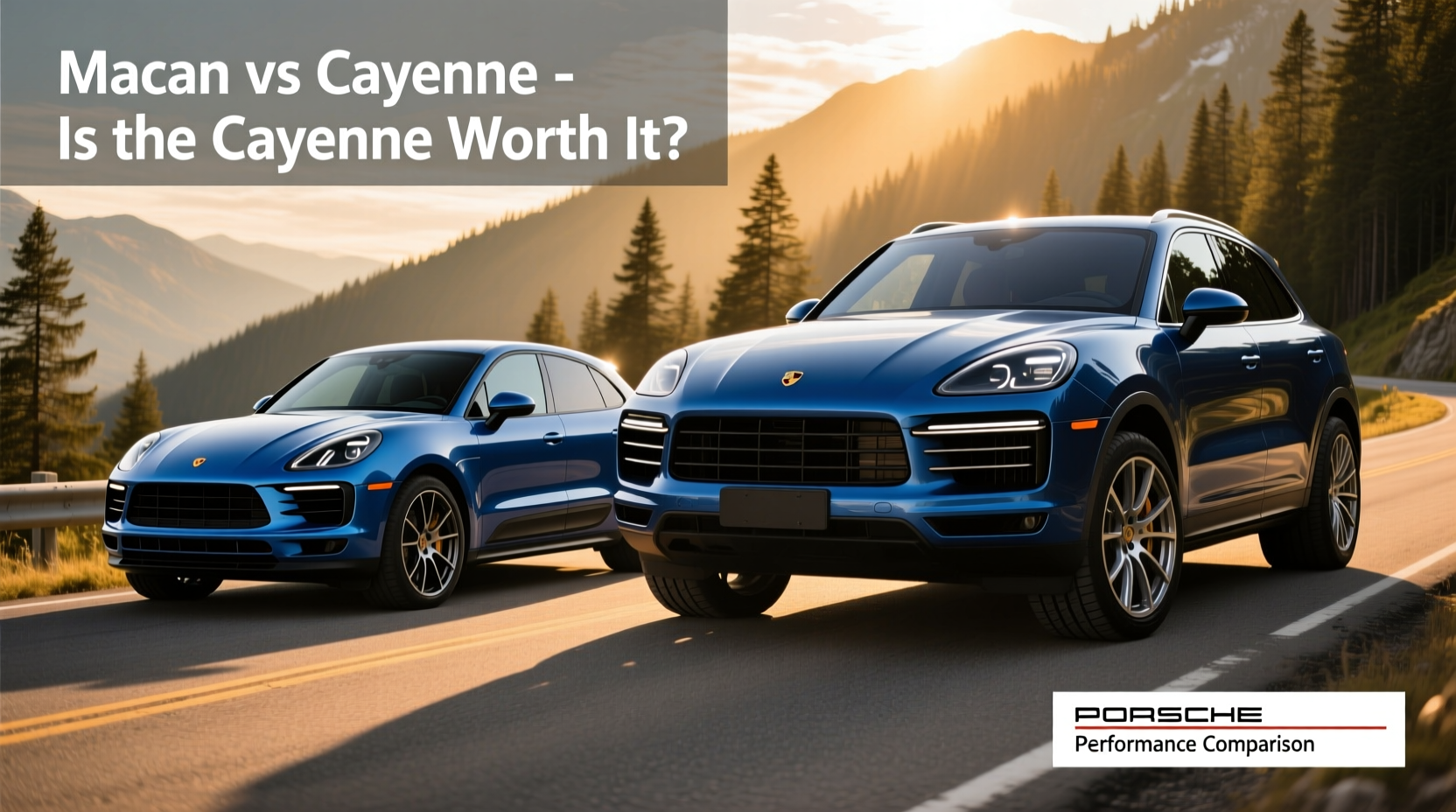
The most immediate distinction is physical presence. The Cayenne is larger in every dimension: longer, wider, taller, and riding on a significantly longer wheelbase. This translates directly into passenger and cargo space.
| Model | Length (in) | Wheelbase (in) | Passenger Volume (cu ft) | Cargo Capacity (cu ft) |
|---|---|---|---|---|
| Porsche Macan | 184.6 | 110.5 | 97.8 | 17.7 (behind rear seats) |
| Porsche Cayenne | 193.4 | 114.0 | 108.3 | 30.0 (behind rear seats) |
The Cayenne offers nearly a foot more length and over three inches more wheelbase. That extra room means genuine legroom for rear passengers, easier third-row access (on models equipped), and vastly superior cargo volume—especially when the seats are folded. For families, frequent travelers, or those who regularly carry gear, this difference is tangible.
In contrast, the Macan feels more compact and nimble, making it better suited for city driving, tight parking spots, and winding roads where agility matters more than elbow room.
Performance and Driving Dynamics
Both SUVs come in multiple performance tiers, but their character diverges under hard driving. The Macan, especially the GTS and Turbo variants, feels like a sports car with elevated seating. Its shorter wheelbase and lighter weight allow for quicker turn-in and a more playful demeanor on backroads.
The Cayenne, while heavier, benefits from advanced air suspension, rear-axle steering, and torque vectoring systems—particularly in higher trims like the S, GTS, and Turbo GT. These features compensate for mass, delivering astonishing balance and composure at speed. On a mountain pass or racetrack, the Cayenne doesn’t feel large; it feels planted and precise.
“The Cayenne redefined what a performance SUV could be. It’s not just big and fast—it’s surgically accurate.” — Jörg Bergmeister, Porsche Motorsport Advisor
Under the hood, both offer V6, V8, and hybrid options. The base Macan now features a turbocharged four-cylinder (in the 2024+ model), while the Cayenne starts with a robust V6. The Cayenne Turbo GT, with 631 horsepower, accelerates from 0–60 mph in under 3.3 seconds—performance that rivals supercars, let alone SUVs.
If track days or spirited weekend drives are part of your lifestyle, the Cayenne’s broader performance envelope may be worth the investment. But for daily commutes with occasional fun, the Macan delivers 90% of the thrill at a lower price point.
Interior Quality and Technology
Inside, both vehicles reflect Porsche’s minimalist yet luxurious design language. High-quality materials, intuitive controls, and driver-focused layouts define the experience. However, the Cayenne pulls ahead in perceived refinement.
The additional space allows for more elaborate trim options, enhanced sound insulation, and optional luxuries like adaptive rear seats, four-zone climate control, and a rear entertainment system. The center console is wider, storage is more abundant, and noise levels at highway speeds are lower thanks to thicker glass and improved aerodynamics.
The Macan, while excellent, uses slightly more shared components from the Volkswagen Group parts bin—particularly in lower trims. The infotainment is identical (Porsche Communication Management), but the overall ambiance feels more “sporty coupe” than “executive lounge.”
Checklist: Key Interior Differences to Evaluate
- Test rear seat comfort with adult passengers
- Compare available seat ventilation and massage options
- Evaluate ambient lighting packages and material upgrades
- Check trunk usability with strollers, golf bags, or pet carriers
- Assess rear visibility and camera system clarity
Total Cost of Ownership: Beyond the Sticker Price
The Macan typically starts around $60,000, while the Cayenne begins near $80,000. Fully loaded, a Cayenne Turbo GT can exceed $150,000. But upfront cost is only part of the equation.
Maintenance, insurance, depreciation, and fuel efficiency all scale with power and size. The Macan generally scores better in long-term ownership costs:
- Maintenance: Annual services are comparable, but major repairs (e.g., air suspension, brakes) are costlier on the Cayenne due to larger components.
- Insurance: Higher premiums for the Cayenne, especially on V8 models.
- Fuel Economy: The Macan averages 2–4 MPG better in combined driving, particularly in four-cylinder form.
- Resale Value: Both hold value exceptionally well, but the Cayenne depreciates slightly faster due to higher initial cost.
Real-World Example: Sarah’s Dilemma
Sarah, a marketing executive in Denver, needed an SUV that balanced performance, family utility, and image. She test-drove a Macan GTS and a Cayenne S. The Macan felt sharp and responsive during her mountain commute, but her twin seven-year-olds complained about legroom on a ski trip.
She opted for the Cayenne S, leasing it with a three-year/36,000-mile agreement. Though her monthly payment increased by $320, she gained peace of mind with greater safety tech, more cargo space for gear, and a smoother ride on long drives. After 18 months, she says, “I use every inch of that extra space. The Macan was fun, but the Cayenne fits my life.”
Her story illustrates a common trade-off: emotional appeal versus practical fit. The Macan seduces with agility; the Cayenne wins with versatility.
FAQ
Is the Macan just a smaller Cayenne?
No. While they share platform technology and design cues, the Macan is built on a modified Audi Q5 architecture (MLB Evo), whereas the Cayenne uses Porsche’s full-size platform. They differ in tuning, proportions, and intended use—think of them as siblings with different personalities rather than clones.
Can the Macan tow as much as the Cayenne?
No. The Cayenne can tow up to 7,700 pounds (with optional package), while the Macan maxes out at 4,400 pounds. For boat trailers, campers, or heavy equipment, the Cayenne has a clear advantage.
Do both have the same infotainment system?
Yes. Both feature Porsche Communication Management (PCM) with a 10.9-inch touchscreen, Apple CarPlay, Android Auto, and available Bose or Burmester audio. Over-the-air updates ensure both stay current.
Final Verdict: Is the Cayenne Worth the Extra?
For drivers who prioritize driving engagement, manage tighter budgets, or live in dense urban areas, the Macan is not just “enough”—it’s exceptional. It captures the essence of Porsche in a compact, efficient, and thrilling package.
But the Cayenne justifies its premium for those who demand more: more space, more power, more refinement, and more capability. It’s a grand tourer with off-road chops, a family hauler with track-day ambition. When you need an SUV that does everything at the highest level, the Cayenne earns its place.
The truth is, neither is objectively better. The Macan proves you don’t need to spend more to feel like a Porsche owner. The Cayenne proves that when you do spend more, Porsche delivers proportionate gains in substance, not just status.




 浙公网安备
33010002000092号
浙公网安备
33010002000092号 浙B2-20120091-4
Comments
No comments yet. Why don't you start the discussion?