
When it comes to holiday decorating, few decisions are as consequential — yet often overlooked — as whether to use a pre-lit Christmas tree or decorate with string lights separately. Both options bring festive cheer, but they differ significantly in how much time, effort, and space they demand during assembly and storage. For busy households, minimalist decorators, or those with limited storage, understanding these differences can mean the difference between a joyful tradition and an annual headache.
This isn’t just about convenience; it’s about sustainability, long-term cost, and even safety. A poorly strung light set can lead to tangled frustration or electrical issues, while a damaged pre-lit tree might render the entire unit unusable. By examining real-world usage, expert insights, and practical logistics, we’ll break down which option truly wins when it comes to ease of use and storage efficiency.
Understanding the Basics: What Defines Each Option?
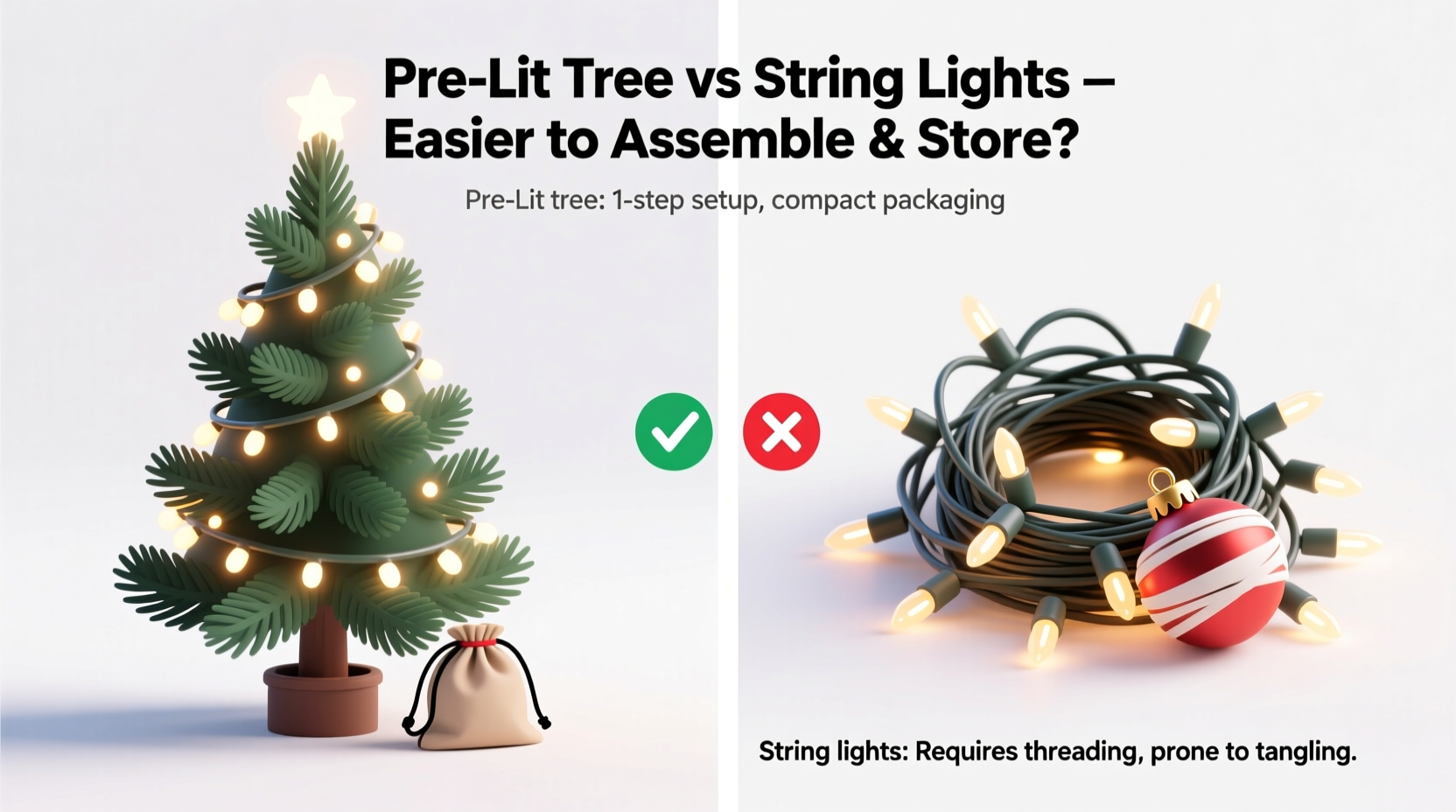
A **pre-lit Christmas tree** is an artificial tree with built-in LED or incandescent lights permanently wired into the branches. These trees come in various sizes, shapes, and light styles — from warm white to multicolor, steady glow to twinkling effects. Once assembled, the lights are already evenly distributed, requiring no additional decoration beyond ornaments and a tree topper.
In contrast, **string lights used alone** refer to purchasing a bare artificial (or real) tree and manually wrapping it with one or more strands of Christmas lights. This method gives complete control over light placement, color, brightness, and pattern. It also allows mixing different types of lights — say, icicle lights on the bottom and warm LEDs on top — for a customized effect.
The core distinction lies in integration. Pre-lit trees bundle two essential components — structure and illumination — into a single product. String lights alone treat lighting as a separate, customizable layer. That separation introduces flexibility but also complexity.
Assembly: Time, Skill, and Frustration Levels Compared
Setting up holiday decorations should feel like part of the celebration, not a chore. Yet many people spend hours untangling lights, testing strands, and adjusting uneven coverage. How do the two approaches compare in real-time labor and difficulty?
Pre-Lit Trees: Plug-and-Play Simplicity
Most pre-lit trees follow a sectional design — typically three sections (bottom, middle, top) that nest together on a central pole. Assembly usually takes 15 to 40 minutes depending on size and experience. Once upright, the tree is already illuminated. No additional wiring, draping, or troubleshooting is needed beyond fluffing branches and adding ornaments.
Modern pre-lit trees often feature “easy-connect” lighting systems, where each section automatically links to the next when stacked. Some even include built-in fuses and voltage regulators to prevent short circuits. If all connections are secure, a single plug powers the entire tree.
String Lights Alone: The Art of Precision Wrapping
Using string lights separately demands more hands-on involvement. First, you must assemble the tree — whether artificial or real — then begin the meticulous process of wrapping lights around it. Experts recommend 100 lights per foot of tree height for full coverage, meaning a 7-foot tree may need 700–1,000 bulbs across multiple strands.
This process is time-consuming. On average, wrapping a tree properly takes 45 minutes to over two hours, depending on skill level and desired density. It also requires judgment: too few lights look sparse; overlapping strands create hotspots or visible gaps. And if one strand fails, it can affect others if they’re daisy-chained.
“With string lights, consistency is everything. I’ve seen trees where the top third has no lights because the decorator ran out of strands halfway through.” — Mark Reynolds, Holiday Display Designer
Storage: Space, Protection, and Longevity
After the holidays, storage becomes the next major challenge. Where will it go? How protected is it? Will it work next year?
Storing a Pre-Lit Tree: One Unit, One Container
Because the lights are fixed, pre-lit trees must be stored as a single unit. Most come with durable carrying bags or foldable storage boxes designed to protect both branches and wiring. When packed correctly, they occupy one dedicated space — ideal for closets, under beds, or garages.
However, improper packing can crush delicate tips or pinch wires, leading to broken bulbs or electrical shorts. Branches must be carefully folded inward, following manufacturer instructions. High-end models with hinged branches simplify this process significantly.
Storing String Lights Separately: Modular but Risky
With standalone string lights, storage is modular: the tree goes in one container, the lights in another (or several). This offers flexibility — you can upgrade lights independently or use them elsewhere — but introduces new risks.
Untangling lights after months of storage is a common pain point. Even when coiled neatly, temperature changes and pressure can cause knots. Additionally, storing multiple strands increases the chance of losing connectors or damaging sockets.
Light-only storage containers vary widely in quality. Some people use old coffee cans or plastic reels; others invest in specialized light-winding tools. But without consistent organization, the system breaks down quickly.
Side-by-Side Comparison: Key Factors at a Glance
| Factor | Pre-Lit Tree | String Lights Alone |
|---|---|---|
| Assembly Time | 15–40 minutes | 45 minutes–2+ hours |
| Skill Required | Low (follow assembly steps) | Moderate to high (wrapping technique) |
| Storage Units Needed | 1 (tree + lights combined) | 2+ (tree, lights, possibly reels/bags) |
| Risk of Tangles | Negligible (wiring internal) | High (especially without proper coiling) |
| Customization | Low (fixed color/brightness) | High (mix colors, effects, density) |
| Lifespan | 5–10 years (if stored well) | Lights: 3–7 years; Tree: varies |
| Repairability | Limited (replace sections or entire tree) | High (swap individual strands) |
Real-World Example: Two Households, Two Choices
Consider two families preparing for the holidays.
The **Martinez family**, living in a small apartment with limited storage, chose a 6.5-foot pre-lit tree five years ago. Every November, they remove it from a single fitted bag stored under their bed. Assembly takes less than 30 minutes, and their children enjoy helping fluff the branches. They appreciate that the lights are always perfect — no arguments over spacing or burnt-out sections. Last year, one branch malfunctioned, but the manufacturer provided a replacement section free of charge.
The **Thompson family**, passionate about DIY decor, prefer using string lights. They own a 7-foot slim artificial tree and wrap it annually with 1,200 warm white LED mini lights arranged in a spiral pattern. They use a cardboard spool to wind the lights cleanly after disassembly. While they enjoy the creative control, they admit the process takes nearly two hours and requires two adults. Two years ago, they lost a connector piece and had to buy a new strand last-minute.
Both setups work — but serve different lifestyles. The Martinez approach prioritizes speed and simplicity; the Thompsons value customization and ritual.
Step-by-Step: Best Practices for Storing Either Option
No matter which route you take, proper storage ensures longevity and reduces frustration next season. Follow this universal timeline:
- Unplug and inspect immediately: After takedown, check for broken bulbs, frayed wires, or loose connections before storing.
- Clean gently: Wipe down tree branches with a dry microfiber cloth to remove dust. For real trees, skip this step — dispose of responsibly.
- Disassemble fully: Take apart tree sections. For string lights, avoid yanking — carefully unwind from the tree.
- Coil lights properly: Use the hand-over-hand method or a reel to prevent kinks. Never wrap lights around your elbow — this causes twists.
- Pack in protective containers: Use rigid bins with dividers for pre-lit trees. Seal string lights in labeled bags to prevent tangling.
- Store in climate-controlled area: Avoid attics, basements, or garages with extreme temperatures or humidity.
- Label everything: Include year, light count, and voltage details for future reference.
Expert Insight: What Industry Professionals Recommend
Interior designers and holiday display experts often weigh in based on client needs. According to Laura Simmons, a professional decorator with over 15 years of experience:
“For 80% of my clients, I recommend pre-lit trees. They save time, reduce stress, and deliver reliable results. The only exceptions are clients who want a specific lighting effect — like vintage bulbs or color-changing sequences — that aren’t available in integrated designs.” — Laura Simmons, Interior Stylist & Holiday Consultant
She also notes that rental properties and small homes benefit most from pre-lit models due to faster setup and compact storage. Meanwhile, commercial displays or photography sets often use standalone string lights for maximum control.
Frequently Asked Questions
Can I replace lights on a pre-lit tree if they burn out?
Yes, but with limitations. Many pre-lit trees use shunt-based LED systems where one bulb failure doesn’t kill the whole strand. Individual bulbs can often be replaced using a twist-and-pull mechanism. However, if the main wire or connector is damaged, repair may not be feasible. Always keep spare bulbs and check manufacturer warranties.
Are pre-lit trees safer than string lights?
Generally, yes — when used correctly. Modern pre-lit trees are tested to meet UL or ETL safety standards, with built-in fuses and low-voltage LEDs. However, any electrical product poses risk if damaged or overloaded. Never add extra strands to a pre-lit tree unless explicitly allowed by the manufacturer.
Which option is more cost-effective over time?
Pre-lit trees have a higher upfront cost ($100–$300), but eliminate the need to buy lights separately. String lights require initial investment in strands ($20–$50) plus potential replacements every few years. Over five years, total costs are often similar — but pre-lit trees offer better value for those prioritizing convenience.
Checklist: Choosing the Right Option for Your Home
- ✅ Do you have limited storage space? → Lean toward pre-lit.
- ✅ Are you short on time during the holidays? → Pre-lit saves hours.
- ✅ Do you love custom lighting designs? → String lights offer more creativity.
- ✅ Are you decorating a rental or temporary space? → Pre-lit is easier to move.
- ✅ Do you frequently lose or damage light strands? → Integrated lighting reduces loss risk.
- ✅ Are you willing to spend more upfront for long-term ease? → Pre-lit is the smarter investment.
Final Verdict: Which Is Easier?
For the majority of households, **pre-lit trees are easier to assemble and store**. They consolidate two major tasks — tree setup and lighting — into one streamlined process. With minimal skill required and consistent results year after year, they suit busy families, small dwellings, and anyone who values holiday peace over perfectionism.
String lights alone remain the choice for enthusiasts, crafters, and those seeking precise aesthetic control. But that freedom comes at the cost of time, effort, and storage complexity. Unless you derive genuine joy from the wrapping process or need specialized lighting, the practical advantages of pre-lit trees are hard to ignore.
Ultimately, the best choice aligns with your lifestyle. If ease is your priority, a high-quality pre-lit tree with energy-efficient LEDs and sturdy construction will serve you well for many seasons. If creativity fuels your holiday spirit, standalone string lights let you craft a unique display — just invest in good storage tools to make next year easier.




 浙公网安备
33010002000092号
浙公网安备
33010002000092号 浙B2-20120091-4
Comments
No comments yet. Why don't you start the discussion?