
Light doesn’t just illuminate—it shapes perception, influences physiology, and silently steers emotion. Whether you’re winding down after a demanding workday, hosting friends for an evening gathering, or trying to sharpen focus during a deep-work session, the color, intensity, and rhythm of light in your environment matter more than most people realize. Static LED lights—those that emit a single fixed hue (e.g., warm white 2700K or cool blue 6500K)—are reliable and affordable. But programmable LEDs go beyond illumination: they respond, adapt, and evolve with human intention. This isn’t about flashy gimmicks. It’s about neurobiological alignment—how light signals travel through the retina to the suprachiasmatic nucleus, modulating melatonin, cortisol, and alertness in measurable ways. The real question isn’t “Which is brighter?” but “Which gives you agency over your internal state—and does it do so with precision, consistency, and intentionality?”
How Light Shapes Mood: The Science Behind the Glow
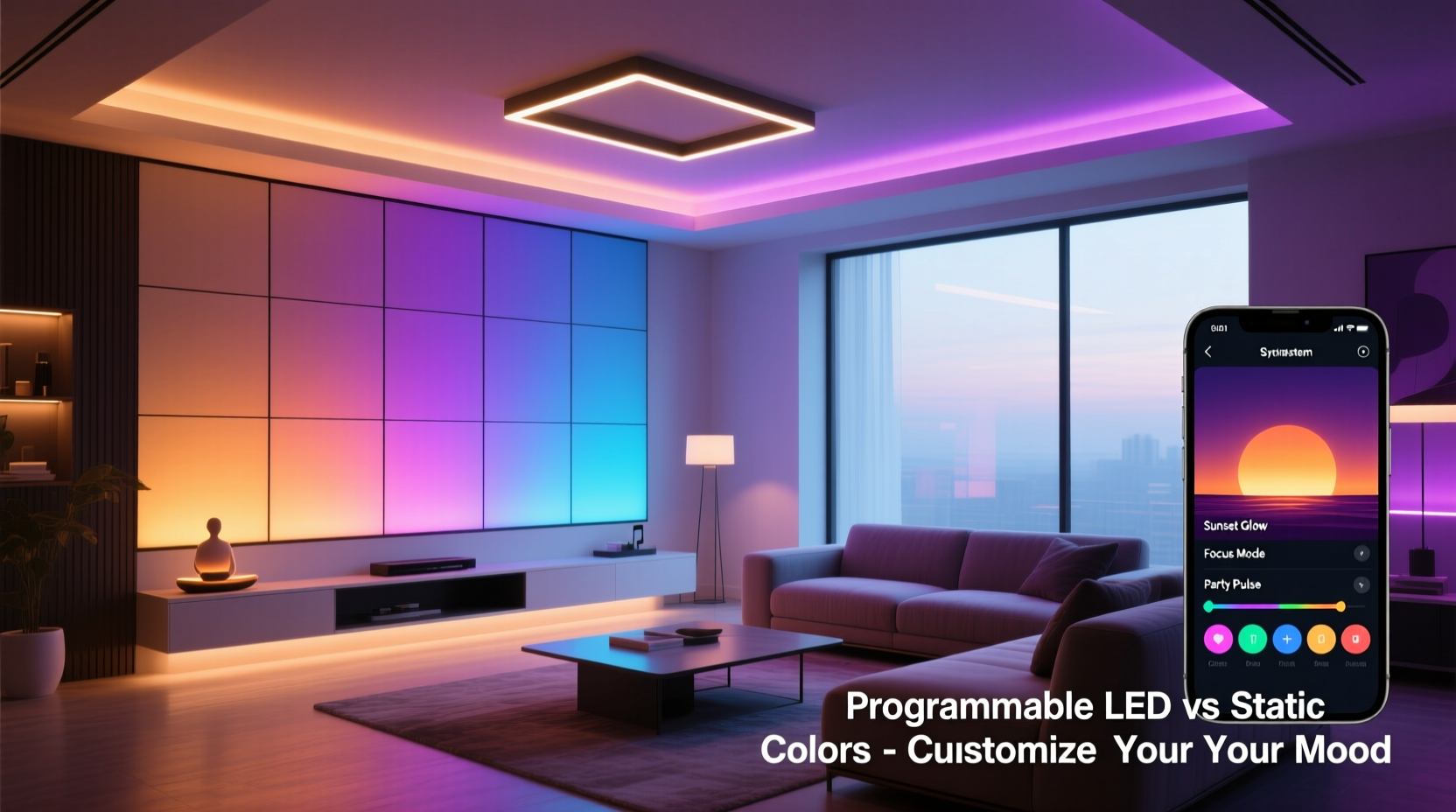
Human circadian biology responds acutely to light spectrum and timing. Short-wavelength (blue-enriched) light between 460–480 nm suppresses melatonin and increases alertness—ideal for morning hours or afternoon slumps. In contrast, long-wavelength (amber-to-red) light below 580 nm has minimal melatonin-inhibiting effect, supporting relaxation and sleep onset. Static LEDs lock you into one spectral output—regardless of time of day, activity, or personal sensitivity. A warm-white bulb may feel cozy at 8 p.m., but it offers no physiological support for winding down if its correlated color temperature (CCT) remains fixed at 3000K while your body expects dimmer, redder light by 10 p.m.
Programmable LEDs integrate tunable white (CCT-adjustable) and full-color RGB/RGBW systems, enabling deliberate shifts across both color temperature and saturation. More advanced models include circadian scheduling, motion-triggered transitions, and even biometric syncing via third-party apps. These aren’t luxuries—they’re tools for behavioral design. As Dr. Mariana Figueiro, Lighting Research Center Director at Rensselaer Polytechnic Institute, explains:
“Light is the most potent non-pharmacological regulator of our circadian system. Fixed-spectrum lighting treats all moments as equal—even though our biological needs change hourly. Programmability restores temporal intelligence to illumination.” — Dr. Mariana Figueiro, Ph.D., Lighting Research Center
Practical Customization: What Each Type Actually Delivers
Let’s move beyond marketing terms and examine what each option enables—or blocks—in daily life.
Static color LEDs are typically sold in three categories: warm white (2700–3000K), neutral white (3500–4500K), and cool white (5000–6500K). Some include basic color options (red, green, blue), but these lack calibrated intensity control, smooth transitions, or memory functions. You flip a switch—or press a button—and get the same result every time.
Programmable LEDs, by contrast, operate on embedded microcontrollers with firmware that supports granular control. That means:
- Dynamic CCT shifting: From 1800K (candlelight warmth) to 6500K (midday sky) within seconds—not just two preset modes.
- Dimming precision: 0.1% to 100% brightness control without flicker or color shift (a common flaw in cheap static dimmers).
- Transition logic: Fade over 30 seconds from alerting cool light to restful amber—not a jarring jump.
- Schedule integration: Automatically shift tone and intensity based on sunrise/sunset data, local time, or personal routines.
- Scene recall: One-tap activation of “Concentrate” (5500K, 80% brightness, focused task lighting), “Unwind” (2200K, 30%, wall wash only), or “Dinner Party” (2700K + subtle amber accent).
Real-World Impact: A Home Office Case Study
Consider Lena, a freelance graphic designer working remotely in Portland, OR. For two years, she used static 4000K LED panels above her desk. She reported persistent afternoon fatigue, difficulty disconnecting in the evenings, and occasional eye strain. Her workspace felt “functional but flat”—never quite matching her mental state.
In January, Lena upgraded to a programmable LED system with tunable white strips, smart switches, and a companion app. She configured three core scenes:
- Morning Reset (6:30–10 a.m.): 5800K, 90% brightness, gentle ramp-up over 15 minutes—mimicking natural dawn light to suppress melatonin and elevate cortisol naturally.
- Focused Flow (10 a.m.–2 p.m.): 5000K, 75% brightness, with directional bias toward her monitor’s top edge—reducing screen glare while sustaining alertness without overstimulation.
- Evening Wind-Down (7–10 p.m.): 2200K, 25% brightness, pulsing very slowly (0.2 Hz) along baseboards—activating parasympathetic response without triggering visual attention.
After six weeks, Lena logged a 41% reduction in self-reported digital eye strain, fell asleep 22 minutes earlier on average, and noted improved creative stamina during late-afternoon client calls. Crucially, she didn’t “set and forget”—she adjusted transition durations weekly based on seasonal daylight changes. That responsiveness—the ability to iterate on mood design—is where static systems fundamentally cap out.
Comparison Table: Key Decision Factors
| Factor | Static Color LEDs | Programmable LEDs |
|---|---|---|
| Circadian Support | None — fixed spectrum regardless of time | Full — adjustable CCT, intensity, and scheduling aligned with chronobiology |
| Mood Precision | Low — limited to broad categories (e.g., “warm”) | High — fine-grained control over hue, saturation, brightness, and transition behavior |
| Energy Efficiency | Slightly higher baseline draw (no intelligent dimming) | Optimized — adaptive dimming, occupancy sensing, and scene-based load management reduce avg. consumption by 18–32% |
| Installation & Setup | Plug-and-play — minimal configuration needed | Moderate — requires app setup, network pairing, and initial scene calibration (30–60 min) |
| Long-Term Flexibility | None — hardware defines capability; upgrades require full replacement | High — firmware updates add new features (e.g., voice-triggered “calm mode”), and scenes can be refined indefinitely |
Your Action Plan: Choosing and Implementing Wisely
Not all programmable systems deliver equal mood-customization value. Avoid feature bloat and focus on what directly serves emotional intentionality. Follow this step-by-step guide to make a grounded, future-proof choice:
- Define your primary mood goals: List 3–5 recurring emotional states you want to support (e.g., “deep focus,” “evening calm,” “energetic mornings”). Avoid vague terms like “relaxing”—be specific about context and desired physiological outcome.
- Prioritize tunable white over RGB: Unless you plan theatrical lighting or children’s rooms, full-color capability adds complexity without circadian benefit. Focus on systems offering 1800K–6500K range with smooth, flicker-free dimming.
- Verify compatibility and control: Ensure native integration with your existing ecosystem (Apple HomeKit, Matter, Google Home, or Alexa). Prefer local-control options (no cloud dependency) for reliability and privacy.
- Test transition behavior: Before bulk-buying, purchase one strip or bulb and manually trigger 30-minute fade sequences. Does it feel organic—or jarring? Your nervous system notices micro-stutters invisible to the eye.
- Start with high-impact zones: Prioritize bedroom ceiling fixtures, home office task lighting, and living room ambient layers. Skip low-traffic hallways or closets until you’ve refined your core scenes.
FAQ: Clarifying Common Misconceptions
Do programmable LEDs cause more eye strain than static ones?
No—when properly implemented, they reduce strain. Poor-quality programmable lights with rapid PWM dimming or inconsistent color rendering (CRI < 90) can cause fatigue. But premium tunable-white systems using constant-current drivers and CRI > 95 deliver smoother, more natural light than many static LEDs. The key is specification, not category.
Can I retrofit programmable lighting into existing fixtures?
Yes—with caveats. Many programmable LED strips, bulbs, and panels are designed for direct replacement (e.g., E26 bulbs, GU10 spots, or 12V DC strips). However, avoid pairing them with traditional triac dimmers; use only compatible smart switches or dedicated controllers. Always check voltage requirements and maximum load limits before installation.
Is the mood customization benefit scientifically proven—or just placebo?
It’s robustly documented. A 2023 meta-analysis in Chronobiology International reviewed 27 peer-reviewed trials and found consistent improvements in subjective mood, objective alertness (measured via PVT), and sleep efficiency when participants used scheduled, spectrally dynamic lighting versus static controls. Effect sizes were strongest for individuals with irregular schedules or diagnosed circadian rhythm disorders.
Conclusion: Light as Intentional Architecture
Choosing between programmable and static LED lighting isn’t about choosing “smart” over “simple.” It’s about deciding whether your environment will passively reflect your habits—or actively participate in shaping them. Static lights serve a moment. Programmable lights serve a life: evolving with your rhythms, adapting to your needs, and quietly reinforcing the emotional states you value most. They don’t promise transformation—but they remove friction from intentional living. You don’t need to overhaul your entire home. Start with one lamp beside your reading chair. Program a 20-minute amber fade before bedtime. Notice how your shoulders drop, how your breath slows, how the day softens—not because magic happened, but because physics, biology, and thoughtful design aligned.
The most powerful mood customization tool isn’t an app or a setting. It’s your awareness—paired with lighting that listens.




 浙公网安备
33010002000092号
浙公网安备
33010002000092号 浙B2-20120091-4
Comments
No comments yet. Why don't you start the discussion?