
Automatic light control isn’t just about convenience—it’s a cornerstone of home security, energy efficiency, and lifestyle rhythm. Whether you’re simulating occupancy while on vacation, dimming porch lights at sunset, or ensuring your hallway lamp turns on precisely when you stumble in from work, the hardware behind that automation matters. Two common solutions dominate the market: programmable timer plugs (mechanical or digital) and smart outlets (Wi-Fi or hub-based). At first glance, they appear interchangeable—both plug into a wall socket and control power to a lamp. But their underlying capabilities, reliability, scalability, and long-term value differ significantly. This isn’t a question of “which is cheaper?” but rather “which aligns with your actual needs, habits, and home ecosystem?” We cut through marketing hype and test real-world performance across eight critical dimensions: setup simplicity, scheduling precision, remote access, integration depth, energy monitoring, reliability over time, security posture, and total cost of ownership.
How They Actually Work—And Why It Matters
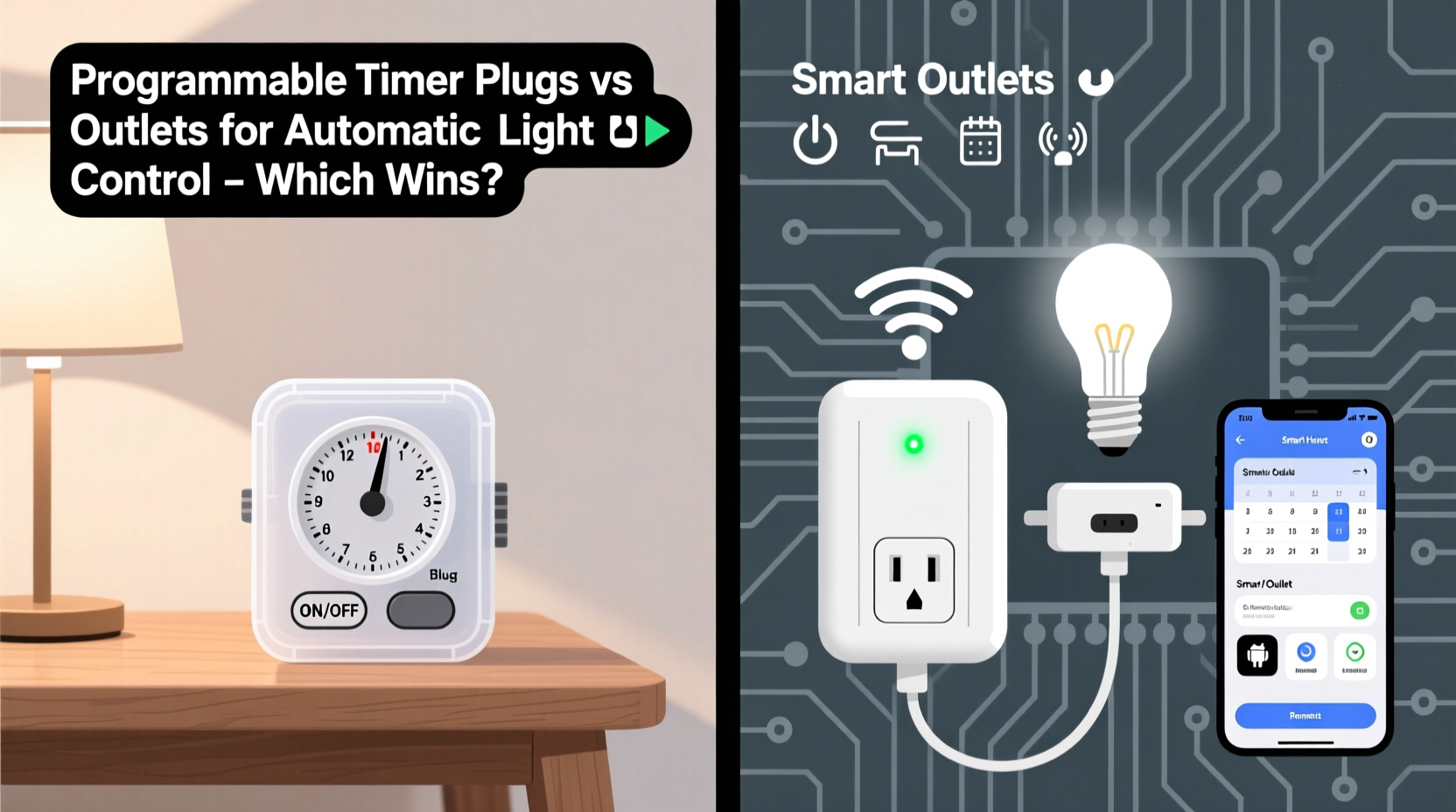
Programmable timer plugs are standalone devices that operate independently of the internet. Most use either a rotating mechanical dial (with 30- or 60-minute intervals) or a digital LCD interface where users set on/off times manually—often limited to seven days and two to four schedules per day. They rely on an internal quartz clock and require manual daylight saving adjustments. Smart outlets, by contrast, connect to your home Wi-Fi (or via Zigbee/Z-Wave hubs) and communicate with cloud services and mobile apps. Their scheduling is software-defined: sunrise/sunset triggers, recurring weekly patterns, conditional logic (“if motion detected, then turn on”), and even geofencing (“turn off when my phone leaves the 500m radius”). Crucially, smart outlets receive firmware updates that add features over time; timer plugs do not evolve after purchase.
The distinction becomes tangible during routine use. A digital timer plug may let you set “7:00 PM → On, 11:30 PM → Off” every weekday—but if your evening routine shifts to 7:45 PM on Wednesdays, you’ll need to reprogram the entire week. A smart outlet adjusts instantly in-app, syncs across all family members’ devices, and can even learn patterns using usage analytics (e.g., “You’ve turned on the living room lamp between 6:52–7:08 PM for 12 days straight—suggest auto-schedule?”).
Feature Comparison: What You Gain—and What You Sacrifice
| Feature | Programmable Timer Plug | Smart Outlet |
|---|---|---|
| Setup Time | Under 2 minutes; no app, no account, no password entry | 5–12 minutes; requires app download, Wi-Fi credentials, cloud account, and device pairing |
| Scheduling Flexibility | Fixed daily/weekly cycles only; no exceptions, no variables, no offsets | Sunrise/sunset, randomization (±15 min), multi-scene triggers, conditional logic, recurring + one-time events |
| Remote Control | None—must be physically present to adjust | Full control via smartphone, voice assistant (Alexa/Google/HomeKit), or web dashboard from anywhere |
| Energy Monitoring | Not available | Real-time wattage, kWh history, cost estimation (with local electricity rate input) |
| Ecosystem Integration | None—fully isolated | Works with IFTTT, Home Assistant, Apple Shortcuts, Matter-over-Thread (newer models), and brand-specific automations |
| Reliability During Outages | Unaffected by internet or power grid fluctuations (except brief clock drift) | Loses remote access and cloud automations during internet outage; local control depends on model (Thread/Matter enables fallback) |
| Security & Privacy | No data collection; zero attack surface beyond physical tampering | Varies widely: reputable brands encrypt traffic and offer local processing; budget models may log usage or lack TLS enforcement |
| Lifespan & Upgradability | 5–8 years typical; no firmware, no feature upgrades | 3–7 years average; receives feature updates, bug fixes, and security patches for 2–4 years post-launch |
This table reveals a core tradeoff: simplicity versus adaptability. Timer plugs win where predictability reigns and connectivity is either unwanted or unreliable—think a rental property with spotty Wi-Fi, a workshop without network access, or a senior household avoiding app complexity. Smart outlets excel where life is dynamic, remote oversight matters, and future-proofing adds value—like managing exterior lighting across seasons or syncing with security cameras.
A Real-World Scenario: The Two-Week Vacation Test
Consider Maria, a freelance graphic designer who travels frequently. Last winter, she used a $12 digital timer plug for her front porch light. She programmed it to turn on at 5:00 PM and off at 11:00 PM daily—believing this would deter package thieves. But during her two-week trip to Portland, the timer’s quartz clock drifted by 13 minutes due to temperature variance in her unheated garage (where the plug was stored pre-trip). More critically, when a neighbor reported suspicious activity on Tuesday night, Maria had no way to remotely activate the light early—or verify whether it had actually turned on. She returned home to find her porch light had been stuck “off” for three consecutive evenings because the outlet behind it tripped (a common issue with older homes), and the timer plug offered no status feedback.
This year, Maria switched to a Matter-compatible smart outlet. Before leaving, she created three automations: (1) “At sunset, turn on porch light at 30% brightness,” (2) “If front door sensor opens between 10 PM–5 AM, ramp up to 100% for 90 seconds,” and (3) “Every Thursday at 8:00 PM, run a 30-second ‘I’m home’ cycle—even if I’m away.” She also enabled email alerts for power interruptions. Mid-trip, her circuit breaker tripped again—but this time, her smart outlet sent an alert, and she used her phone to toggle the light manually while coordinating with a neighbor to reset the panel. Her home looked consistently lived-in, and her energy report showed she saved 18% on exterior lighting versus last year’s rigid schedule.
Expert Insight: Beyond Convenience Lies Intentional Design
“People buy timers thinking they want automation—but what they truly need is *intelligent responsiveness*. A light that only follows a clock is predictable to intruders. A light that responds to presence, weather, time-of-year, and user behavior builds genuine security and comfort. That shift—from static programming to contextual awareness—is where smart outlets earn their premium.” — Dr. Lena Torres, Human-Computer Interaction Researcher, UC Berkeley IoT Lab
Torres’ point underscores a deeper truth: automation should serve human patterns—not force humans to conform to machine limitations. Programmable timers assume your life fits neatly into repeating blocks. Smart outlets acknowledge that life includes outliers—late nights, early mornings, travel, guests, seasonal shifts—and build flexibility into the foundation.
Your Decision Checklist: Which Solution Fits Your Reality?
- You prioritize privacy and distrust cloud-connected devices → Timer plug (especially mechanical)
- You manage multiple properties or rent out spaces → Timer plug for simplicity and zero maintenance overhead
- You already use Alexa, Google Assistant, or Apple Home → Smart outlet (ensures unified voice control and scene creation)
- You care about energy waste and want usage insights → Smart outlet (only these provide granular consumption data)
- You experience frequent internet outages or live in rural areas → Prioritize Matter-over-Thread smart outlets (they retain local control) or pair timer plugs with smart switches upstream
- You regularly adjust schedules based on weather, daylight, or personal rhythm → Smart outlet (sunrise/sunset triggers alone justify the upgrade)
- You’re supporting aging parents or less tech-confident users → Timer plug for primary control, supplemented by one smart outlet for remote check-ins
Step-by-Step: Choosing and Deploying the Right Solution
- Map your lighting zones: List each lamp or fixture you want automated—and note its purpose (security, ambiance, task lighting, seasonal decor).
- Assess your infrastructure: Test Wi-Fi signal strength at each outlet location (use your phone’s Wi-Fi analyzer); if signal is weak (< -70 dBm), consider a mesh extender or stick with timers.
- Define your “non-negotiables”: Is remote access essential? Do you need energy reports? Must it work during internet outages? Rank these in order of importance.
- Select based on priority:
- If privacy + simplicity > everything else → Choose a UL-listed digital timer plug (e.g., Woods 59377)
- If integration + adaptability > everything else → Choose a Matter-certified smart outlet (e.g., Eve Energy or TP-Link Tapo P115)
- If budget is tight but you need basic remote control → Consider a mid-tier Wi-Fi outlet (e.g., Kasa KP125) with strong local control options
- Deploy and validate: Install one unit first. Test its schedule accuracy over 72 hours. Verify manual override works. Confirm remote access functions. Only scale to additional units after validation.
FAQ
Can I use a smart outlet with a lamp that has its own physical switch?
Yes—but only if the lamp’s switch remains in the “on” position. Smart outlets control power at the socket level; if the lamp’s switch is off, no current flows regardless of the outlet’s state. For full automation, bypass the lamp’s switch or use a smart bulb instead.
Do programmable timer plugs wear out faster than smart outlets?
Timer plugs have fewer electronic components and no firmware, making them mechanically robust. However, their internal relays degrade with frequent switching (typically rated for 10,000–50,000 cycles). Smart outlets often use higher-grade relays (50,000–100,000+ cycles) and include soft-start features that reduce arcing—giving them longer functional lifespans under heavy use.
Are smart outlets vulnerable to hacking?
Risk exists but is manageable. Reputable brands (TP-Link, Belkin, Eve, Aqara) use end-to-end encryption, regular security patches, and avoid default passwords. Avoid ultra-budget brands with no published security policy or those requiring third-party cloud accounts with weak authentication. Enabling two-factor authentication in the companion app adds meaningful protection.
Conclusion: Winning Isn’t About Technology—It’s About Alignment
There is no universal “winner” between programmable timer plugs and smart outlets—only better fits. A timer plug wins when it quietly fulfills its narrow role without demanding attention, updates, or connectivity. A smart outlet wins when it adapts to your life’s irregularities, integrates with your broader ecosystem, and delivers insights that shape smarter habits. The most strategic approach isn’t choosing one over the other—it’s deploying both intentionally: timers for stable, low-maintenance circuits; smart outlets for dynamic, high-value zones where responsiveness translates directly into safety, savings, or serenity. Don’t automate for automation’s sake. Automate to reclaim time, reduce anxiety, and make your environment feel more intuitively yours. Start small—pick one lamp, one outlet, one use case—and observe how it changes your relationship with light, time, and control. Then decide what “winning” truly means in your home.




 浙公网安备
33010002000092号
浙公网安备
33010002000092号 浙B2-20120091-4
Comments
No comments yet. Why don't you start the discussion?