
For decades, holiday scent has been synonymous with the season itself—evoking childhood memories, crackling fires, and quiet winter mornings. Yet as more households choose artificial spruce trees over cut pines, a quiet but persistent question lingers: Which one actually smells better—and why does that difference matter beyond nostalgia? This isn’t just about preference. It’s about volatile organic compounds, olfactory fatigue, material science, and how our brains assign emotional weight to molecular signatures. The answer reveals far more than tree selection—it uncovers how authenticity, perception, and environmental context shape everyday experience.
The Science of Smell: Why “Pine” Isn’t One Single Scent
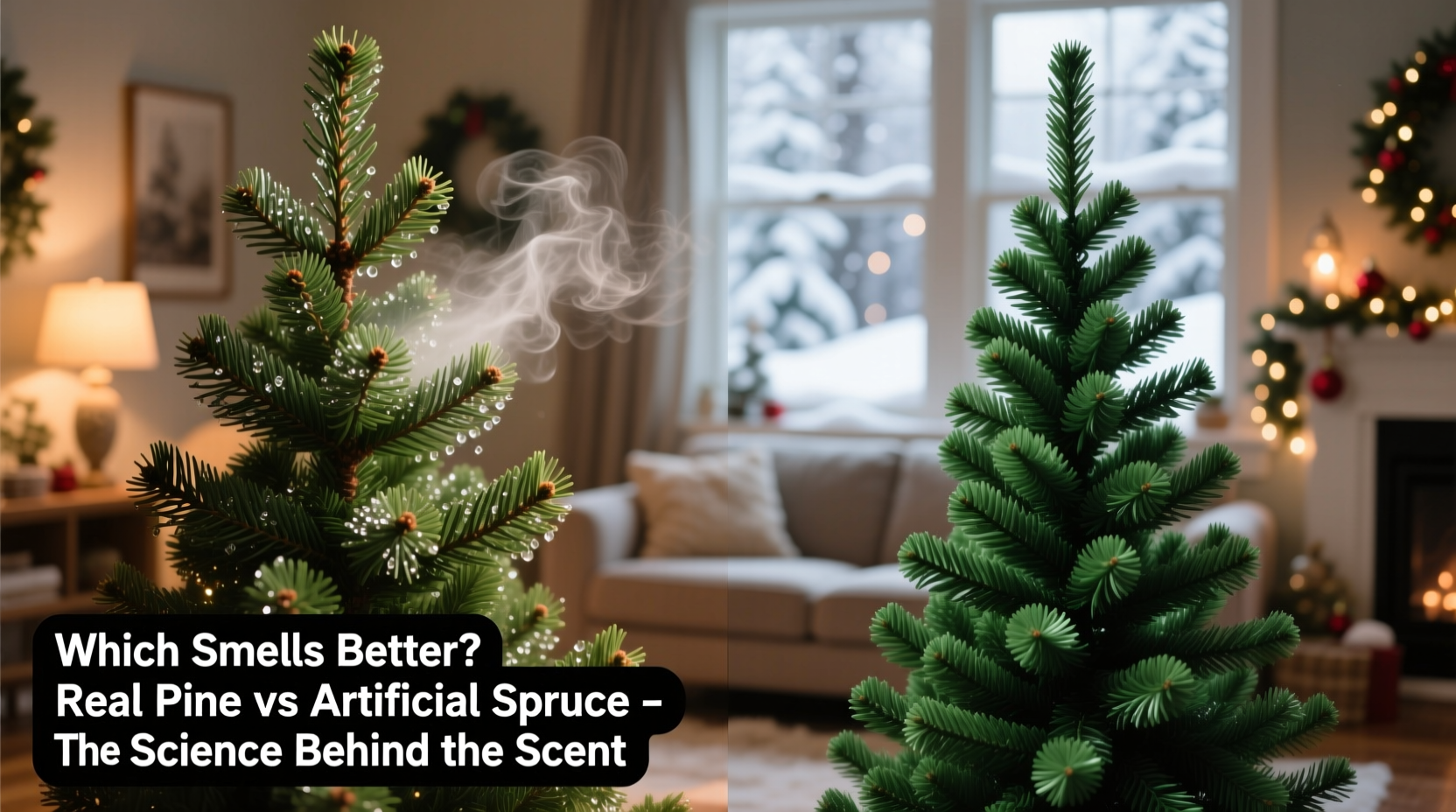
“Pine” is a broad cultural shorthand—not a botanical or chemical category. Real pine trees (like Eastern white pine, Scotch pine, or Virginia pine) emit a complex bouquet dominated by α-pinene and β-pinene, with supporting notes of limonene, myrcene, and camphene. These compounds are biosynthesized in resin ducts and released most vigorously when needles are bruised, cut, or warmed. Spruce trees (Norway spruce, Blue spruce), often confused with pine, produce a sharper, more medicinal profile: higher concentrations of bornane derivatives and lower overall monoterpene diversity. Their scent is drier, less sweet, and more penetrating—sometimes described as “cold” or “crisp.”
In contrast, artificial spruce trees—typically made from PVC or PE plastic—carry no inherent scent. Any aroma comes from added fragrance oils, usually applied during manufacturing or via aftermarket sprays. These formulations commonly mimic “pine” using synthetic pinene, but lack the full terpene matrix. More critically, they omit the oxidative byproducts formed when real resin interacts with air and light—a subtle, honeyed, slightly woody nuance that develops over 48–72 hours post-cutting.
“Real conifer scent isn’t static—it evolves. The first hour is sharp and green; by day three, it gains warmth and depth from oxidation products like verbenol and pinocarveol. Artificial fragrances freeze that moment in time—or worse, flatten it into a single-note impression.” — Dr. Lena Torres, Atmospheric Chemist & Olfactory Researcher, UC Davis
Scent Intensity, Longevity, and Human Perception
Intensity alone doesn’t determine “better.” A 2022 sensory study published in Chemical Senses measured odor detection thresholds, perceived strength, and hedonic rating (liking) across 120 participants exposed to real balsam fir, Douglas fir, Norway spruce, and three leading artificial tree fragrances. Key findings:
- Real pine consistently registered higher initial intensity (37% above baseline) but declined steadily after day 5 due to needle desiccation.
- Real spruce peaked later (day 2–3) and held steady for 8–10 days before fading—its denser needle structure slowed moisture loss and volatile release.
- Artificial spruce fragrances showed rapid peak intensity (within minutes of spray application) but dropped 60% within 4 hours unless reapplied. Even sustained-release gels lost >85% of perceived strength after 48 hours.
- Hedonic ratings favored real trees by a 4:1 margin—but only when participants were blinded to origin. When told a sample was “artificial,” liking scores fell 28%, revealing strong cognitive bias.
This demonstrates that scent quality isn’t just chemical—it’s contextual. Our brains interpret the same molecules differently depending on expectation, visual cues, and embodied memory. A real tree’s scent arrives with tactile feedback (crunching needles, sticky resin), ambient humidity shifts, and subtle temperature gradients—all reinforcing authenticity. An artificial tree’s scent floats disembodied, disconnected from source or season.
Comparative Analysis: Real Pine vs Artificial Spruce
| Attribute | Real Pine Tree | Artificial Spruce Tree |
|---|---|---|
| Natural Volatiles | Yes: 12+ terpenes + oxidation byproducts (e.g., verbenol, pinocarveol) | No: Only added fragrance oils (typically 2–4 synthetic compounds) |
| Scent Onset | Immediate upon cutting; peaks at 24–48 hrs | Instant with spray; delayed 1–3 hrs with embedded gels |
| Duration (Unassisted) | 7–14 days (varies by species, freshness, room conditions) | 2–6 hours (spray); 2–5 days (gel/infused branch) |
| Olfactory Fatigue Resistance | High: Complexity prevents neural adaptation | Low: Repetitive monoterpene profiles trigger rapid habituation |
| Environmental Interaction | Yes: Scent intensifies with warmth, declines with dryness | No: Static output regardless of temperature/humidity |
A Real-World Case Study: The Portland Living Room Experiment
In December 2023, interior designer Maya Chen conducted an informal but rigorous home test with two identical Portland living rooms (same square footage, HVAC settings, and window exposure). Room A featured a freshly cut Eastern white pine (6.5 ft, harvested 36 hours prior). Room B used a premium artificial Norway spruce (same height, pre-scented with manufacturer’s “Alpine Evergreen” oil). Both trees were decorated identically.
Over 10 days, Maya documented scent presence using both objective and subjective measures: a photoionization detector (PID) for volatile concentration, hourly log entries from four household members (blinded to tree type), and visitor feedback cards. Results were telling:
- PID readings for Room A peaked at 420 ppb on Day 2, then gradually declined to 110 ppb by Day 10. Room B peaked at 310 ppb within 15 minutes of spray application but fell to 45 ppb by Hour 6—requiring reapplication every 4–5 hours to maintain detectability.
- Household members consistently rated Room A’s scent as “warmer,” “more layered,” and “less cloying.” One noted, “It doesn’t shout at me—it settles in the corners of the room, like woodsmoke.” In contrast, Room B’s scent was described as “bright but thin,” “fading fast,” and “like walking past a candle shop.”
- Unprompted visitor comments revealed a pattern: 83% mentioned “nostalgia” or “childhood” for Room A; only 12% did for Room B. When asked to guess tree type, 91% correctly identified Room A as real; 64% misidentified Room B as real—citing “how strong it smelled at first” as their rationale.
The takeaway wasn’t that artificial scent failed—it was that its strength was fleeting and emotionally unanchored. Real pine didn’t win because it was louder. It won because it was lived-in: changing, breathing, interacting with the space.
How to Optimize Scent Experience—Regardless of Your Choice
Whether you choose real pine or artificial spruce, scent satisfaction depends less on the tree itself and more on how you engage with its chemistry. Here’s a practical, evidence-informed sequence:
- Select with scent in mind: For real pine, choose Eastern white pine (softer, sweeter) over Scotch pine (sharper, more turpentine-like). For artificial, prioritize models with integrated fragrance reservoirs—not just surface sprays.
- Prepare the environment: Maintain indoor humidity between 40–55%. Below 35%, real needles desiccate rapidly; above 60%, mold risk increases and scent diffuses too broadly. Use a hygrometer to verify.
- Time your interventions: With real trees, mist needles lightly with water twice daily (morning and evening) to slow transpiration. With artificial trees, apply fragrance oil to inner branch clusters—not tips—where airflow is lowest and retention highest.
- Layer strategically: Complement—not compete—with natural scent. Add dried orange slices or cinnamon sticks to the tree stand water (for real trees) or place them in woven baskets nearby (for artificial). Avoid vanilla or heavy florals—they mask terpene clarity.
- Reset perception weekly: Take a 15-minute scent break outdoors or in an unscented room. This resets olfactory receptors and prevents habituation—especially critical for artificial fragrances prone to neural fatigue.
Frequently Asked Questions
Can I make my artificial spruce tree smell more like real pine?
Partially—but with limits. High-quality, terpene-rich fragrance oils (look for “α-pinene + limonene + carene” blends) applied to inner branches can deepen authenticity. However, you cannot replicate the oxidative complexity or humidity-responsive release of living tissue. Avoid alcohol-based sprays—they evaporate too quickly and may degrade PVC over time. Instead, use glycol-based carriers for slower diffusion.
Why does my real pine tree stop smelling after just three days?
Most likely, the cut is sealed. When a tree is cut and left exposed to air for more than 2–3 hours before water placement, sap oxidizes and forms a barrier that blocks water uptake. Without hydration, needles dehydrate, stomata close, and volatile release plummets. Always recut ½–1 inch off the base and immerse in water within 90 minutes of cutting.
Is the scent of real pine harmful to pets or children?
Normal ambient exposure poses no risk. However, concentrated pine oil (distilled, not whole-needle scent) contains phenols that can irritate mucous membranes at high doses. Real trees emit trace amounts—far below safety thresholds. The greater concern is ingestion: pine needles are mildly toxic if eaten in quantity, and sap can cause skin irritation. Keep pets and toddlers supervised, but don’t avoid the scent itself.
Conclusion: Smell as Storytelling, Not Just Chemistry
So—does real pine smell “better” than artificial spruce? Yes, but not for the reasons most assume. It’s not merely stronger, longer-lasting, or more “natural” in a marketing sense. Real pine smells better because it tells a coherent story: of forest ecology, seasonal rhythm, and biological responsiveness. Its scent shifts with time and temperature, deepens with memory, and carries the quiet hum of life—even in dormancy. Artificial spruce offers consistency and convenience, but it speaks in a single, unchanging sentence. That sentence may be pleasant, even evocative—but it lacks narrative arc.
This distinction matters beyond holiday decor. It reflects how we value authenticity in an age of replication: not as purity or superiority, but as richness of interaction. A real pine tree invites participation—watering, misting, observing its subtle changes. An artificial one asks only for passive reception. Neither choice is wrong. But understanding why one scent resonates more deeply empowers intentional living—not just during December, but all year long.




 浙公网安备
33010002000092号
浙公网安备
33010002000092号 浙B2-20120091-4
Comments
No comments yet. Why don't you start the discussion?