
When it comes to decorating for the holidays, few elements set the mood like Christmas lights. Today’s LED technology has transformed simple strings of bulbs into dynamic tools for creative expression. Among the most discussed options are RGB LED lights and static color LED lights. While both deliver brightness and energy efficiency, they differ significantly in one critical area: customization. For homeowners, event planners, and holiday enthusiasts who want more than just a festive glow, understanding these differences is essential to making the right choice.
The question isn’t just about color—it’s about control, creativity, and convenience. One option lets you shift from red to rainbow with a tap on your phone; the other stays exactly as it arrives out of the box. This article breaks down the key distinctions between RGB and static color LED Christmas lights, focusing specifically on their customization capabilities, so you can design a display that reflects your vision—whether subtle or spectacular.
Understanding the Core Differences
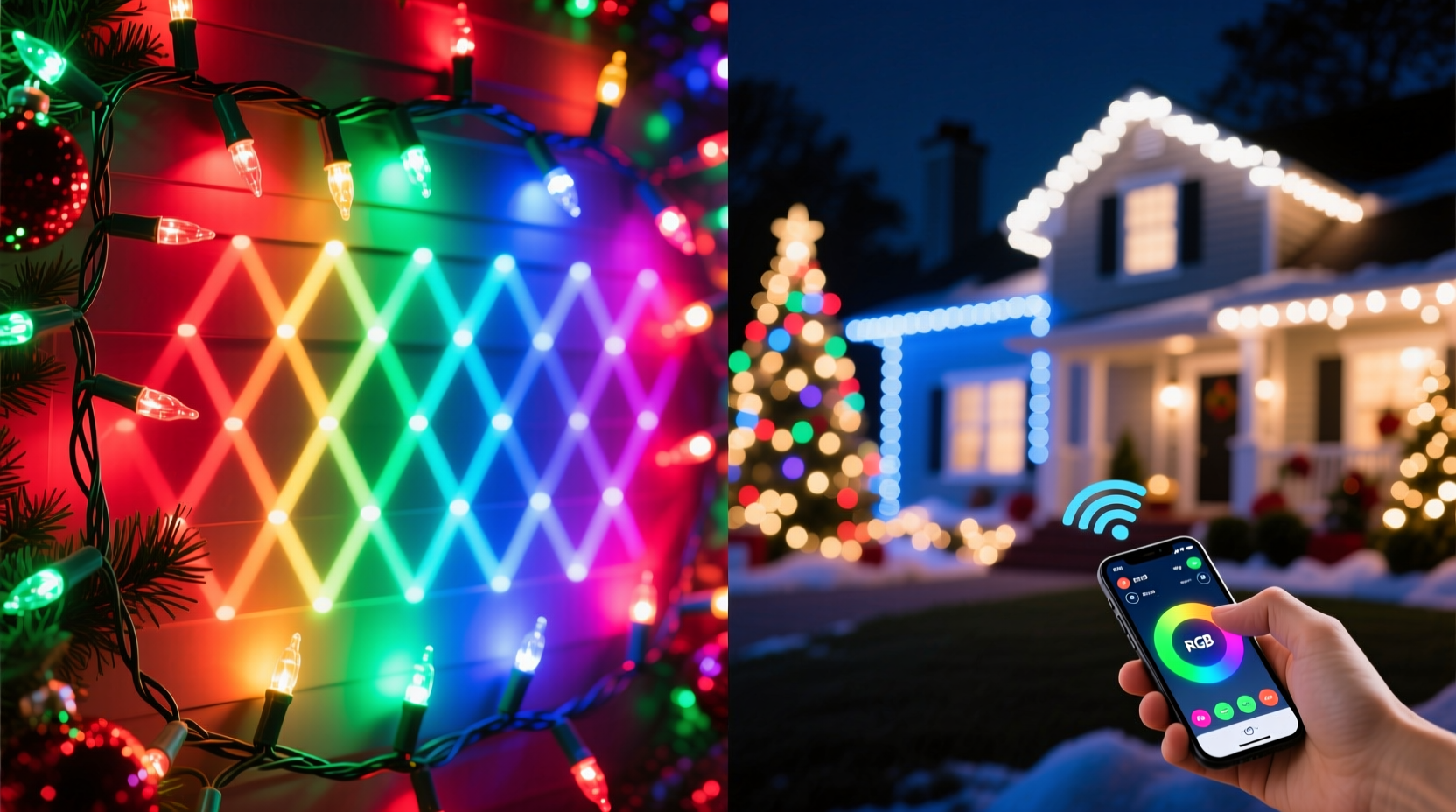
Before diving into customization, it’s important to clarify what sets RGB and static color LEDs apart at the technical level.
Static color LED lights emit a single, unchanging hue. Whether warm white, cool white, blue, green, or red, each bulb produces the same color throughout its lifespan. These are often used in traditional string lights, icicle lights, or net lights where consistency and simplicity are valued.
RGB LED lights, on the other hand, combine red, green, and blue diodes within each bulb. By varying the intensity of each diode, the light can produce millions of colors—including white—and transition between them dynamically. Many RGB systems come with controllers, remotes, or smartphone apps that allow users to change colors, adjust brightness, and select lighting effects such as fading, twinkling, or chasing patterns.
This fundamental difference in design directly impacts how much freedom you have in shaping your lighting experience.
Color Range and Flexibility
The most obvious advantage of RGB LEDs is their vast color range. A single strand can simulate nearly any color in the visible spectrum. Want deep purple for a Halloween setup? Switchable with a button. Need patriotic red, white, and blue for Independence Day? Done. Hosting a birthday party with custom theme colors? No problem.
In contrast, static color LEDs are limited to their factory-set shade. If you purchase green lights, they will only ever be green. To achieve multiple colors, you must buy and install separate strands for each hue—a less efficient and more cluttered solution.
Control Options and Smart Integration
Customization extends beyond color selection—it includes how you interact with your lights. Modern RGB LED systems often support advanced control methods:
- Remote controls – Allow basic color and effect changes from a distance.
- Smartphone apps – Enable precise color picking, scheduling, scene saving, and synchronization with music.
- Voice assistants – Compatible with Alexa, Google Assistant, or Siri for hands-free operation.
- Music sync modes – Automatically pulse or shift colors in time with ambient sound.
These features turn lighting into an interactive experience. You can program a slow fade from gold to crimson for a romantic dinner, set a strobe effect for a backyard dance party, or schedule your tree to glow softly at sunset and shut off at midnight.
Static color LEDs typically lack any form of intelligent control. Some may include simple on/off switches or basic timers, but there's no way to alter brightness, pattern, or timing beyond those basics. They serve a functional role rather than a dynamic one.
“RGB lighting has evolved from novelty to necessity for decorators who want emotional impact through illumination.” — Marcus Lin, Lighting Designer & Holiday Display Consultant
Comparison Table: Customization Features at a Glance
| Feature | RGB LED Lights | Static Color LED Lights |
|---|---|---|
| Color Options | Millions (via RGB mixing) | One fixed color per strand |
| Color Changing Ability | Yes, instant and programmable | No |
| Lighting Effects | Fade, strobe, chase, twinkle, wave, etc. | Usually steady on or simple blink |
| App/Smart Home Control | Common on mid-to-high-end models | Rare or nonexistent |
| Scheduling & Automation | Yes, via app or hub | Only with external timer |
| Music Synchronization | Available on many models | Not supported |
| Best For | Dynamic displays, multi-event use, creative themes | Traditional decor, permanent installations, budget setups |
Real-World Scenario: A Home Decorator’s Dilemma
Sarah Thompson, a homeowner in Portland, Oregon, wanted to elevate her annual Christmas display. In past years, she used static white and multicolor strands across her roofline and trees. While cheerful, the look never changed—and storing multiple boxes of different-colored lights was cumbersome.
Last season, she invested in an RGB LED system with Wi-Fi connectivity. Using a smartphone app, she programmed her lights to:
- Display warm white during Thanksgiving week.
- Shift to animated red-and-green patterns starting December 1st.
- Play a synchronized light show every evening at 6:30 PM with holiday music streamed through outdoor speakers.
- Automatically dim after 9 PM for neighborhood courtesy.
Neighbors began referring to her home as “the light house,” and local media featured her display. More importantly, Sarah reused the same strands for New Year’s Eve with a blue-and-silver gradient and even repurposed them for her daughter’s unicorn-themed birthday party in spring.
Her experience illustrates a key truth: RGB LEDs aren’t just for holidays—they’re adaptable tools for year-round ambiance.
Installation and Setup Considerations
While RGB lights win in customization, they do require more thoughtful setup. Here’s what to keep in mind:
- Power Requirements: Some RGB systems, especially longer runs or addressable strips, need higher voltage or additional power injectors to prevent dimming at the end of the line.
- Controller Placement: The controller or hub must be accessible for updates and troubleshooting, yet protected from weather if used outdoors.
- Wi-Fi Reliability: Smart RGB lights depend on stable internet or Bluetooth connections. Poor signal can delay commands or disconnect devices.
- Learning Curve: First-time users may find apps or programming interfaces overwhelming. Reading manuals and starting with presets helps.
Static color LEDs, by comparison, are truly plug-and-play. No configuration needed. Just unbox, drape, and enjoy. This simplicity makes them ideal for renters, older adults, or anyone prioritizing ease over experimentation.
Step-by-Step: Setting Up a Customizable RGB Display
To get the most from your RGB LED Christmas lights, follow this sequence:
- Plan Your Layout: Sketch where lights will go—rooflines, trees, windows—and measure distances to determine how many strands you’ll need.
- Choose the Right Type: Decide between non-addressable (whole strand changes together) and addressable (individual bulbs controlled separately). Addressable offers greater precision but costs more.
- Install with Power in Mind: Plug into GFCI outlets. Use extension cords rated for outdoor use. Avoid daisy-chaining too many strands.
- Connect to Controller: Pair the lights with the remote or hub. Follow manufacturer instructions for syncing.
- Download App & Customize: Select colors, save scenes (e.g., “Christmas Eve Glow”), set schedules, and test music sync.
- Weatherproof Connections: Use waterproof covers or electrical tape on all outdoor junctions.
- Test Before Finalizing: Run through all effects and transitions to ensure smooth performance.
Cost and Long-Term Value
Initially, RGB LED lights are more expensive than static color versions. A 50-light RGB string might cost $25–$40, while a comparable static strand sells for $8–$15. However, the long-term value shifts the equation.
Because RGB lights can mimic any color, you eliminate the need to buy multiple sets for different occasions. Over three years, one high-quality RGB setup could replace five or more static color purchases. Additionally, smart features reduce energy waste through automation, and durable construction on premium models ensures longevity.
For commercial displays, event planners, or serious hobbyists, the return on investment becomes clear quickly. Even casual users benefit from reusability across seasons—from Valentine’s Day (pink and red pulses) to St. Patrick’s Day (green waves) to Fourth of July (red, white, and blue chases).
Frequently Asked Questions
Can I mix RGB and static color lights in the same display?
Yes, you can physically mix them, but doing so reduces overall control. Since static lights can’t change or sync, they’ll remain constant while RGB lights shift. This can create visual imbalance unless intentionally designed—for example, using static white lights as a base and RGB accents for focal points.
Do RGB lights use more energy than static color LEDs?
Not significantly. Both types are highly energy-efficient. While RGB bulbs contain three diodes, they rarely run all at full brightness simultaneously. Actual power draw depends more on total lumens and length than color type. Most RGB strings consume only slightly more wattage than single-color equivalents.
Are RGB lights harder to install outdoors?
They’re not inherently harder, but they do require extra care with electronics. Ensure controllers are sheltered from rain, and use outdoor-rated enclosures. Also, verify that your RGB product is labeled for exterior use—some cheaper models are indoor-only.
Final Verdict: Which Offers Better Customization?
When customization is the priority, RGB LED Christmas lights are the clear winner. Their ability to produce millions of colors, execute complex lighting sequences, integrate with smart home ecosystems, and adapt to multiple events makes them unmatched in flexibility.
Static color LEDs serve a purpose—they’re reliable, affordable, and perfect for minimalist or traditional displays. But they offer zero adaptability. Once installed, what you see is what you get.
If your goal is personal expression, seasonal rotation, or creating memorable experiences for family and community, RGB technology empowers you to go beyond decoration and into storytelling with light.
“The best holiday lighting doesn’t just illuminate—it evokes emotion. And that starts with having full creative control.” — Lena Park, Architectural Lighting Specialist
Take Action: Light Up Your Vision
You don’t need a massive budget or engineering degree to start customizing your holiday display. Begin with a single RGB strand on your porch or tree. Experiment with colors and effects. Save your favorite combinations. Next year, expand the system. Over time, you’ll build a dynamic, responsive lighting environment that reflects your personality and enhances every celebration.
Whether you're aiming for cozy charm or dazzling spectacle, remember: true customization means your lights change when you want, how you want. With RGB LEDs, the only limit is your imagination.




 浙公网安备
33010002000092号
浙公网安备
33010002000092号 浙B2-20120091-4
Comments
No comments yet. Why don't you start the discussion?