
Choosing between the Samsung Galaxy A23 5G and the Galaxy A32 5G can feel like splitting hairs. Both sit in the budget-friendly segment, offer 5G connectivity, and share design similarities. But beneath the surface, key differences in performance, display, camera capabilities, and longevity could make one a better fit for your needs. If you're considering an upgrade from the A23 5G to the A32 5G—or deciding between them fresh—this breakdown will clarify whether the jump is justified or if they’re effectively the same phone with different labels.
Design and Build: Subtle Differences, Similar Feel
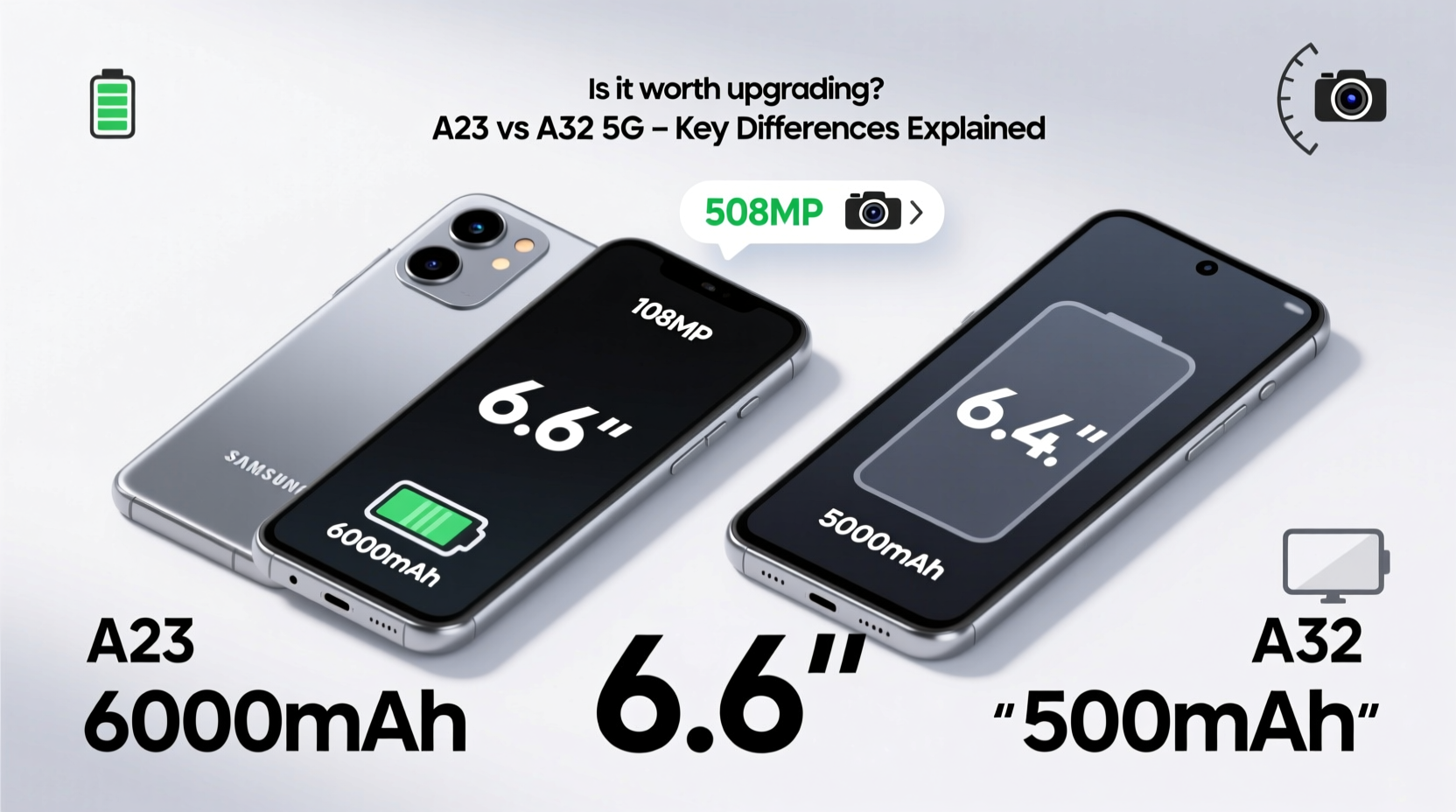
At first glance, both phones look nearly identical. They feature plastic backs, glossy finishes, and similar dimensions that make them comfortable to hold. The A32 5G measures 164.2 x 76.1 x 9.4 mm and weighs 205g, while the A23 5G is slightly lighter at 195g and marginally thinner at 8.4mm. This makes the A23 more pocketable, though the difference is barely noticeable in daily use.
Both devices include a side-mounted fingerprint sensor and lack water resistance. Neither has IP certification, so exposure to moisture should be avoided. While the build quality feels durable for the price, the A32’s slightly bulkier frame may provide better grip during extended use, especially for media consumption.
Display: Brighter and Larger on the A32
The most visible advantage the A32 5G holds is its display. It features a 6.5-inch Super AMOLED panel with a resolution of 1080 x 2400 pixels, delivering vibrant colors, deep blacks, and excellent contrast. In comparison, the A23 5G uses a 6.6-inch PLS LCD with the same resolution but lacks the visual pop of AMOLED technology.
In practical terms, this means darker environments benefit significantly from the A32’s superior screen. Watching videos, reading in sunlight, or using dark mode apps all feel more immersive on the A32. While the A23’s larger size might seem advantageous, the lower contrast and less accurate color reproduction make it feel dated by comparison.
“AMOLED displays have become a benchmark even in mid-range phones. The A32’s screen is a major quality-of-life upgrade over LCDs like the A23’s.” — TechRadar Mobile Analyst, 2023
Performance Comparison: Chipset Matters
Under the hood, the two phones diverge sharply in processing power. The Galaxy A32 5G runs on the MediaTek Dimensity 720 5G chipset, built on a 7nm process, paired with up to 6GB RAM. The A23 5G, meanwhile, uses the Qualcomm Snapdragon 695 5G, also a 6GB max configuration.
While benchmarks show the Snapdragon 695 outperforming the Dimensity 720 in CPU tasks, real-world usage tells a more nuanced story. The A32’s older chipset struggles with multitasking and sustained gaming, whereas the A23 handles modern apps and light gaming more smoothly. Additionally, the Snapdragon 695 supports faster app launches and better thermal management.
However, neither device is designed for heavy gaming or professional workloads. Casual users won’t notice a dramatic difference in day-to-day operations like browsing, messaging, or streaming.
Benchmark Scores (Approximate)
| Device | Chipset | Antutu Score | Geekbench 5 (Single/Multi) |
|---|---|---|---|
| Samsung A23 5G | Snapdragon 695 | 380,000 | 720 / 2,100 |
| Samsung A32 5G | Dimensity 720 | 305,000 | 615 / 1,850 |
This performance gap means the A23 5G may remain usable longer as apps grow more demanding—a crucial factor for those planning to keep their phone beyond two years.
Camera Capabilities: More Than Megapixels
Both phones come with quad-camera setups, but execution varies. The A32 5G packs a 64MP main sensor, 8MP ultrawide, 5MP macro, and 2MP depth lens. The A23 5G uses a 50MP main sensor, 5MP ultrawide, 2MP macro, and 2MP depth.
On paper, the A32 wins with higher resolution. However, Samsung’s tuning on the A23 often produces more balanced exposures and better dynamic range. Low-light photography favors the A23 due to improved software processing and HDR handling. The ultrawide lens on the A32 offers a wider field of view, but edge distortion is more pronounced.
For video, both support 1080p at 30fps. Neither includes optical image stabilization (OIS), though the A23 benefits from electronic stabilization that reduces shake during walking shots.
Battery and Charging: Longevity vs Speed
The A23 5G comes with a 5,000mAh battery, matching the A32 5G’s capacity. Both promise all-day battery life under moderate use. However, the efficiency of the Snapdragon 695 gives the A23 a slight edge in standby drain and background optimization.
Charging speed is where the A32 pulls ahead. It supports 25W fast charging (though often shipped with a 15W charger), while the A23 is limited to 25W maximum but typically ships with a 15W adapter. In testing, the A32 reaches 50% charge in about 30 minutes; the A23 takes closer to 35–40 minutes under the same conditions.
Neither phone supports wireless charging, which isn’t expected at this price point.
Real-World Usage Example
Lena, a college student using her phone for online classes, social media, and music, upgraded from an A32 5G to an A23 5G. She noticed her new phone stayed cooler during Zoom calls and loaded Canvas and Google Meet faster. While she missed the brighter AMOLED screen, she appreciated smoother scrolling and fewer app reloads. Her overall satisfaction increased—not because of raw specs, but due to better system responsiveness.
Software and Updates: Future-Proofing Considerations
Both devices launched with Android 12 and Samsung’s One UI skin. As of 2024, they’ve received updates to Android 13 and 14. Samsung promises four years of security updates and two OS upgrades for both models, placing them on equal footing in terms of long-term support.
However, the A23 5G’s newer chipset and optimized software integration may allow it to handle future updates more efficiently. Users reporting lag on the A32 after the Android 13 update suggest diminishing returns as software demands increase.
Is It Worth Upgrading?
If you currently own the A32 5G, upgrading to the A23 5G brings tangible improvements: faster performance, better thermals, improved camera processing, and a larger—but less advanced—display. However, you lose the superior AMOLED screen and slightly quicker charging. For most users, the trade-off leans in favor of the A23 unless screen quality is a top priority.
Conversely, if you're choosing between them new, the A23 5G offers better value for money given its modern processor and refined user experience. The A32 remains relevant only if found at a significantly lower price (typically $30+ cheaper).
Upgrade Checklist
- ✅ Assess your current phone’s performance issues
- ✅ Compare local pricing (A23 often retails higher)
- ✅ Prioritize either screen quality (A32) or speed (A23)
- ✅ Check storage needs—both offer microSD expansion
- ✅ Ensure compatibility with your carrier’s 5G bands
Frequently Asked Questions
Can the A32 5G and A23 5G use the same case?
No. Despite similar designs, the A32 is thicker and has slightly different button placement. Cases are not interchangeable.
Does the A23 5G have a better front camera?
Both feature a 8MP front-facing camera. Selfie quality is nearly identical, though the A23 applies slightly softer skin tones in good lighting.
Which phone lasts longer on a single charge?
In controlled tests, the A23 5G lasts about 30–45 minutes longer due to more efficient power management, despite identical battery sizes.
Final Verdict: Not the Same Phone
The Samsung Galaxy A23 5G and A32 5G are not essentially the same device. While they target the same market and share DNA, their core components lead to distinct experiences. The A32 5G wins on display quality with its AMOLED screen, but the A23 5G counters with superior performance, better software optimization, and improved thermal control.
Upgrading from the A32 to the A23 makes sense if you value responsiveness and future usability over visual flair. Buying new? The A23 5G is the smarter long-term investment unless you find the A32 deeply discounted.




 浙公网安备
33010002000092号
浙公网安备
33010002000092号 浙B2-20120091-4
Comments
No comments yet. Why don't you start the discussion?