
When Samsung’s Galaxy S8 launched in 2017, it set a new standard for smartphone design with its edge-to-edge display and refined software. Fast forward to today, and many long-time S8 users are questioning whether it’s time to move on. The Samsung Galaxy A52, released in 2021, represents a modern mid-range alternative that offers significant upgrades in key areas. But is the jump from an S8 to an A52 truly worthwhile in 2024? The answer depends on your usage, expectations, and how much value you place on longevity and future-proofing.
Performance and Hardware: A Generational Leap
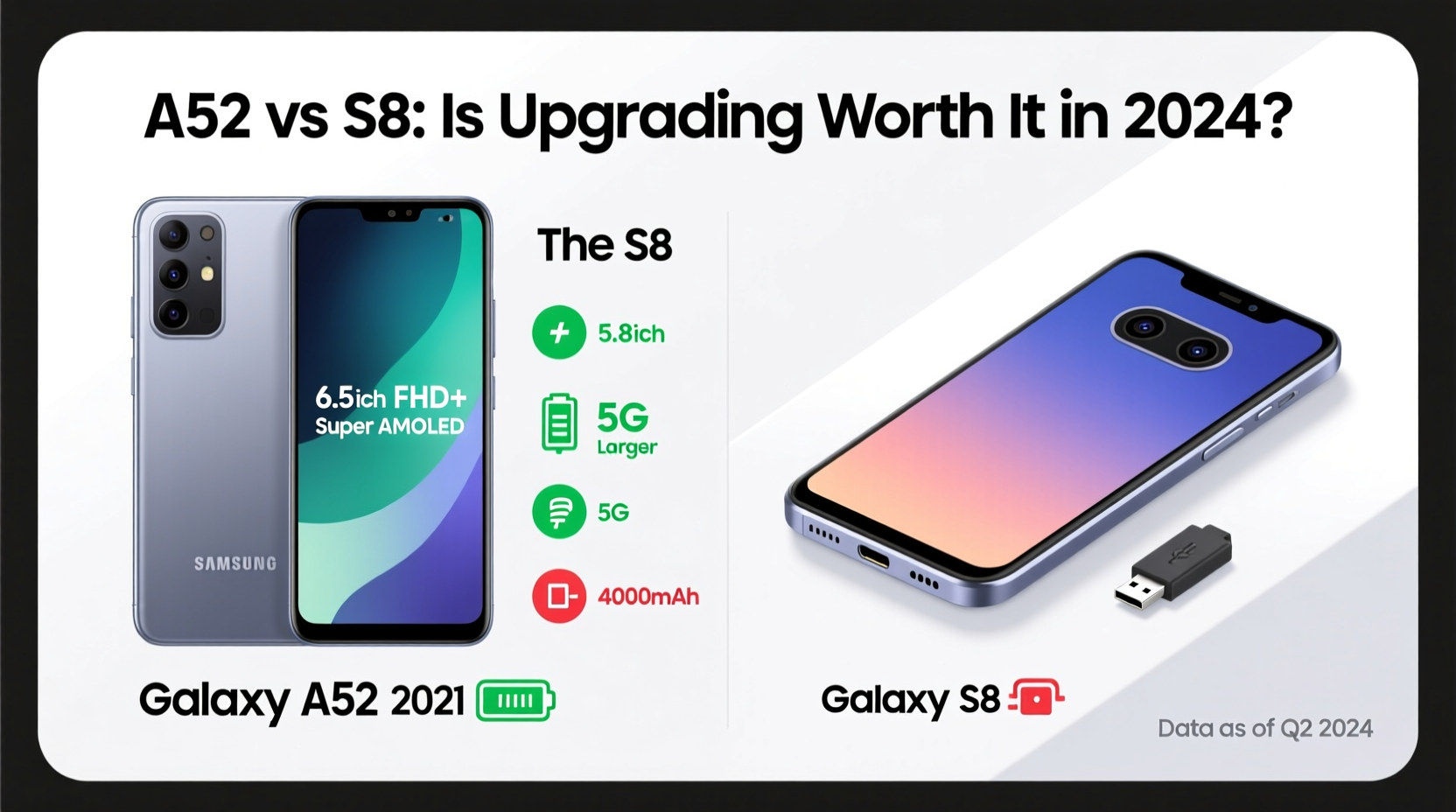
The hardware gap between the Galaxy S8 and the A52 is substantial—spanning nearly four years of technological advancement. The S8 was powered by either the Snapdragon 835 or Exynos 8895, depending on region, both of which were flagship-grade at the time. In contrast, the A52 runs on the Snapdragon 750G, a mid-tier chip optimized for efficiency and moderate multitasking.
While the S8’s processor was once top-of-the-line, it now struggles with modern apps, background processes, and system updates. Android 10 was the final major OS update for the S8, meaning it lacks support for newer features and security patches. The A52, on the other hand, launched with Android 11 and is eligible for three major OS updates, currently supporting up to Android 14 with ongoing security patches into 2025.
Display and Design Comparison
The S8 introduced Samsung’s Infinity Display—a sleek, curved 5.8-inch Quad HD+ Super AMOLED screen with minimal bezels. At the time, it was among the most beautiful displays on any phone. The A52, however, features a larger 6.5-inch Full HD+ Super AMOLED display with a 90Hz refresh rate, offering smoother scrolling and improved responsiveness.
While the S8’s screen resolution was technically higher (1440 x 2960), the A52 compensates with better brightness (up to 800 nits), improved outdoor visibility, and adaptive refresh technology. Additionally, the A52 has an IP67 rating for dust and water resistance—something the S8 lacks entirely.
| Feature | Samsung Galaxy S8 | Samsung Galaxy A52 |
|---|---|---|
| Display Size | 5.8 inches | 6.5 inches |
| Resolution | 1440 x 2960 (QHD+) | 1080 x 2400 (FHD+) |
| Refresh Rate | 60Hz | 90Hz |
| Display Type | Super AMOLED | Super AMOLED |
| Brightness (Peak) | ~600 nits | ~800 nits |
| Water Resistance | No official rating | IP67 certified |
The A52’s flat display may lack the visual drama of the S8’s curves, but it’s more practical for daily use—especially when applying screen protectors or avoiding accidental touches.
Camera Capabilities: From Good to Versatile
The Galaxy S8 featured a single 12MP rear camera with Dual Pixel autofocus and f/1.7 aperture—an excellent shooter for its time. It captured sharp images with natural color reproduction and handled low light reasonably well. However, it lacked ultra-wide or macro lenses, limiting creative flexibility.
The A52 introduces a quad-camera setup: a 64MP main sensor, 12MP ultra-wide, 5MP macro, and 5MP depth sensor. This allows users to shoot wide-angle landscapes, detailed close-ups, and portrait photos with adjustable bokeh. While pixel count doesn’t always equal quality, the A52 benefits from advanced image processing, Night Mode, and improved HDR handling.
“Modern mid-range phones like the A52 offer computational photography features that even flagship phones from 2017 couldn’t match.” — David Lin, Mobile Imaging Analyst at TechPulse Insights
In real-world conditions, the A52 consistently outperforms the S8 in dynamic range, detail retention, and low-light clarity. Video recording also sees a leap—from 4K@30fps on the S8 to stabilized 4K on the A52, plus improved audio capture and steady video in motion.
Battery Life and Charging: All-Day Power vs. Fading Endurance
The S8 came with a 3000mAh battery, which was adequate in 2017 but falls short by today’s standards. With regular use, it often required daily charging, and after years of charge cycles, many units now suffer from reduced capacity and faster drain.
The A52 packs a 4500mAh battery—50% larger—and supports 25W fast charging (though often shipped with a 15W charger). Real-world testing shows the A52 can last 1.5 to 2 days under moderate use, making it far more reliable for commuting, travel, or heavy app usage.
Additionally, the A52 includes adaptive battery management through One UI, learning your habits to optimize power consumption over time—a feature absent in the older S8’s software environment.
Software Experience and Longevity
This is where the decision becomes less about specs and more about sustainability. The S8 reached end-of-life in terms of software support in 2020. No further Android version updates or monthly security patches are provided, leaving it vulnerable to emerging threats and incompatible with some newer apps.
The A52, while not a flagship, receives regular updates and will likely remain secure and functional through at least 2025. Its One UI interface includes modern conveniences like dark mode scheduling, enhanced privacy controls, improved split-screen multitasking, and better integration with Samsung’s ecosystem (SmartThings, Wearables, etc.).
Mini Case Study: Maria’s Upgrade Decision
Maria had been using her Galaxy S8 since 2017. By 2023, she noticed apps took longer to load, her battery drained by noon, and several banking and messaging apps began displaying compatibility warnings. She considered buying another used flagship but decided to test the A52 at a local store. After just 10 minutes of use, she was struck by how fast the home screen felt and how clear the camera preview was. She upgraded and reported immediate improvements: “I didn’t realize how much I was compromising until I switched. My Zoom calls are clearer, my maps don’t freeze, and I’m not afraid of running out of battery during school pickup.”
Upgrade Checklist: Are You Ready?
Use this checklist to determine if moving from the S8 to the A52 makes sense for you:
- ✅ Does your S8 take more than 10 seconds to open common apps?
- ✅ Have you experienced random reboots or overheating?
- ✅ Is your battery life below 5 hours of screen-on time?
- ✅ Are you unable to install certain apps due to OS limitations?
- ✅ Do you want better photo quality without carrying a separate camera?
- ✅ Do you value water resistance for daily peace of mind?
If you answered yes to three or more, the upgrade is likely justified.
Frequently Asked Questions
Will my accessories work with the A52?
Most Bluetooth devices (earbuds, smartwatches) will pair seamlessly. However, older micro-USB chargers and docks won’t work—the A52 uses USB-C. You’ll need new cables and potentially new car mounts or bedside chargers.
Is the A52 too big compared to the S8?
The A52 is larger and heavier (189g vs. 155g), so it may feel bulky at first. However, its taller 20:9 aspect ratio makes one-handed use manageable despite the bigger screen. Try holding a demo unit before purchasing if size is a concern.
Can the A52 run modern games smoothly?
Yes. Games like Genshin Impact or Call of Duty: Mobile run at medium settings with stable frame rates. The S8 would struggle significantly with these titles today, often dropping below 30fps.
Conclusion: A Worthy Step Forward
Upgrading from the Galaxy S8 to the A52 in 2024 isn’t just about better specs—it’s about reclaiming reliability, security, and usability. The A52 delivers tangible improvements across every core function: longer battery life, sharper cameras, faster performance, and continued software support. While the S8 was a pioneer in its era, it no longer meets the demands of modern mobile life.
For former S8 owners still holding on out of loyalty or hesitation, the A52 represents a smart, cost-effective transition into the current generation of smartphones. It balances premium features with accessible pricing, ensuring you stay connected, productive, and protected without overspending.




 浙公网安备
33010002000092号
浙公网安备
33010002000092号 浙B2-20120091-4
Comments
No comments yet. Why don't you start the discussion?