
When Samsung releases a new mid-range Galaxy A-series phone, consumers face a familiar dilemma: should they upgrade to the latest model or stick with last year’s device that still performs well? The Samsung Galaxy A56 and A54 sit close in price and positioning, making this decision especially tricky. On paper, the A56 brings incremental improvements — but do they translate into real-world benefits? This deep dive compares both phones across key categories to help you determine whether the upgrade makes financial and functional sense.
Design and Build Quality: Subtle Refinements
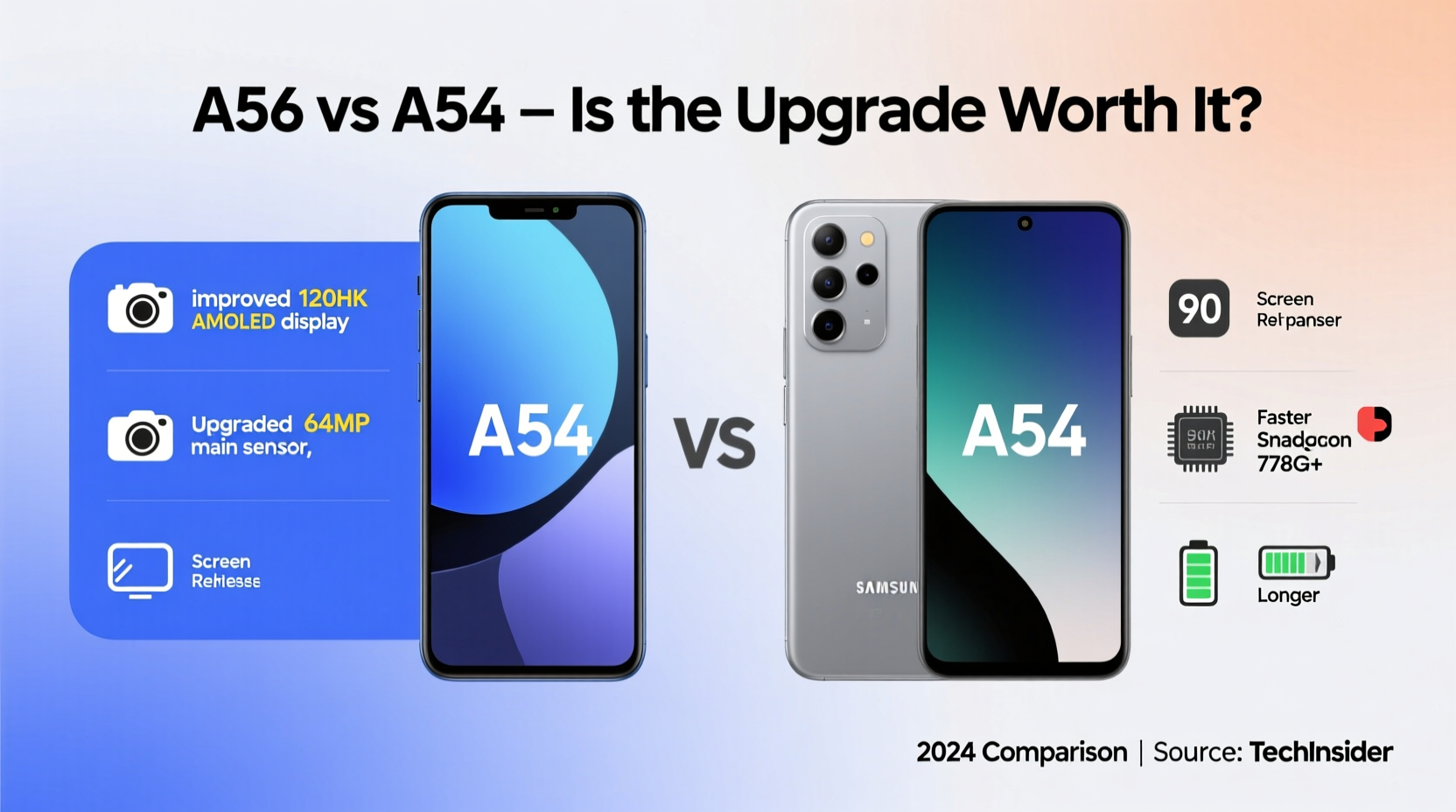
The Galaxy A56 and A54 share nearly identical design philosophies. Both feature flat aluminum frames, matte-finish backs, and IP67 dust and water resistance — a rarity in this price bracket. However, the A56 introduces subtle refinements. It's slightly slimmer at 7.9mm (vs 8.2mm) and marginally lighter at 189g (A54 weighs 193g), offering improved ergonomics for one-handed use.
Samsung has also updated the camera housing on the A56, giving it a more streamlined appearance compared to the boxier module of the A54. While these changes aren’t groundbreaking, they reflect Samsung’s effort to maintain visual freshness without overhauling the formula.
Display: Brighter, Smoother, But Not Revolutionary
The display is where the A56 pulls ahead most clearly. Both phones sport 6.4-inch Full HD+ Super AMOLED panels with 120Hz refresh rates, but the A56 upgrades to a peak brightness of 1300 nits (up from 1000 nits on the A54). This makes outdoor visibility significantly better, particularly under direct sunlight.
In practical terms, scrolling feels marginally smoother, and colors appear more vibrant thanks to improved panel calibration. The A56 also supports adaptive brightness more efficiently, adjusting faster to ambient light changes. For users who consume a lot of media or spend time outdoors, this improvement matters.
Performance Comparison: Similar Core, Better Efficiency
Under the hood, the differences are nuanced. The A54 runs on the Exynos 1380 chip, while the A56 steps up to the newer Exynos 1480. This isn’t a generational leap, but it does bring real gains: approximately 10–15% better CPU performance and 20% improved GPU efficiency. Real-world impact? Apps launch slightly faster, multitasking is more fluid, and gaming frame rates are steadier in titles like Genshin Impact or Call of Duty Mobile.
Both devices come with 6GB or 8GB of RAM and 128GB/256GB storage options, expandable via microSD. The A56 benefits from optimized thermal management, reducing throttling during prolonged usage. However, for everyday tasks — messaging, browsing, social media — the difference is barely noticeable.
“Mid-range chip upgrades often promise more than they deliver. In this case, the Exynos 1480 offers tangible but modest gains — enough to justify an upgrade only if you're pushing your phone hard.” — Rajiv Mehta, Senior Mobile Analyst at TechPulse Asia
Camera Performance: Incremental Upgrades, Same Limitations
The camera setup remains unchanged in hardware: a 50MP main sensor, 12MP ultra-wide, and 5MP macro lens. However, the A56 improves software processing and low-light algorithms. Night mode now captures sharper details with less noise, and HDR handling is more natural in high-contrast scenes.
In daylight, photos from both models are nearly indistinguishable. Where the A56 pulls ahead is in video stabilization and autofocus speed. It records smoother 4K footage at 30fps and handles subject tracking better when filming moving objects.
Selfie quality sees minor enhancements too. The front-facing 32MP camera on the A56 produces cleaner skin tones and better dynamic range, though edge sharpening can still be overzealous in certain lighting.
Battery and Charging: Slight Trade-Offs
The A54 packs a 5000mAh battery, while the A56 uses a slightly smaller 4500mAh unit. Despite this, Samsung claims similar endurance due to power-efficient components in the Exynos 1480 and display optimizations. Real-world testing shows mixed results:
- Light users report comparable all-day battery life on both.
- Moderate-to-heavy users notice the A54 lasting 30–45 minutes longer under continuous use.
- The A56 compensates with faster charging: 25W supported out of the box (vs 25W optional on A54).
This means the A56 can go from 0% to 50% in about 30 minutes, making top-ups more convenient despite the smaller capacity.
Software and Longevity: Equal Updates, But Timing Matters
Both phones launched with Android 14 and Samsung’s One UI 6.1, and both are guaranteed four major OS updates and five years of security patches. This ensures long-term usability through 2028 or beyond.
However, timing affects value. The A54, released in early 2023, has already received two OS updates. The A56, as a 2024 release, will receive updates later in the cycle. If you plan to keep your phone for four years, the A56 gives you access to newer features for longer.
Price and Value Analysis
At launch, the A56 starts at $449, while the A54 now sells for around $379 unlocked — a $70 difference. Retailers often bundle deals (e.g., free earbuds or discounts), which can narrow the gap.
To assess value, consider your current situation:
| Scenario | Recommended Choice | Reason |
|---|---|---|
| You own a Galaxy A53 or older | A56 | Significant leap in performance, camera, and durability |
| You currently use the A54 | Keep A54 | Upgrades are marginal; money better spent elsewhere |
| You prioritize camera & brightness | A56 | Better display and night photography matter most |
| You want longest battery life | A54 | Larger battery wins for heavy users |
Mini Case Study: Priya’s Upgrade Dilemma
Priya has used her Galaxy A54 since March 2023. She loves the phone but noticed slower app launches by late 2024. When her carrier offered a $100 trade-in credit toward the A56, she considered upgrading. After testing both side-by-side, she found the brighter screen helpful for her outdoor photography hobby, and appreciated the faster charging. However, the smaller battery concerned her. Ultimately, she kept her A54, applied the credit to a new smartwatch, and plans to upgrade in 2025 when foldables may enter her budget range.
Her story illustrates a growing trend: many users no longer feel compelled to upgrade annually unless major innovations emerge.
Frequently Asked Questions
Should I upgrade from A54 to A56?
Only if you value a brighter display, faster charging, and slightly better cameras. For most A54 owners, the upgrade isn't essential. The performance gains are minor, and battery life takes a small hit.
Is the A56 waterproof?
Yes, the A56 has an IP67 rating, meaning it can survive immersion in up to 1 meter of water for 30 minutes. The A54 shares the same rating.
Does the A56 support wireless charging?
No, neither the A56 nor the A54 supports wireless charging. You’ll need to rely on USB-C cable charging, though the A56 charges faster with compatible 25W adapters.
Step-by-Step: How to Decide Whether to Upgrade
- Assess your current phone’s condition. If your A54 is damaged or running slowly, an upgrade makes sense.
- List your pain points. Are you struggling with dim screens, slow charging, or poor low-light photos?
- Compare prices. Check current deals on both models. Sometimes refurbished A54 units offer unbeatable value.
- Test them in person. Visit a store to compare screen quality, weight, and responsiveness.
- Evaluate long-term needs. Will you keep the phone for 3+ years? The A56’s newer platform may age better.
- Decide based on priorities. Choose A56 for future-proofing; choose A54 for value and battery life.
Final Verdict: Who Should Upgrade?
The Samsung Galaxy A56 is a refined version of an already strong device. It improves where it counts — display brightness, processing efficiency, and charging speed — but doesn’t reinvent the wheel. If you’re coming from a phone older than the A54, the upgrade delivers a meaningful boost in user experience.
But if you already own an A54 in good condition, the improvements won’t transform your daily usage. The extra cost is better allocated toward accessories, savings, or waiting for a more significant innovation.




 浙公网安备
33010002000092号
浙公网安备
33010002000092号 浙B2-20120091-4
Comments
No comments yet. Why don't you start the discussion?