
When Samsung released the Galaxy A40 and A70 in 2019, they targeted two very different segments of the mid-range smartphone market. The A40 was positioned as an entry-level device focused on design and display quality, while the A70 leaned into power, battery life, and camera capabilities for users who wanted more without stepping into flagship territory. If you're currently using the A40 and wondering whether upgrading to the A70 makes sense, the answer depends on what you value most—performance, longevity, or cost efficiency.
This comparison dives deep into key differences in hardware, software experience, camera quality, battery life, and real-world usability to help you make an informed decision. Whether you're due for an upgrade or just curious about the gap between these two models, understanding their strengths and limitations will clarify if the jump from A40 to A70 is justified—or if staying put is smarter.
Design and Build: Subtle Differences, Different Feel
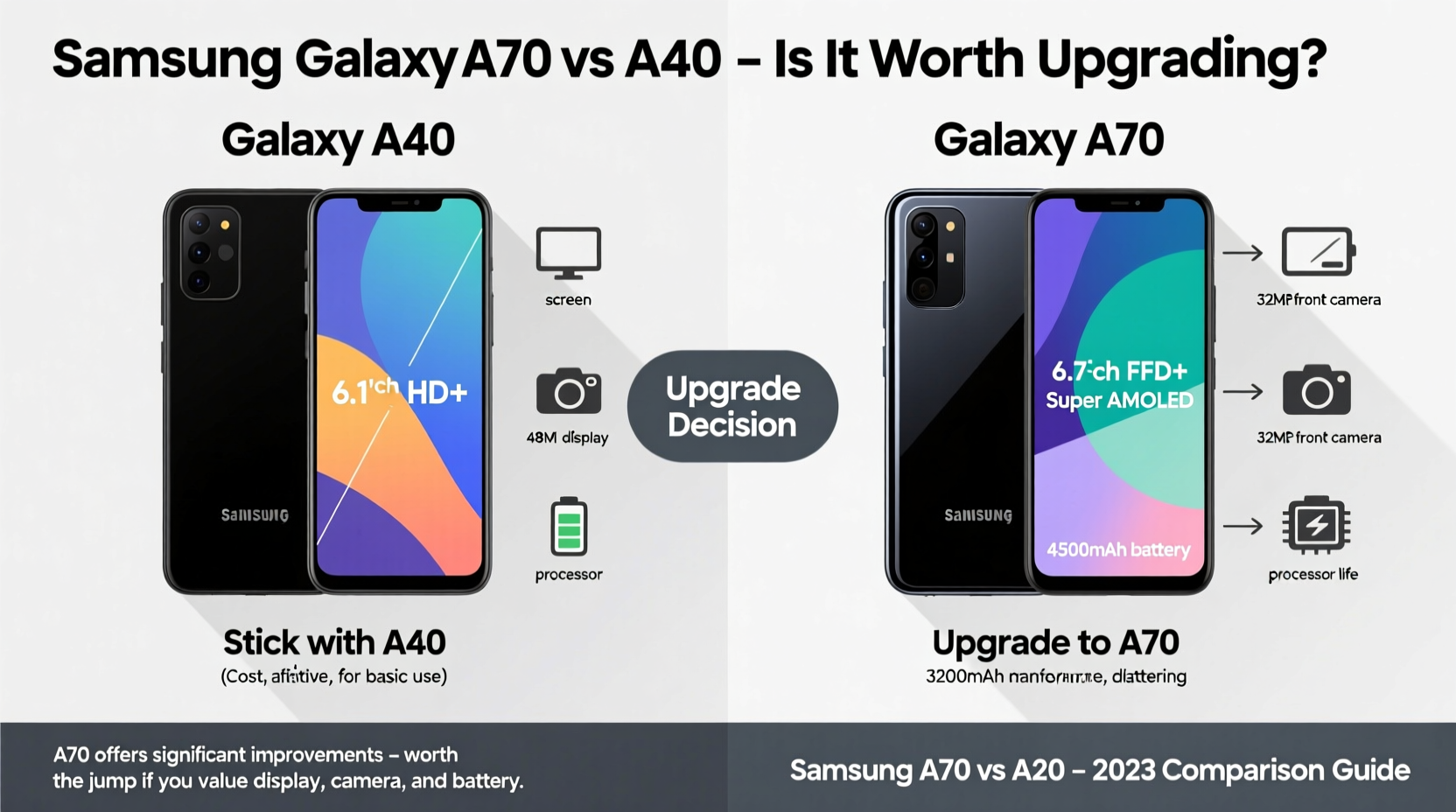
At first glance, both phones share Samsung’s minimalist aesthetic with slim bezels and glass-like finishes. However, there are notable differences in size, materials, and ergonomics.
The Galaxy A40 measures 144.4 x 69.5 x 7.9 mm and weighs just 140g, making it one of the lightest and most compact devices in its class. It features a plastic body with a glossy finish that mimics glass but is prone to smudges and scratches. Its smaller form factor makes it ideal for one-handed use and pocket-friendly carrying.
In contrast, the A70 is significantly larger at 164.3 x 76.7 x 7.9 mm and weighs 183g. While also built with plastic, its curved back improves grip despite the added bulk. The A70 includes an optical fingerprint sensor under the display—a feature absent on the A40, which relies solely on face recognition and a rear-mounted capacitive sensor (depending on region).
Display Quality: Both Shine, But Differently
One area where both phones impress is the display. The A40 sports a 5.9-inch Full HD+ Super AMOLED panel with a 1080x2340 resolution and a tall 19.5:9 aspect ratio. Colors are vibrant, blacks are deep, and outdoor visibility is excellent for its price point.
The A70 steps up slightly with a 6.7-inch Super AMOLED Plus Infinity-U display (FHD+, 1080x2400), offering more screen space and slightly improved pixel density. Though not a massive leap in sharpness, the larger size enhances video, gaming, and multitasking experiences.
Both support Always-On Display and adaptive brightness, but only the A70 benefits from being part of Samsung’s higher-tier A-series lineup, often receiving faster software updates and longer support cycles.
Performance Comparison: Where the Real Gap Lies
Under the hood, the difference becomes stark. The A40 runs on the Exynos 7904—a capable octa-core processor paired with 4GB RAM and 64GB storage. It handles everyday tasks like browsing, messaging, and streaming efficiently but struggles with heavy multitasking or modern mobile games.
The A70, meanwhile, uses the more powerful Snapdragon 675 chipset (in most regions) with options for 6GB or 8GB RAM and up to 128GB internal storage. This results in smoother app launches, better background handling, and noticeably improved gaming performance. Apps like PUBG Mobile or Call of Duty run at medium settings without constant frame drops.
“Mid-range phones live or die by their processors. The Snapdragon 675 gives the A70 a meaningful edge in responsiveness and future-proofing.” — Rajiv Mehta, Mobile Hardware Analyst at TechPulse Asia
If you plan to keep your phone for two years or more, the A70’s superior chipset ensures it stays usable longer as apps grow more demanding.
Camera Capabilities: More Than Just Megapixels
On paper, both phones have dual rear cameras, but implementation varies widely.
- Samsung A40: 16MP main + 5MP ultra-wide. Basic setup; decent daylight shots, weak low-light performance, no depth sensor for bokeh control.
- Samsung A70: 32MP main + 5MP depth sensor + 8MP ultra-wide. Triple-lens system enables better portrait mode, wider framing, and sharper detail retention.
The front-facing camera also favors the A70: a 32MP selfie shooter versus the A40’s 25MP unit. In practice, this means crisper selfies, better skin tone rendering, and enhanced beauty modes.
Video recording maxes out at 1080p/30fps on both, but the A70 includes electronic image stabilization (EIS), reducing shake during handheld filming—a subtle but valuable addition.
Battery Life and Charging: A Clear Winner Emerges
Battery capacity is perhaps the most decisive factor. The A40 packs a modest 3100mAh cell, sufficient for light users but requiring daily charging even with moderate use.
The A70 counters with a robust 4500mAh battery—nearly 50% larger—that easily lasts a full day and a half with mixed usage. Even heavy users can stretch it across two days with conservative settings.
Additionally, the A70 supports 25W fast charging (though typically ships with a 15W charger), allowing a 0–50% charge in around 30 minutes. The A40 lacks fast charging entirely, topping up at a standard 10W rate.
Detailed Feature Comparison Table
| Feature | Samsung Galaxy A40 | Samsung Galaxy A70 |
|---|---|---|
| Display | 5.9\" FHD+ Super AMOLED | 6.7\" FHD+ Super AMOLED Plus |
| Processor | Exynos 7904 | Snapdragon 675 |
| RAM / Storage | 4GB / 64GB | 6GB/8GB / 128GB |
| Rear Cameras | 16MP + 5MP UW | 32MP + 8MP UW + 5MP Depth |
| Front Camera | 25MP | 32MP |
| Battery | 3100mAh | 4500mAh |
| Charging | 10W (standard) | 25W (fast charging supported) |
| Fingerprint Sensor | Rear (some models only) | Under-display optical |
| Software Support | Android 9 → One UI Core 2.5 (ended) | Android 9 → One UI 3.1 (longer update cycle) |
| Price (Launch) | €349 | €399 |
Real-World Example: Maria’s Upgrade Decision
Maria had been using her Galaxy A40 since 2019. She loved its sleek look and crisp screen but grew frustrated by slow app switches, frequent crashes on Instagram Reels, and having to carry a power bank by midday. When she considered upgrading, she hesitated—was spending another €200 justified?
After testing the A70 at a retail store, she noticed immediate improvements: apps opened faster, videos loaded smoothly, and the larger screen made reading emails easier. Most importantly, the battery lasted through her workday and evening workouts without needing a recharge.
She decided the upgrade was worth it—not because the A70 was “flagship-level,” but because it removed daily friction. For her, productivity and reliability outweighed cost savings.
Step-by-Step: How to Decide If You Should Upgrade
- Evaluate current pain points: Are you experiencing lag, short battery life, or poor photo quality?
- Assess usage patterns: Do you stream, game, or rely on navigation? These demand more power and battery.
- Check software status: Is your A40 still receiving security updates? (Likely no.) The A70 received updates longer.
- Compare resale/trade-in value: Selling your A40 could reduce the effective cost of the A70.
- Test the A70 hands-on: Visit a retailer to feel the size, speed, and screen before committing.
FAQ Section
Can the Samsung A40 still handle daily tasks in 2024?
Yes, but with limitations. Basic calling, texting, WhatsApp, and light web browsing work fine. However, newer versions of social media apps and multitasking will feel sluggish. No official updates mean growing security risks over time.
Is the camera upgrade from A40 to A70 noticeable?
Yes, especially in variety and clarity. The A70’s triple camera offers ultra-wide shots, better portraits, and sharper details. Low-light photos remain average but are generally cleaner than the A40’s output.
Does the A70 support expandable storage?
Yes. Like the A40, the A70 includes a dedicated microSD card slot supporting up to 512GB, useful for storing photos, music, or offline videos.
Conclusion: To Upgrade or Not?
The choice between sticking with the A40 or upgrading to the A70 hinges on your priorities. If you’re satisfied with basic functionality, don’t mind slower performance, and prioritize affordability, the A40 might still suffice—especially as a secondary device or for minimal usage.
But if you want a more responsive experience, longer battery life, better cameras, and a phone that won’t feel obsolete within a year, the A70 delivers tangible improvements. Despite its higher initial cost, the investment pays off in daily usability, durability, and peace of mind.
Technology evolves quickly, but thoughtful upgrades shouldn’t be driven by hype—they should solve real problems. If your A40 is holding you back, stepping up to the A70 isn’t just reasonable; it’s practical.




 浙公网安备
33010002000092号
浙公网安备
33010002000092号 浙B2-20120091-4
Comments
No comments yet. Why don't you start the discussion?