
When Samsung released the Galaxy S10 series in 2019, it brought meaningful improvements over its predecessor, the S9. But for users still satisfied with their S9, the question remains: is upgrading to the S10e truly worthwhile? While both phones share DNA, the differences go beyond just design tweaks. Understanding how they compare in real-world usage—performance, camera quality, battery life, and long-term software support—can help determine whether the upgrade delivers tangible benefits or just incremental changes.
Design and Display Differences
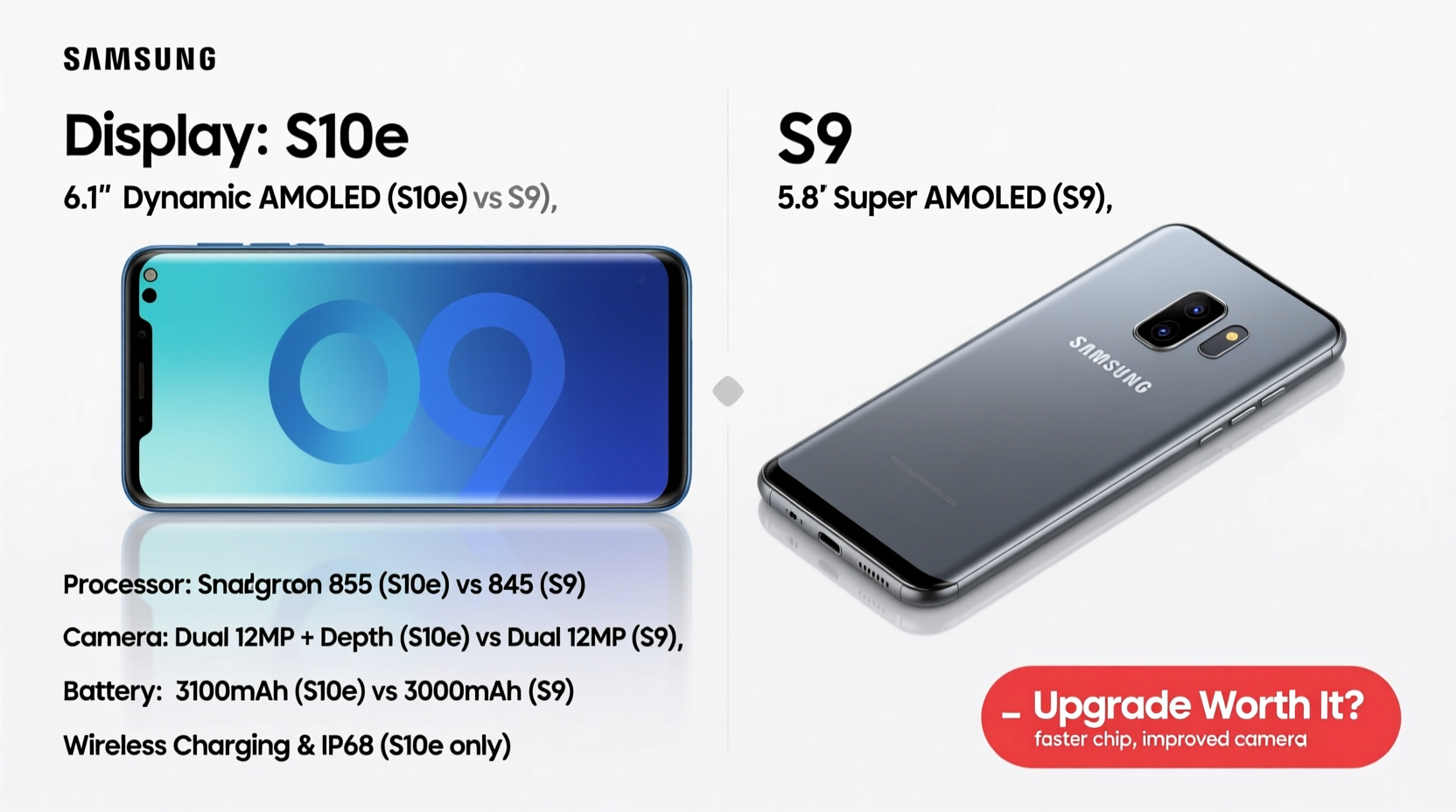
The most noticeable change between the S9 and S10e lies in their design language. The S9 features a traditional 18.5:9 Full HD+ Super AMOLED display with bezels on all sides and a physical home button housing the fingerprint sensor. In contrast, the S10e adopts a more modern aesthetic with a smaller 5.8-inch Dynamic AMOLED display that uses a punch-hole cutout for the front camera and eliminates the physical home button.
This shift reflects broader industry trends toward edge-to-edge screens. Though the S10e’s screen is slightly shorter in height than the S9’s 5.8-inch panel, its aspect ratio (19:9) and HDR10+ certification offer richer colors and better outdoor visibility. Additionally, the S10e’s flat display makes screen protector application easier and reduces accidental edge touches—a common complaint on curved-screen models like the S9.
Performance and Hardware Comparison
Under the hood, both devices are powered by flagship chipsets—Exynos 9810 for international S9 models and Snapdragon 845 in most regions. The S10e steps up with either the Exynos 9820 or Snapdragon 855, depending on region, offering roughly 30–35% better CPU performance and significantly improved GPU efficiency. This translates into smoother multitasking, faster app launches, and better gaming performance.
RAM configurations also differ. The S9 launched with 4GB RAM, while the S10e comes with 6GB standard. More RAM allows for better background app retention and future-proofing as Android becomes increasingly memory-hungry.
| Feature | Samsung Galaxy S9 | Samsung Galaxy S10e |
|---|---|---|
| Processor | Snapdragon 845 / Exynos 9810 | Snapdragon 855 / Exynos 9820 |
| RAM | 4GB | 6GB |
| Storage Options | 64GB + microSD | 128GB / 256GB + microSD |
| Battery Capacity | 3000 mAh | 3100 mAh |
| Fingerprint Sensor | Rear-mounted (capacitive) | Side-mounted (power button) |
The S10e also supports faster charging standards and wireless power sharing (PowerShare), allowing it to charge other Qi-compatible devices—something the S9 lacks entirely.
Camera Capabilities: Evolution Over Revolution
The S9 introduced a solid single 12MP rear camera with dual aperture (f/1.5–f/2.4), capable of adapting to lighting conditions. It delivered excellent low-light performance for its time. The S10e improves on this with a dual-camera setup: a 12MP main sensor (same variable aperture) and a 16MP ultra-wide lens. This addition opens creative possibilities, especially for landscapes, architecture, and group shots where field of view matters.
Front-facing cameras see an upgrade too. The S9 has an 8MP selfie shooter, while the S10e uses a 10MP sensor with autofocus and better dynamic range. Combined with AI scene optimization and improved HDR processing, selfies and video calls look noticeably sharper and more natural.
“While the S9’s camera was class-leading in 2018, the S10e’s ultra-wide lens adds versatility that changes how users capture everyday moments.” — David Kim, Mobile Photography Analyst at TechLens Review
However, in typical daylight photos, the difference may not be dramatic enough to justify an upgrade solely for photography unless you frequently shoot wide-angle content.
Battery Life and Longevity Considerations
Despite having only a modest increase in capacity (3000mAh vs. 3100mAh), the S10e often outperforms the S9 in battery endurance. Why? Because the Snapdragon 855 is built on a more efficient 7nm process compared to the 10nm Snapdragon 845, and Android optimizations in One UI 1.0+ reduce background drain.
In real-world testing, the S10e typically lasts half a day longer on mixed usage—around 5–6 hours of screen-on time versus the S9’s 4–5 hours. Both support fast charging and wireless charging, but the S10e charges slightly faster due to updated power management.
Mini Case Study: Daily Use After Upgrade
Consider Mark, a freelance designer who used his S9 daily for emails, social media, navigation, and light photo editing. By late 2020, he noticed slowing app responses and frequent need to restart the device. After switching to the S10e, he reported immediate improvements: apps opened quicker, multitasking felt seamless, and the extra battery gave him confidence during client meetings without needing a portable charger. Most importantly, he began using the ultra-wide camera for documenting product mockups—something he hadn’t realized was missing until he had access to it.
For users in similar situations—those pushing their S9 past two years of heavy use—the S10e offers measurable gains in responsiveness and usability.
Software Support and Future-Proofing
One often-overlooked factor in upgrade decisions is software longevity. Samsung committed to three generations of OS updates for the S10 series. As of 2024, the S10e has received updates up to Android 13 with security patches continuing into 2025. In contrast, the S9 stopped receiving major OS updates after Android 10 and ended official security support in 2021.
This means S9 users miss out on critical privacy enhancements, new features, and compatibility with modern apps. Messaging platforms, banking apps, and productivity tools increasingly require newer Android versions. Running outdated software increases vulnerability to exploits and limits functionality.
Checklist: Should You Upgrade from S9 to S10e?
- ✅ Is your S9 showing signs of slowdown or storage limitations?
- ✅ Do you want better battery life without sacrificing portability?
- ✅ Are you interested in ultra-wide photography or improved selfie quality?
- ✅ Do you rely on secure, up-to-date software for work or personal data?
- ✅ Have you encountered apps that no longer support your current OS version?
If three or more apply, the S10e represents a justified upgrade path.
Frequently Asked Questions
Is the S10e smaller than the S9?
No, they have nearly identical dimensions and weight. The S10e feels slightly wider due to its flat edges, but it's designed to fit comfortably in one hand, much like the S9.
Does the S10e fix the S9’s fingerprint sensor issues?
Yes. The S9’s rear-mounted fingerprint sensor was notoriously inaccurate and required awkward finger positioning. The S10e integrates the sensor into the power button on the side, making it far more accessible and reliable.
Can I expect longer software support on the S10e?
Absolutely. The S10e received three major Android upgrades (up to Android 12, extended to 13 via some carriers) and continued security patches, whereas the S9’s support ended earlier. This ensures better app compatibility and security protection.
Final Verdict: Is the Upgrade Worth It?
The Samsung Galaxy S10e isn't a radical departure from the S9, but it refines nearly every aspect: performance, display, camera flexibility, biometrics, and long-term software viability. For users still clinging to a well-worn S9 in 2024, the upgrade brings meaningful improvements that enhance daily usability and extend device relevance.
It’s particularly valuable if you prioritize responsive performance, appreciate photographic versatility, or depend on secure, updated software. While casual users might find the S9 “good enough” for basic tasks, the S10e delivers a more modern smartphone experience within a familiar compact form factor.




 浙公网安备
33010002000092号
浙公网安备
33010002000092号 浙B2-20120091-4
Comments
No comments yet. Why don't you start the discussion?