
The Samsung Galaxy S9 was a flagship powerhouse in 2018—fluid performance, a stunning display, and one of the best cameras on the market at the time. Fast forward six years, and the Galaxy S22 arrived with next-gen processing, AI-enhanced photography, and 5G connectivity. If you're still holding onto your S9, you might be wondering: is upgrading to the S22 actually worth it, or can your trusty device keep up?
For many users, the decision isn’t just about specs—it’s about real-world usability, longevity, cost, and whether the improvements translate into meaningful daily benefits. Let’s break down the key differences and help you determine whether it’s time to move on or if your S9 still has life left in it.
Performance: A Generational Leap
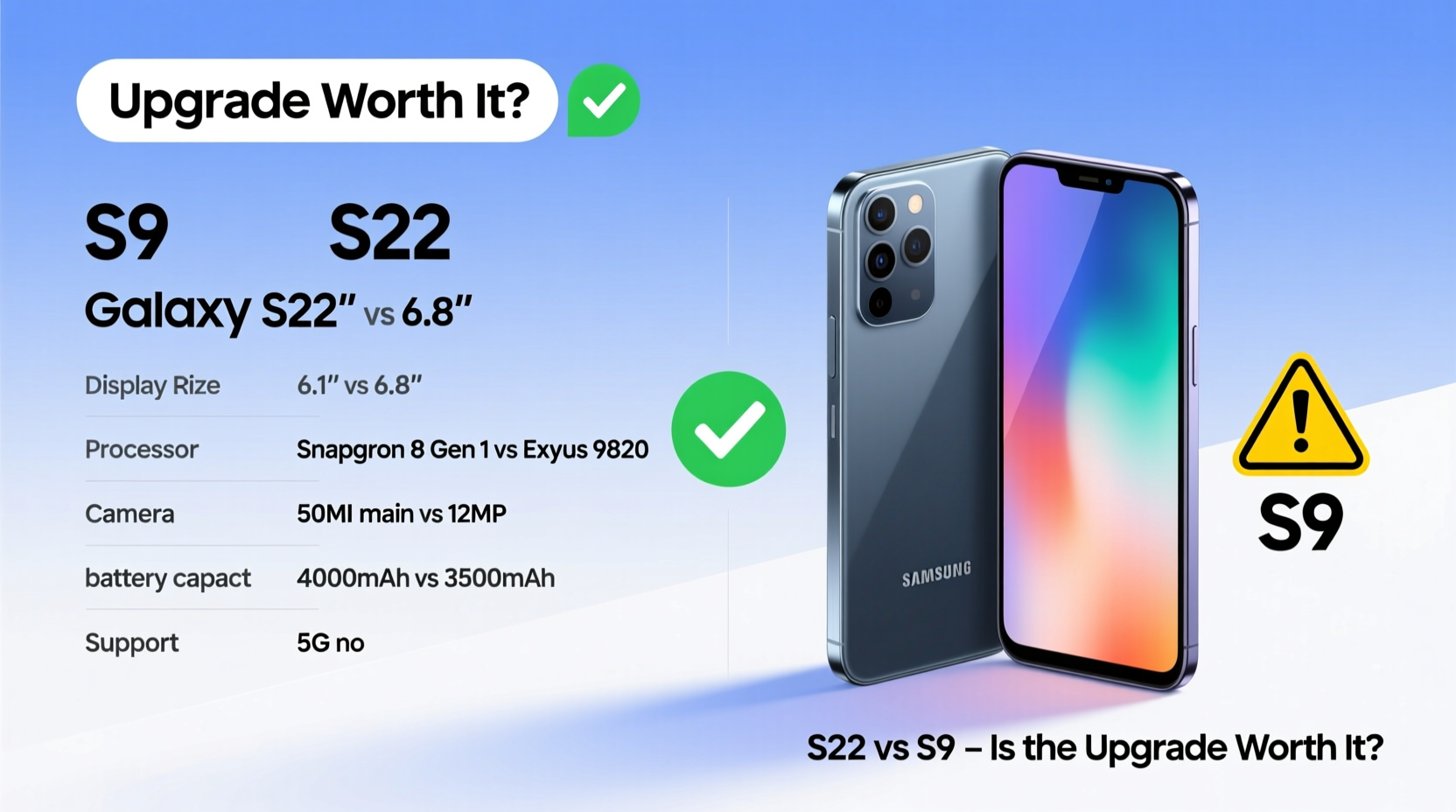
The most significant difference between the S9 and S22 lies under the hood. The S9 launched with the Snapdragon 845 (or Exynos 9810 in some regions), which was top-tier in 2018. By today’s standards, it struggles with multitasking, modern app demands, and sustained performance under load. In contrast, the S22 runs on the Snapdragon 8 Gen 1 (or Exynos 2200 depending on region), offering nearly double the CPU and GPU performance.
This leap means apps open faster, games run smoothly at high settings, and background processes don’t slow down the system. Android updates have also become more demanding—especially One UI 6 on the S22—which the S9 simply wasn't built to handle efficiently.
Camera Comparison: Night Photography and AI Smarts
The S9 had a solid 12MP rear camera with dual-pixel autofocus and optical image stabilization. It took excellent photos in daylight and introduced a \"Super Slow-mo\" video mode that was ahead of its time. However, low-light performance was average, and zoom capabilities were limited.
The S22 improves dramatically in every category. Its 50MP main sensor captures significantly more detail, especially in mixed lighting. With advanced AI processing, multi-frame exposure, and improved night mode, the S22 produces brighter, clearer, and more balanced photos—even in near-dark conditions.
The ultrawide and telephoto lenses also outperform the S9's single rear setup, giving you greater creative flexibility. Video recording jumps from 4K at 30fps on the S9 to 8K at 24fps on the S22, though most users will appreciate the improved stabilization and HDR10+ support more than the resolution bump.
“Modern smartphone photography isn’t just about megapixels—it’s about computational imaging. The S22 leverages AI to correct exposure, enhance textures, and reduce noise in ways the S9 could never achieve.” — David Lin, Mobile Imaging Analyst at TechPulse Weekly
Battery Life and Charging: Efficiency Over Capacity
The S9 came with a 3,000mAh battery, while the S22 packs a slightly larger 3,700mAh unit. But capacity alone doesn’t tell the full story. The S22 benefits from a more power-efficient processor, adaptive 120Hz display, and optimized software that extends usable life despite higher performance.
In real-world use, the S22 lasts a full day for most users, even with heavy usage. The S9, after years of charging cycles, likely holds less than 80% of its original capacity—meaning shorter battery life and more frequent charging. Additionally, the S22 supports faster wired and wireless charging, cutting downtime significantly.
Charging & Battery Comparison
| Feature | Samsung S9 | Samsung S22 |
|---|---|---|
| Battery Capacity | 3,000 mAh | 3,700 mAh |
| Wired Charging | Fast Charging (15W) | Super Fast Charging 2.0 (25W) |
| Wireless Charging | Qi/PMA (10W max) | Qi (15W max) |
| Reverse Wireless Charging | No | Yes (for earbuds, smartwatches) |
| Expected Daily Use | 12–14 hours (with aging battery) | 16–18 hours |
Software Support and Security
This is where the S9 falls definitively behind. Samsung ended major OS updates for the S9 in 2021, capping it at Android 10 with One UI 2.5. While it still receives occasional security patches in some regions, these are infrequent and not guaranteed.
The S22, on the other hand, launched with Android 12 and is eligible for four generations of OS upgrades—up to Android 16—and five years of security patches. This means better app compatibility, enhanced privacy controls, and access to new features like improved face recognition, smarter Bixby routines, and advanced Knox security layers.
If you rely on banking apps, messaging platforms, or productivity tools, outdated software can lead to compatibility issues or even security vulnerabilities. Google and developers increasingly optimize apps for newer Android versions, leaving older devices behind.
Real-World Example: Sarah’s Upgrade Dilemma
Sarah has used her Galaxy S9 since 2018. She replaced the battery two years ago and uses a rugged case to protect the glass back. For daily tasks—calls, texts, social media, and light browsing—it still works. But recently, she noticed Instagram crashes often, WhatsApp takes 10 seconds to open, and her phone heats up during video calls.
She considered the S22 after seeing a friend’s photos. When she tried it, the difference was immediate: apps loaded instantly, videos played without stutter, and taking pictures in dim lighting didn’t require a tripod anymore. After weighing the $600 price tag against the frustration of slowdowns, she upgraded. Six months later, she says it was “the best tech decision I’ve made in years.”
Sarah’s story reflects a growing trend: even well-maintained older phones hit a usability wall when software demands evolve beyond their hardware limits.
Upgrade Checklist: Are You Ready for the S22?
Before making the jump, ask yourself the following:
- Does your S9 struggle to run basic apps like Gmail, Chrome, or Maps?
- Have you noticed longer app loading times or frequent crashes?
- Is your battery life below 12 hours with moderate use?
- Are you unable to update to the latest Android version?
- Do you want better photo quality, especially at night?
- Do you use services that require modern security features?
If three or more apply, upgrading is likely worthwhile.
Frequently Asked Questions
Can the Galaxy S9 still be used in 2024?
Yes, but with limitations. It can handle calls, messaging, music streaming, and light web browsing. However, app performance degrades over time, and lack of updates poses security risks. It’s best suited as a backup or secondary device now.
How much faster is the S22 than the S9?
Benchmarks show the S22 is roughly 2.5x faster in CPU tasks and up to 3x faster in graphics performance. Real-world use reflects this in smoother navigation, quicker app launches, and better gaming.
Is the S22 worth $600 if I still love my S9?
If your S9 meets your needs and doesn’t frustrate you daily, it may not be worth the cost. But if you value reliability, camera quality, battery life, and future-proofing, the investment pays off in long-term satisfaction.
Final Verdict: To Upgrade or Not?
The Galaxy S9 was an excellent phone in its era, and credit to Samsung for building a durable, long-lasting device. But technology moves fast. What felt blazing-fast in 2018 now feels constrained by modern standards.
The S22 offers tangible improvements: a sharper display, vastly superior camera system, longer software support, and noticeably better performance. These aren’t incremental upgrades—they represent a shift in user experience. Tasks that once required patience on the S9 happen instantly on the S22.
That said, if your S9 still handles your routine without issue, and you’re not chasing photo quality or app responsiveness, there’s no urgent need to upgrade. But if you find yourself waiting for apps, worrying about battery, or missing out on new features, the S22 delivers a refreshingly modern smartphone experience.




 浙公网安备
33010002000092号
浙公网安备
33010002000092号 浙B2-20120091-4
Comments
No comments yet. Why don't you start the discussion?