
Front door security has evolved dramatically in recent years. What was once limited to a simple lock and a metal peephole now includes advanced digital surveillance tools. Two of the most common upgrades homeowners consider are smart doorbells and peephole cameras. Both promise enhanced visibility and peace of mind, but they differ significantly in functionality, installation, cost, and overall impact on home safety. Choosing between them isn’t just about preference—it’s about understanding how each device contributes to a layered security strategy.
While both systems allow you to see who is at your door without opening it, their capabilities diverge in ways that can influence everything from deterrence to evidence collection after an incident. To determine which option provides greater security benefits, it's essential to examine their features, limitations, and real-world applications in depth.
Understanding the Basics: How Each System Works
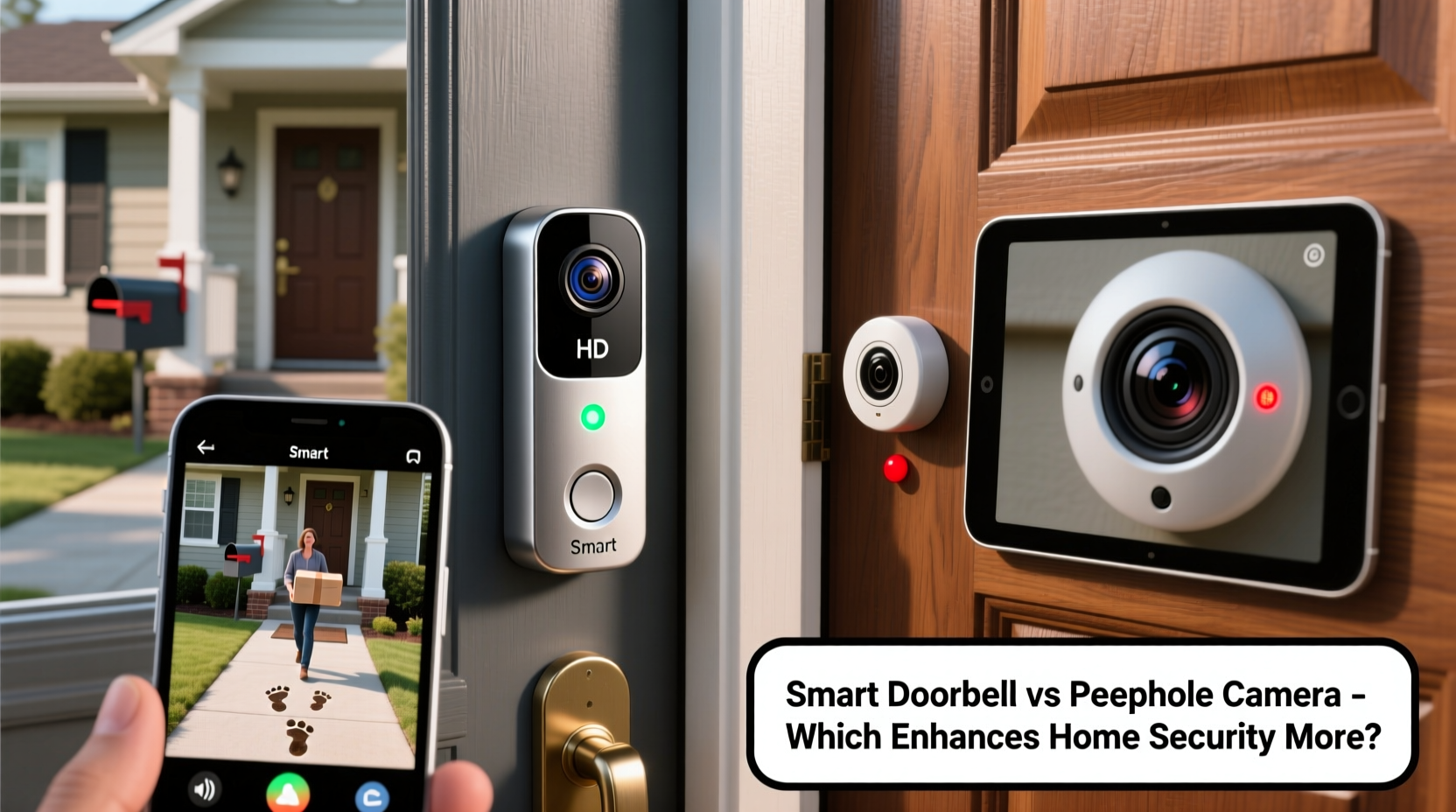
A **peephole camera** replaces or fits into the existing peephole on your front door. It captures video footage from the same vantage point as a traditional fisheye lens but transmits the image wirelessly to a smartphone app or a small indoor monitor. These devices are typically battery-powered or use low-voltage wiring and are designed for discreet monitoring with minimal setup.
In contrast, a **smart doorbell** integrates a doorbell button, motion sensors, HD camera, microphone, and speaker into a single unit mounted outside your door. When someone rings the bell or triggers motion detection, you receive a notification on your phone and can view live video, speak to visitors remotely, and record events to cloud storage. Most models support two-way audio, night vision, and integration with smart home ecosystems like Alexa or Google Home.
The core difference lies in scope: peephole cameras are primarily visual aids focused on identification, while smart doorbells function as interactive security hubs that combine surveillance, communication, and automation.
Feature Comparison: Capabilities That Matter for Security
| Feature | Smart Doorbell | Peephole Camera |
|---|---|---|
| Installation | Requires power (wired or rechargeable battery), mounting on exterior wall | Minimal; replaces existing peephole, often no wiring needed |
| Motion Detection | Advanced PIR sensors with customizable zones and alerts | Limited or none; some models offer basic motion triggers |
| Video Quality | 1080p–2K resolution, wide-angle lens, HDR, color night vision | 720p–1080p, narrow field of view due to door thickness constraints |
| Two-Way Audio | Standard feature with noise cancellation | Rare; only available in select high-end models |
| Remote Access | Full mobile app access from anywhere with internet | App-based viewing, but connectivity may be less reliable |
| Cloud Storage | Subscription plans for event recording and history | Often local-only storage (microSD); limited cloud options |
| Deterrence Value | Visible design with warning labels deters intruders | Covert—offers little psychological deterrent |
| Integration | Works with alarms, lights, locks, voice assistants | Standalone; rarely integrates with other systems |
This comparison reveals that smart doorbells offer broader functionality and deeper integration potential. Their presence alone can discourage suspicious behavior, thanks to visible branding and status lights indicating recording. Peephole cameras, while less obtrusive, lack many proactive security features and are better suited for passive observation.
Real-World Effectiveness: Which One Actually Prevents Crime?
Security isn't just about seeing who’s at the door—it’s about preventing break-ins, verifying identities, responding in real time, and gathering usable evidence if something goes wrong. In this context, smart doorbells have a measurable edge.
A 2022 study by the University of North Carolina’s Department of Criminology found that homes with visible outdoor security devices, including smart doorbells, were up to 60% less likely to be targeted by burglars. The reasoning? Intruders prefer unmonitored entries, and a blinking camera light signals risk.
Peephole cameras, being hidden inside the door, provide zero visual deterrence. A would-be thief won’t know they’re being watched until it’s too late—and even then, there’s no way to interact or warn them off. This makes peephole cameras reactive rather than preventive.
“Deterrence is half the battle in home security. Devices that announce their presence reduce opportunity and increase perceived risk for criminals.” — Dr. Lena Patel, Urban Security Researcher, Johns Hopkins University
Moreover, smart doorbells enable immediate interaction. You can challenge someone loitering near your porch, ask delivery personnel to leave packages in a safe spot, or alert authorities during suspicious activity—all remotely. Some models even support automated responses, such as playing a recorded message when motion is detected after dark.
Consider this scenario: A package is delivered during work hours. With a smart doorbell, you get a push notification, watch the drop-off live, and store the footage. Later, if the package disappears, you have timestamped video showing theft in action—potentially enough for police to identify the suspect. With a peephole camera, unless you happened to check the feed at that exact moment, the event likely goes unrecorded or unnoticed.
Mini Case Study: The Front Porch Theft That Changed a Neighborhood
In suburban Denver, a string of porch thefts plagued a quiet cul-de-sac. Residents installed various solutions—some opted for peephole cameras, others chose Ring or Nest doorbells. After three weeks, only one household captured clear, actionable footage: a homeowner with a smart doorbell who received a motion alert at 2:17 a.m. He watched live as a man grabbed a package and fled. The video, complete with facial detail and direction of escape, was shared with local law enforcement and posted in a neighborhood group. Within 48 hours, the suspect was identified and apprehended.
Meanwhile, several neighbors with peephole cameras reviewed their recordings after the fact but found nothing useful—either because the device didn’t trigger, the angle was too narrow, or the file had overwritten itself due to limited storage.
This case illustrates a critical point: real-time engagement and reliable recording infrastructure matter far more than mere visibility.
When a Peephole Camera Might Be the Better Choice
Despite the advantages of smart doorbells, peephole cameras still serve a niche purpose. They are best suited for specific situations:
- Rental properties where tenants cannot modify exterior walls or install wired devices.
- Doors with structural limitations, such as steel doors or historical woodwork, where drilling for a doorbell could damage integrity.
- Privacy-focused users who want to observe without broadcasting their surveillance setup.
- Budget-conscious buyers seeking basic functionality under $50, compared to $100–$250 for quality smart doorbells.
Additionally, peephole cameras eliminate concerns about weather exposure since the main unit sits indoors. They also tend to raise fewer legal questions regarding audio recording laws, as many lack microphones entirely.
However, these benefits come at the cost of reduced situational awareness. Without motion alerts or remote notifications, you must manually open the app to check who’s there—meaning missed deliveries, ignored visitors, or delayed responses to emergencies.
Checklist: Choosing the Right Device for Your Needs
Use this checklist to evaluate which system aligns with your priorities:
- Can I drill into my doorframe or run wiring? → Yes: Smart doorbell | No: Peephole camera
- Is deterring crime important? → Yes: Smart doorbell | No preference: Either
- Do I want to talk to visitors remotely? → Yes: Smart doorbell | No: Peephole camera possible
- Am I renting or restricted by HOA rules? → Yes: Peephole camera may be safer
- Do I need long-term video storage? → Yes: Smart doorbell with subscription
- Is budget under $60? → Yes: Peephole camera
- Do I already have smart home devices? → Yes: Smart doorbell integrates better
Step-by-Step Guide to Maximizing Security Benefits
Whichever device you choose, its effectiveness depends on proper setup and usage. Follow this timeline to ensure optimal performance:
- Week 1: Installation & Testing
Install the device according to manufacturer instructions. Test all functions—motion detection, audio, night vision, and app connectivity. Adjust angles to cover entry points fully. - Day 8: Configure Alerts
Customize motion sensitivity and alert schedules. Disable notifications during daytime if unnecessary, but keep them active overnight. - Day 14: Enable Cloud Backup (if applicable)
Subscribe to a plan that retains footage for at least 30 days. Verify automatic uploads work after events. - Day 21: Integrate with Other Systems
Connect your smart doorbell to voice assistants or smart lights. Set routines like “When motion detected at night, turn on porch light.” - Ongoing: Review Footage Weekly
Scan recordings weekly to catch anomalies early. Delete irrelevant clips to manage storage.
Frequently Asked Questions
Can a peephole camera be hacked?
Yes, any internet-connected camera carries some risk. However, peephole cameras generally use simpler protocols and smaller networks, making them less attractive targets than widely used smart doorbells. Always change default passwords, enable encryption, and update firmware regularly regardless of device type.
Do smart doorbells work in extreme weather?
Most reputable brands (e.g., Ring, Arlo, Google Nest) are rated for temperatures between -20°C to 50°C (-4°F to 120°F) and are water-resistant. Avoid direct downpour exposure and ensure the mounting area is shielded if possible.
Are there legal issues with recording audio?
In the U.S., federal law permits audio recording with one-party consent (you being the party). However, 12 states—including California and Massachusetts—require all parties to consent. Check your local laws before enabling two-way talk features.
Final Verdict: Which Improves Home Security More?
The evidence clearly favors smart doorbells as the superior option for improving overall home security. Their combination of deterrence, interactivity, intelligent alerts, and integration creates a dynamic defense layer that peephole cameras simply cannot match. While peephole cameras offer a low-cost, minimally invasive alternative, they function more like observational tools than true security systems.
Home security today isn’t just about watching—it’s about responding, documenting, and discouraging threats before they escalate. A smart doorbell transforms your front door into an active checkpoint, giving you control even when you’re miles away. For most homeowners, especially those with families, pets, or frequent deliveries, the investment pays off in peace of mind and tangible protection.
That said, technology should fit your lifestyle, not complicate it. If your living situation restricts modifications or you value discretion over functionality, a peephole camera remains a viable stopgap. But if you're serious about strengthening your home’s defenses, a smart doorbell delivers measurable, real-world advantages.




 浙公网安备
33010002000092号
浙公网安备
33010002000092号 浙B2-20120091-4
Comments
No comments yet. Why don't you start the discussion?