
When Apple launched the AirTag in 2021, it redefined how consumers track everyday items with precision, simplicity, and seamless integration. Samsung responded with its SmartTag 2 in 2023, aiming to close the gap for Galaxy users. But nearly three years after AirTag’s debut, a pressing question remains: Are Samsung users missing out?
This isn’t just about battery life or price—it’s about ecosystem strength, tracking accuracy, global availability, and long-term usability. For Android and Galaxy loyalists, choosing between staying within Samsung’s ecosystem or adopting an Apple product raises deeper concerns about compatibility, privacy, and convenience.
Tracking Technology: U1 Chip vs Bluetooth LE
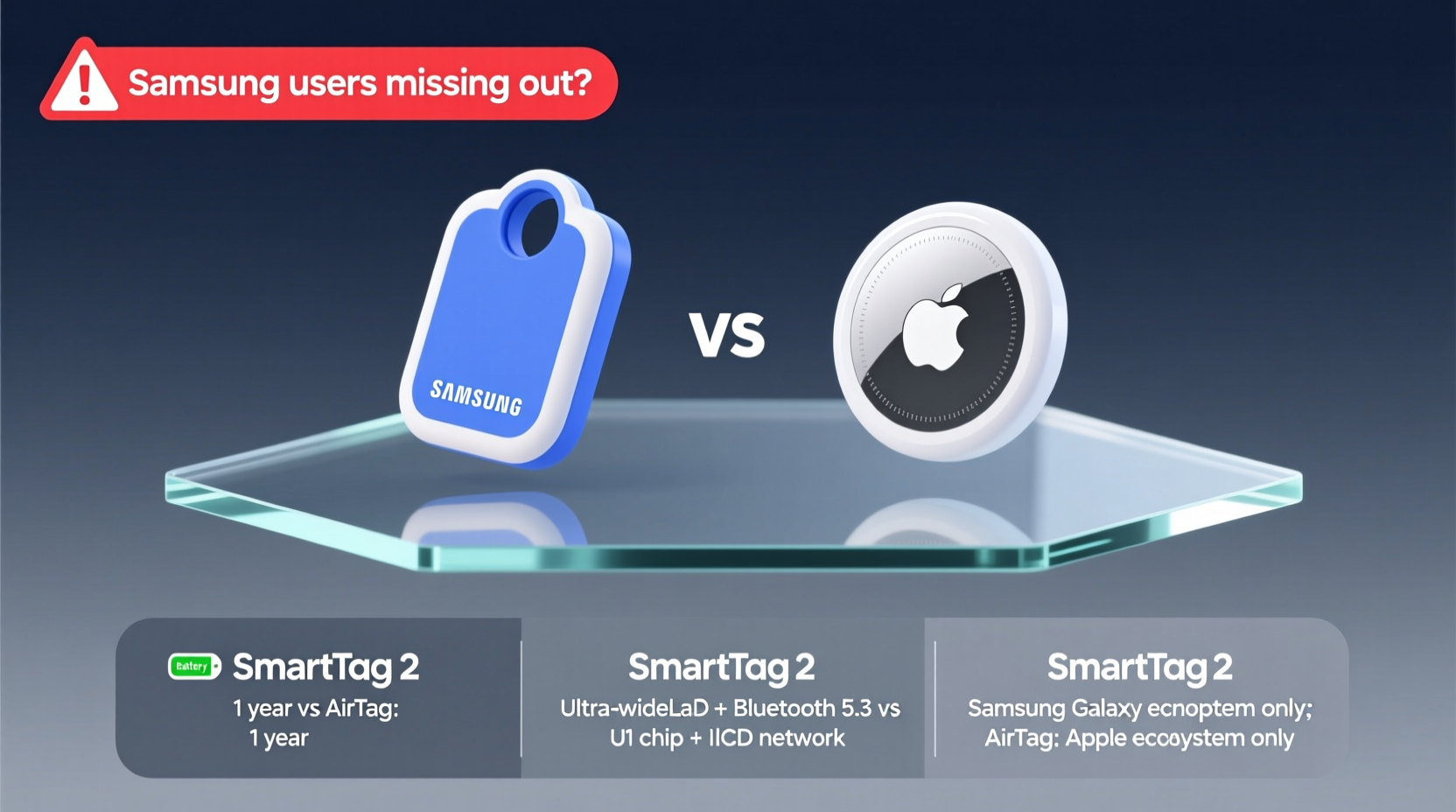
The most significant technical difference between AirTag and SmartTag 2 lies in their core locating technology. Apple’s AirTag uses Ultra-Wideband (UWB) via the proprietary U1 chip, which enables spatial awareness—meaning your iPhone can guide you to an AirTag with directional arrows and distance estimates using augmented reality.
Samsung’s SmartTag 2, while improved over the original, still relies on Bluetooth Low Energy (BLE) and lacks built-in UWB. This means it cannot offer precision finding on par with AirTag unless paired with a UWB-enabled Galaxy device like the S21 Ultra or later models. Even then, Samsung’s implementation is less refined than Apple’s seamless AR interface.
Bluetooth alone works well for general tracking—“ringing” the tag or seeing its last known location—but falls short when searching under couch cushions or in dense environments where signal triangulation matters.
Ecosystem Integration: Apple’s Advantage
Apple’s Find My network is one of the most powerful passive tracking infrastructures ever built. With over 2 billion active Apple devices worldwide, every iPhone, iPad, and Mac acts as a potential relay to anonymously detect lost AirTags—even if they’re out of Bluetooth range.
Samsung’s SmartThings Find network is growing but operates on a much smaller scale. While it leverages millions of Galaxy devices, it doesn’t match Apple’s density, especially outside North America and parts of Europe. This affects recovery rates significantly.
“Ecosystem scale directly impacts findability. In urban areas, AirTag has a clear edge due to sheer device volume.” — David Lin, IoT Analyst at TechSignal Research
Moreover, AirTags benefit from automatic alerts when detected moving with someone who isn’t their owner—a privacy feature that also helps locate stolen items. Samsung offers similar anti-theft alerts, but rollout has been slower and less consistent across regions.
Feature Comparison: SmartTag 2 vs AirTag
| Feature | AirTag | SmartTag 2 |
|---|---|---|
| Connectivity | Ultra-Wideband + Bluetooth LE | Bluetooth LE (UWB optional via phone) |
| Battery Type | Replaceable CR2032 | Replaceable CR2032 |
| Battery Life | ~1 year | ~1 year |
| Precision Finding | Yes (with U1 chip) | Limited (requires compatible Galaxy phone) |
| Find Network Size | Over 2 billion Apple devices | Tens of millions of Galaxy devices |
| Water Resistance | IP67 | IP57 |
| Custom Engraving | Free at purchase | Not available |
| Price (MSRP) | $29 (single), $99 (4-pack) | $30 (single), $70 (4-pack) |
The table reveals that while both devices share similarities in design and battery, AirTag pulls ahead in precision, network reach, and user experience polish. SmartTag 2 counters with slightly better value in multi-packs and deeper integration with Samsung’s SmartThings app for automation scenarios.
Real-World Use Case: Traveler’s Dilemma
Consider Maria, a frequent business traveler based in Chicago who uses a Galaxy S24 Ultra. She attaches a SmartTag 2 to her luggage before a trip to Tokyo. Upon arrival, she realizes her suitcase didn’t make it off the carousel.
She opens SmartThings Find and sees her bag was last located near baggage claim. However, because Tokyo has lower Galaxy device density compared to iPhones, updates are sparse. It takes six hours before another Galaxy user passes nearby and relays a new location.
In contrast, had she used an AirTag, multiple iPhones passing through Narita Airport would have anonymously pinged its location within minutes, increasing the chances of rapid recovery.
This scenario illustrates how network effects can outweigh hardware parity. Even with a high-end Galaxy phone, ecosystem limitations hinder performance in critical moments.
Are Samsung Users Missing Out?
The answer depends on priorities.
If you value tight integration with Galaxy devices, enjoy SmartThings automations (like triggering routines when tags enter/exit range), and rarely travel outside major cities, SmartTag 2 may be sufficient—and even preferable.
But if you frequently misplace keys, travel internationally, or want the highest likelihood of recovering lost items, AirTag currently offers superior reliability. Its precision finding, vast anonymous network, and consistent software updates give it a measurable edge.
Samsung users aren’t “missing out” entirely, but they are accepting trade-offs: reduced global coverage, less accurate finding, and slower innovation cycles. Apple continues to refine Find My with firmware updates and tighter iOS integration, while Samsung’s roadmap for SmartTag remains opaque.
- ✅ Do you own an iPhone or plan to join the Apple ecosystem soon? → Choose AirTag
- ✅ Is your primary phone a Galaxy model with UWB (S21 Ultra or newer)? → SmartTag 2 viable
- ✅ Do you travel often or lose items in public spaces? → AirTag recommended
- ✅ Want to automate home actions (e.g., lights turn on when you arrive)? → SmartTag 2 excels here
- ✅ Prioritize lowest cost per tag? → Buy SmartTag 2 in bulk
- ✅ Concerned about cross-platform sharing? → AirTag supports limited Android access via NFC
What Samsung Could Do Better
To truly compete, Samsung needs more than incremental hardware updates. It must invest in expanding the SmartThings Find network, standardize UWB across mid-tier devices, and improve the precision finding UI to match Apple’s intuitive arrow guidance.
Additionally, opening limited cross-compatibility—such as allowing Galaxy users to detect lost AirTags or enabling partial Find My access—could bridge gaps. Right now, interoperability is minimal, locking users into siloed experiences.
One promising development is Samsung’s participation in the Connected Standards Alliance, which aims to unify item trackers under a common protocol. Future tags may support cross-brand detection, leveling the playing field.
Frequently Asked Questions
Can I use an AirTag with a Samsung phone?
Yes, but with limitations. You can set up an AirTag via NFC by tapping it to your Android phone, and view its last known location through the “Find Items” website. However, you won’t get real-time tracking, precision finding, or seamless app integration.
Does SmartTag 2 work with iPhones?
No. SmartTag 2 requires the SmartThings app, which is only available on Android and select Samsung smartwatches. iPhone users cannot pair or manage SmartTags.
Which lasts longer: AirTag or SmartTag 2?
Both use the same CR2032 battery and last approximately one year under normal usage. Neither is rechargeable, which simplifies design but adds ongoing maintenance.
Conclusion: Make the Choice That Fits Your Life
Samsung’s SmartTag 2 is a capable tracker that serves Galaxy users well within its ecosystem. But when measured against AirTag’s precision, network scale, and polished user experience, it’s hard to ignore the advantages Apple offers.
For Samsung loyalists, this doesn’t mean defecting to Apple—it means recognizing where compromises exist and deciding whether they matter for your lifestyle. If you're deeply embedded in the Galaxy universe and value smart home integrations, stick with SmartTag 2. But if peace of mind, global reliability, and cutting-edge location tech are non-negotiable, many Samsung users might indeed be missing out.




 浙公网安备
33010002000092号
浙公网安备
33010002000092号 浙B2-20120091-4
Comments
No comments yet. Why don't you start the discussion?