
For years, Gmail has dominated personal email with its intuitive interface, smart filtering, and seamless integration with Google’s ecosystem. But as awareness of digital surveillance and data monetization grows, many users are reevaluating their reliance on free services that trade privacy for convenience. One of the most popular alternatives is ProtonMail, a Switzerland-based encrypted email service built around end-to-end encryption and a strict no-logs policy. But when you make the switch, what actual privacy benefits do you gain—and which promises are more marketing than measurable?
The answer isn't binary. Moving from Gmail to ProtonMail brings meaningful improvements in certain areas, while leaving others unchanged or only marginally better. Understanding the real differences requires looking beyond slogans like “encrypted” and “private” and examining how each platform handles your data at every stage—from storage and access to metadata collection and legal jurisdiction.
How Gmail Handles Your Data (and Why It Matters)
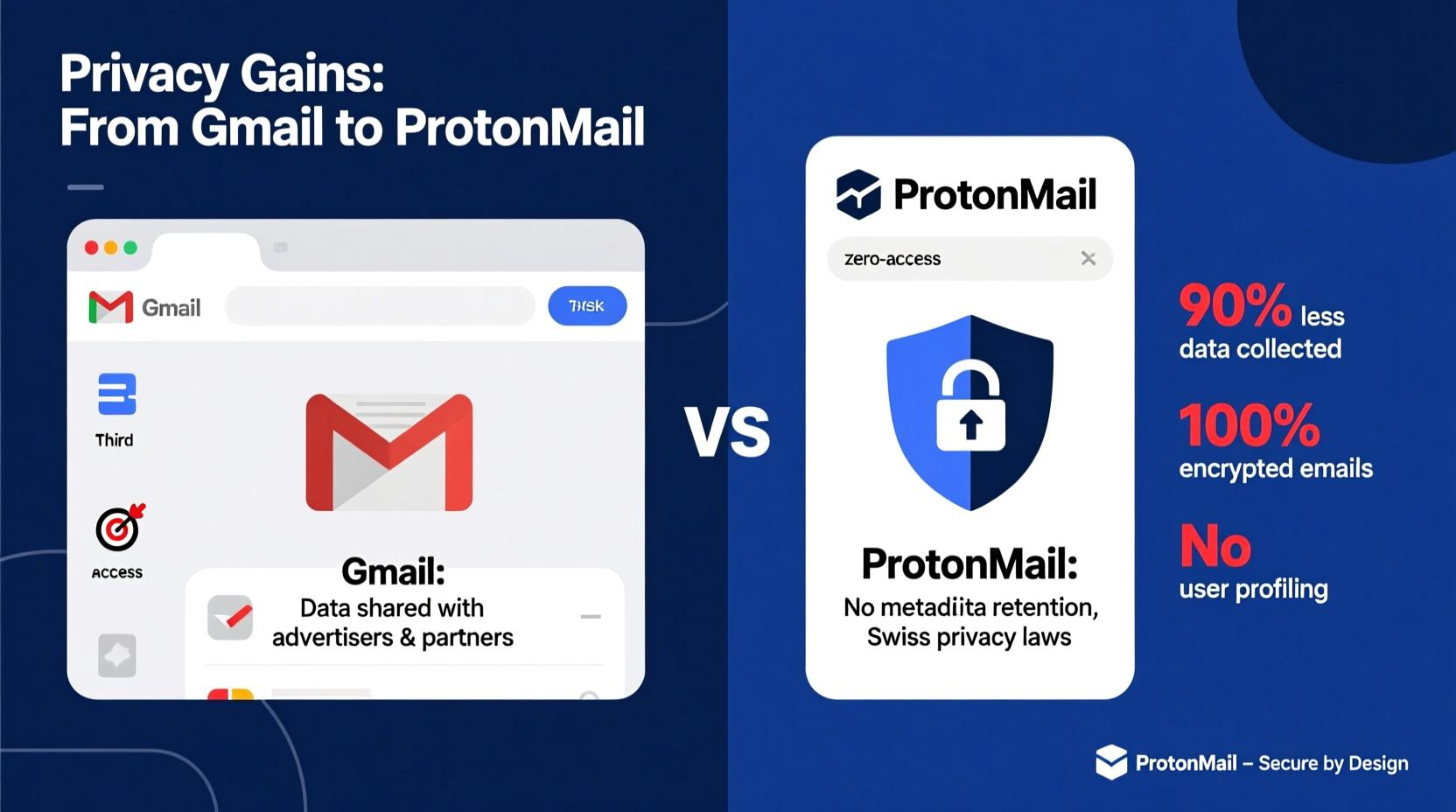
Google’s business model revolves around advertising. Even if you don’t see ads in your inbox, Gmail scans the content of your emails—unless they’re encrypted via third-party tools—to build user profiles used across its ad network. This scanning happens automatically through machine learning systems that analyze subject lines, body text, attachments, and even links clicked within messages.
This deep analysis enables features like Smart Reply, travel itinerary detection, and spam filtering. But it also means your communications are processed by algorithms designed to extract value. While Google claims this scanning is automated and not reviewed by humans, the fact remains: your email content is accessible to Google’s systems in readable form.
Additionally, Gmail collects extensive metadata: who you email, when, how often, device types, IP addresses, and location patterns. This data contributes to behavioral profiling and can be shared with law enforcement under valid legal requests. Google publishes a Transparency Report detailing government data demands, showing thousands of user data disclosures annually.
ProtonMail’s Core Privacy Architecture
ProtonMail was founded in 2014 by scientists who met at CERN, with a mission to provide secure communication tools grounded in cryptography. Unlike Gmail, ProtonMail uses end-to-end encryption (E2EE) by default for all messages sent between ProtonMail users. This means the body of your email, subject line, and attachments are encrypted on your device before being uploaded to their servers.
The encryption keys are derived from your password and never leave your device. As a result, ProtonMail cannot decrypt your emails—even if compelled by a court order. This is a fundamental architectural difference: where Gmail holds the key to your data, ProtonMail does not.
Messages sent to non-ProtonMail recipients can still be protected using password-protected encrypted emails. The recipient receives a link and must enter a password (shared out-of-band) to view the message. While less seamless, this preserves confidentiality against third-party interception.
ProtonMail also operates under Swiss privacy laws, which are among the strongest in the world. Switzerland is not part of the EU or the Five Eyes intelligence alliance, and its legal framework requires high thresholds for data disclosure. Combined with ProtonMail’s warrant canary and public resistance to government overreach, this adds an additional layer of institutional protection.
“Privacy isn’t just a feature—it’s a human right.” — Andy Yen, CEO and Co-Founder of Proton
Real Privacy Gains: What Actually Changes After Switching
Moving from Gmail to ProtonMail doesn’t eliminate all risks, but it shifts control over your data in significant ways. Below are the tangible privacy advantages you gain:
- Email Content Protection: Your message bodies and subject lines are encrypted and inaccessible to ProtonMail or any third party without your decryption key.
- No Behavioral Profiling: ProtonMail does not scan your emails for advertising or analytics purposes. There is no ad targeting based on your correspondence.
- Reduced Metadata Exposure: While some metadata is still collected (e.g., IP address during login), ProtonMail minimizes retention and allows anonymous sign-up without phone verification on paid plans.
- Stronger Legal Jurisdiction: Based in Switzerland, ProtonMail resists broad data requests and publishes transparency reports showing minimal compliance with government demands.
- Open-Source Clients: ProtonMail’s apps and web clients are open-source, allowing independent audits of their security claims.
However, important limitations remain. End-to-end encryption only applies to emails between ProtonMail users. Messages to Gmail or Outlook users are encrypted in transit (via TLS) but stored in plaintext on the recipient’s server—meaning Google can still scan them.
Additionally, while ProtonMail encrypts message content, it cannot hide metadata entirely. They log IP addresses temporarily for abuse prevention, though these logs are deleted after seven days. For maximum anonymity, users are encouraged to connect via Tor or a trusted VPN.
Comparison: Gmail vs. ProtonMail Privacy Features
| Feature | Gmail | ProtonMail |
|---|---|---|
| Email Content Scanning | Yes – for ads, spam, and AI features | No – end-to-end encrypted |
| End-to-End Encryption | No (requires external tools like PGP) | Yes – by default for Proton-to-Proton emails |
| Data Monetization | Yes – via ad targeting | No – subscription-funded model |
| Jurisdiction | United States | Switzerland |
| Metadata Retention | Extensive, long-term | Limited; IP logs deleted after 7 days |
| Anonymous Sign-Up | No – requires phone number | Yes – on paid plans |
| Open Source Clients | No | Yes – auditable codebase |
A Real-World Example: Journalist Switches to ProtonMail
Sarah Kim, an investigative reporter covering corporate misconduct, used Gmail for years. After a source expressed concern about surveillance, she migrated to ProtonMail. Within weeks, she noticed immediate differences. Her new account required no phone number, and she could send encrypted emails to colleagues simply by using her ProtonMail address.
When communicating with confidential sources, she used ProtonMail’s password-protected emails, sharing passphrases via Signal. She also connected through Tor Browser to mask her IP address during sensitive logins. During a subsequent subpoena from a regulatory agency, her email provider confirmed they had no access to her message content.
“It’s not just about encryption,” Sarah said. “It’s about trust. Knowing that even under pressure, ProtonMail can’t hand over my emails changes the game.”
While Gmail might have complied with a similar request—providing full access to archived messages—ProtonMail’s architecture rendered such a demand technically unfulfillable.
What Doesn’t Change: Limitations of the Switch
Despite its strengths, ProtonMail isn’t a panacea for all privacy concerns. Users should understand the boundaries of what it can protect:
- Recipient Security: If you email someone using Gmail, Yahoo, or another non-E2EE service, your message is decrypted upon arrival. That provider can scan, store, and share it.
- Device Vulnerabilities: Encryption only protects data in transit and at rest. Malware, keyloggers, or unauthorized physical access to your device can compromise your account regardless of email provider.
- Phishing & Social Engineering: ProtonMail doesn’t offer superior protection against scams. You’re still responsible for recognizing suspicious links and attachments.
- Contact Discovery: ProtonMail does not integrate with Google Contacts or other social graphs, which limits cross-platform syncing but also reduces tracking surface.
Moreover, switching email providers introduces friction. Migrating years of correspondence, updating accounts, and informing contacts takes time. Some services may block ProtonMail domains due to spam filtering policies, requiring workarounds.
Step-by-Step Guide to Transitioning Securely
Making the switch effectively involves more than signing up. Follow these steps to maximize privacy and minimize disruption:
- Choose a Strong Password: Use a unique, high-entropy passphrase. Consider a password manager to generate and store it securely.
- Enable Two-Factor Authentication (2FA): Use an authenticator app or hardware key (U2F). Avoid SMS-based 2FA due to SIM-swapping risks.
- Migrate Contacts: Export your Gmail contacts and import them into ProtonMail. Be cautious about storing contact details in plaintext.
- Set Up Email Forwarding (Optional): Use ProtonMail’s bridge feature (available on paid plans) to sync with existing Gmail via IMAP, allowing gradual transition.
- Notify Key Contacts: Send a secure message to family, colleagues, and financial institutions with your new address.
- Update Account Recovery Options: Replace old email recovery fields on banking, social media, and cloud services.
- Delete Old Gmail Data: Once transitioned, consider deleting or disabling your Gmail account to prevent future exposure.
Frequently Asked Questions
Can governments force ProtonMail to hand over my emails?
No. Due to end-to-end encryption, ProtonMail does not possess the decryption keys needed to access your message content. Even with a court order, they cannot comply with requests for readable emails. They may disclose limited metadata under Swiss law, but only after rigorous legal scrutiny.
Is ProtonMail completely anonymous?
Not entirely. Free accounts require an email for recovery, though paid plans allow fully anonymous registration. To enhance anonymity, use a VPN or Tor when accessing your account, and avoid linking ProtonMail to other identifiable online profiles.
Do I lose functionality by switching?
You may experience reduced integration with productivity tools like Google Calendar or Docs. Search functionality within encrypted emails is slower due to client-side decryption. However, core email functions—sending, receiving, organizing—are fully supported, and the trade-off in privacy is substantial.
Checklist: Before You Make the Switch
- ✅ Assess your need for true email privacy (journalism, activism, sensitive communications)
- ✅ Choose a ProtonMail plan (Free, Plus, or Unlimited based on storage and features)
- ✅ Create a strong, unique password and back it up securely
- ✅ Enable 2FA using an authenticator app
- ✅ Export and transfer essential contacts and calendar events
- ✅ Test sending encrypted emails to another Proton user
- ✅ Update recovery emails and two-factor methods on critical accounts
- ✅ Inform frequent correspondents of your new address
- ✅ Consider using the Proton Mail Bridge for desktop client integration
- ✅ Plan to phase out or deactivate your old Gmail account
Conclusion: Is the Switch Worth It?
Switching from Gmail to ProtonMail delivers real, measurable privacy gains—especially in content protection, freedom from algorithmic surveillance, and resistance to mass data collection. While it won’t make you invisible online or protect against all threats, it fundamentally alters the power dynamic between you and your email provider.
If you value control over your digital life and want to minimize exposure to corporate data harvesting and state surveillance, ProtonMail offers a credible alternative. The transition requires effort and adjustment, but for many, the peace of mind is worth it.




 浙公网安备
33010002000092号
浙公网安备
33010002000092号 浙B2-20120091-4
Comments
No comments yet. Why don't you start the discussion?